
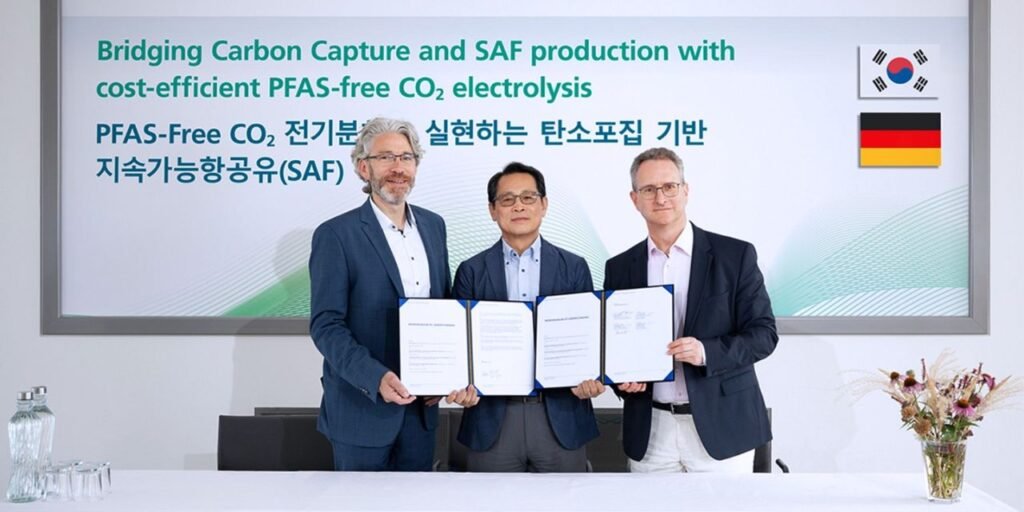
Fraunhofer Institute for Applied Polymer Research IAP, Fraunhofer Institute for Environmental, Safety and Energy Technology UMSICHT, and South Korean energy company SGC Energy have signed a Memorandum of Understanding (MoU) to jointly advance technologies for CO₂ utilisation, hydrogen production, fuel cells and energy storage.
The partnership aims to bring together advanced materials research, electrochemical systems expertise and industrial capabilities to support the development of technologies that can reduce fossil-fuel dependence and improve the efficiency of renewable energy conversion and storage.
Collaboration Focuses on Climate-Neutral Technologies
The partners will explore technologies that can use carbon dioxide as a feedstock while enabling renewable electricity to be converted into hydrogen, synthetic fuels and stored energy.
Fraunhofer IAP will contribute its expertise in innovative polymeric materials and membranes, while Fraunhofer UMSICHT will provide knowledge in electrochemistry, system development and plant engineering. SGC Energy will contribute industrial resources, including CO₂ and power infrastructure, along with engineering expertise required for commercial deployment.
Professor Alexander Böker, Director of Fraunhofer IAP, said the collaboration brings together material development, system integration and practical application from the beginning of the innovation process.
CO₂ Electrolysis for Sustainable Fuel Production
A major focus of the partnership will be CO₂ electrolysis, an electrochemical process that converts carbon dioxide into chemical feedstocks and synthetic fuels using electricity.
One potential application is the production of sustainable aviation fuel (SAF). The technology is considered particularly promising in South Korea, where CO₂ utilisation aligns with national decarbonisation objectives.
SGC Energy plans to explore the integration of its carbon-capture facilities with technologies developed by Fraunhofer IAP and Fraunhofer UMSICHT. The approach could enable captured CO₂ to be incorporated into industrial value chains while reducing dependence on fossil-based feedstocks.
Advanced Membranes for More Efficient Electrochemical Systems
Membrane technology will play an important role in the collaboration. Membranes enable selective separation and ion transport within electrochemical systems, directly influencing efficiency, selectivity and operational lifetime.
While established membrane technologies are widely used in hydrogen electrolysis, further development is required for CO₂ electrolysis to improve its commercial viability and long-term performance.
Fraunhofer IAP will contribute its expertise in developing polymer-based energy materials, including PFAS-free high-performance membranes for electrolyzers, polymer solid electrolytes and battery binders.
The development of PFAS-free materials could also help manufacturers respond to increasing regulatory attention surrounding per- and polyfluoroalkyl substances (PFAS).
Fraunhofer UMSICHT to Support System Development
Fraunhofer UMSICHT will contribute its experience in developing cost-competitive CO₂ electrolysis cells and stack concepts, as well as designing, scaling and testing electrochemical systems under industry-relevant conditions.
The institute will focus on integrating CO₂ electrolysis technologies into existing industrial infrastructure. This systems-level approach is intended to accelerate the transition of technologies from laboratory research to commercial applications.
Professor Christian Doetsch, Director of Fraunhofer UMSICHT, highlighted the importance of integrating new materials, electrochemical processes and scalable plant concepts to successfully transform industrial energy systems.
SGC Energy Brings Industrial and Commercial Expertise
As the industry partner, SGC Energy will provide practical market requirements and experience across industrial energy value chains.
The company’s involvement is expected to help ensure that the technologies developed through the partnership address real-world operational and economic requirements from an early stage.
Ken Yoon, Chief Strategy Officer of SGC Energy, said the collaboration represents a strategic step toward developing technologies required for a climate-neutral industrial sector.
Partnership to Drive Joint R&D Projects
The signing of the MoU establishes a framework for the three organisations to prepare and implement joint research and development projects.
Over the coming months, the partners plan to define specific initiatives covering:
- CO₂ utilisation and electrolysis
- Hydrogen technologies
- Fuel cell systems
- Battery technologies
- Advanced membranes and polymeric energy materials
- Industrial-scale electrochemical systems
By combining advanced materials, electrochemical engineering and industrial deployment capabilities, the partnership aims to accelerate the development and commercialisation of technologies supporting a more efficient and climate-neutral industrial energy system.