The global Active Cooling Textile market is experiencing rapid growth as demand for smart temperature-regulating fabrics expands across sportswear, healthcare, military, automotive, and industrial sectors. Rising adoption of wearable technologies, increasing global temperatures, and growing consumer preference for performance apparel are driving strong momentum in the industry.
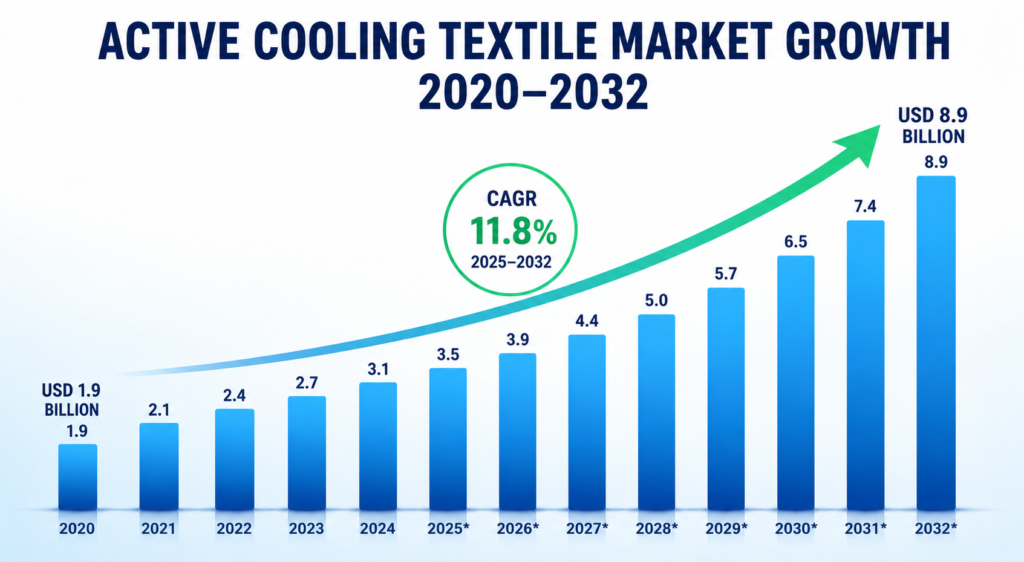
According to industry insights highlighted by Marketintelo, the global Active Cooling Textile market was valued at approximately USD 3.1 billion in 2024 and is projected to reach nearly USD 8.9 billion by 2032, registering a robust CAGR of 11.8% during the 2025–2032 forecast period.Active Cooling Textiles are advanced fabrics engineered to regulate body temperature through moisture management, phase-change materials, conductive fibers, and smart wearable technologies. These textiles are increasingly capable of reducing skin temperature by 2°C to 5°C, improving comfort and performance in extreme environmental conditions.
Industry estimates indicate that more than 620 million square meters of cooling fabrics are expected to be produced globally in 2025, representing a 14.6% year-over-year increase compared to 2024. Cooling yarn production alone rose by 18.2% in 2025 as manufacturers accelerated investments in high-performance textile technologies.The market has shown strong historical growth over the past decade. From approximately USD 1.1 billion in 2016, the market expanded to USD 1.9 billion by 2020 before crossing USD 3.1 billion in 2024. Between 2020 and 2022, the sector grew nearly 28.4% as consumers increasingly demanded breathable, moisture-wicking, and thermoregulating fabrics following the pandemic.
Sportswear remains the largest revenue-generating segment within the Active Cooling Textile industry. In 2024, sportswear cooling fabrics generated nearly USD 1.1 billion in revenue and accounted for approximately 36% of total market share. Global athletic apparel production exceeded 14.5 billion units in 2024, with nearly 22% incorporating advanced cooling technologies.Consumer demand for thermal-regulation apparel continues to rise sharply. Industry surveys show that approximately 61% of fitness apparel buyers now prefer garments featuring cooling and moisture-management functionality. As a result, leading apparel manufacturers increased research and development spending on cooling textile technologies by nearly 16% in 2024.
Advanced materials such as graphene-coated fabrics, cooling polymer fibers, and phase-change material (PCM) textiles are among the fastest-growing innovations in the market. Graphene-enhanced cooling fabrics demonstrated thermal conductivity improvements ranging between 30% and 45% compared to conventional polyester blends. Meanwhile, PCM-based textiles recorded a 22% increase in commercial adoption during 2024.Asia-Pacific continues to dominate the global Active Cooling Textile market due to its large-scale textile manufacturing capabilities and cost-efficient production ecosystem. The region accounted for approximately 41.3% of global market revenue in 2024, generating nearly USD 1.28 billion.
China remained the world’s largest exporter of cooling textiles, accounting for 31% of global exports, while India’s technical textile market surpassed USD 23 billion in 2025. Cooling fabrics are rapidly emerging as one of the country’s fastest-growing technical textile categories.North America generated more than USD 920 million in market revenue during 2024 and remains a major hub for smart textile innovation. The U.S. Department of Defense allocated more than USD 145 million toward smart wearable textile programs between 2022 and 2025, boosting military demand for cooling uniforms and wearable thermal-management systems.
Military procurement of cooling textiles increased by 21% between 2023 and 2025 as defense agencies prioritized soldier comfort and operational performance in extreme climates.Healthcare applications are also expanding rapidly. Cooling textiles are increasingly integrated into patient care garments, rehabilitation systems, and wearable medical devices designed to improve patient comfort and thermal regulation. The healthcare cooling textile segment is projected to grow at a CAGR of 13.6% through 2032.Hospitals adopting temperature-management wearable systems increased by approximately 19% globally between 2023 and 2025, reflecting rising demand for advanced medical textiles.
Industrial worker safety represents another major growth opportunity for the sector. Heat-related workplace injuries cost global industries nearly USD 48 billion annually, encouraging greater adoption of Active Cooling Textile uniforms in mining, oil & gas, manufacturing, and construction industries. Adoption of cooling workwear increased by nearly 24% in 2024 alone.The industry is also benefiting from rising investments in smart textile innovation. Global smart textile investments increased steadily from USD 1.3 billion in 2021 to more than USD 2.4 billion in 2024, with projections reaching USD 2.8 billion in 2025.
Sustainability trends are reshaping market dynamics as well. Recycled cooling fiber adoption increased significantly, with sustainable Active Cooling Textile products accounting for approximately 26% of global sales in 2025, compared to only 11% in 2020.Looking ahead, industry analysts expect annual global production volumes to exceed 1.4 billion square meters of cooling textiles by 2032. Smart wearable integration alone could generate more than USD 2.2 billion in additional market opportunities during the forecast period.
With rising investments, accelerating wearable technology adoption, and growing demand for climate-responsive apparel, the Active Cooling Textile market is expected to remain one of the fastest-growing segments within the global textile and smart fabric industry through 2032.
Read A Full Report: https://marketintelo.com/report/active-cooling-textile-
market