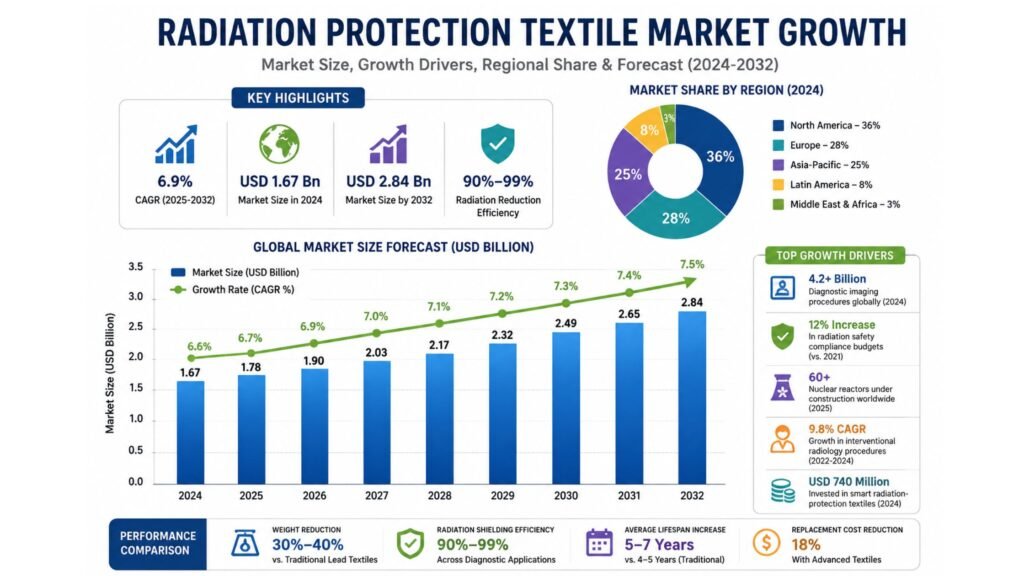
The global Radiation Protection Textile market is witnessing strong growth as healthcare institutions, nuclear facilities, defense agencies, and industrial manufacturers intensify investments in worker safety and radiation shielding solutions. Increasing diagnostic imaging procedures, expanding nuclear infrastructure, and stricter occupational radiation safety regulations are accelerating market demand worldwide.
According to industry insights highlighted by Dataintelo, the global Radiation Protection Textile market was valued at approximately USD 1.67 billion in 2024 and is projected to reach nearly USD 2.84 billion by 2032, expanding at a CAGR of 6.9% during the forecast period from 2025 to 2032.Radiation protection textiles are specially engineered materials designed to shield individuals from harmful ionizing radiation such as X-rays, gamma rays, and beta particles. These advanced fabrics are widely used in protective aprons, thyroid shields, gloves, blankets, and industrial safety garments across hospitals, diagnostic centers, nuclear plants, and defense environments.
The healthcare sector continues to dominate market demand, accounting for nearly 58% of global radiation protection apparel usage in 2024. More than 4.2 billion diagnostic imaging procedures, including CT scans, fluoroscopy, and X-rays, were conducted globally last year, significantly increasing the need for reliable protective wear among radiologists, technicians, surgeons, and medical staff.One of the most transformative industry trends is the shift from traditional lead-based shielding materials to lightweight composite and lead-free textiles. Since 2021, demand for lightweight radiation protection garments has increased by approximately 27%, primarily due to concerns surrounding the heavy weight of conventional lead aprons, which often contribute to musculoskeletal injuries among healthcare professionals.
Modern lead-free radiation protection textiles offer up to 30%–40% weight reduction while maintaining radiation attenuation efficiency ranging between 90% and 99% for diagnostic imaging applications. Manufacturers are increasingly integrating advanced materials such as tungsten-bismuth composites and nanotechnology-enhanced fabrics to improve flexibility, durability, and wearer comfort.Rising cancer diagnosis rates and growing imaging volumes are also contributing significantly to market expansion. Global CT scan procedures increased from nearly 330 million in 2020 to more than 410 million in 2024, creating sustained demand for radiation shielding products in hospitals and diagnostic centers worldwide.
Governments and regulatory authorities across North America, Europe, and Asia are simultaneously tightening occupational radiation exposure regulations. Healthcare institutions are now allocating approximately 12% more annual budgets toward radiation safety compliance compared to 2021, further supporting industry growth.The nuclear energy sector is emerging as another major growth driver. More than 60 nuclear reactors are currently under construction globally in 2025, increasing demand for industrial-grade radiation shielding textiles designed for workers operating in high-radiation environments.
Interventional radiology procedures are also expanding rapidly, growing at an annual rate of nearly 9.8% since 2022. These procedures often expose medical professionals to prolonged low-dose radiation, strengthening the need for lightweight and ergonomic wearable protection.Regionally, North America led the global market in 2024 with approximately 36% revenue share, supported by advanced healthcare infrastructure, high imaging volumes, and strict workplace safety standards. The United States alone performs more than 95 million CT scans annually, generating significant demand for protective radiation apparel.
Meanwhile, Asia-Pacific is expected to register the fastest growth during the forecast period, with a projected CAGR of 8.3% through 2032. Countries including China, India, Japan, and South Korea are heavily investing in healthcare infrastructure, diagnostic imaging technologies, and nuclear energy projects. India increased healthcare infrastructure spending by nearly 14% in 2024, accelerating procurement of radiation safety products across hospitals and industrial facilities.
Europe accounted for nearly 28% of global market revenue in 2024, with regional growth driven largely by environmental regulations encouraging the adoption of recyclable and lead-free shielding materials.A recent 2024 hospital safety study highlighted the practical advantages of advanced radiation protection textiles. Hospitals that replaced conventional lead aprons with lightweight composite shielding garments reported a 32% reduction in worker fatigue complaints and a 21% improvement in procedural mobility during long-duration surgeries.
Additionally, healthcare facilities experienced approximately 18% lower replacement costs due to improved durability and extended product lifespan.
Looking ahead, lead-free shielding materials are expected to account for more than 48% of total market revenue by 2030, compared to 31% in 2023. Emerging economies are anticipated to contribute over 40% of new market demand during the forecast period as healthcare access and industrial safety standards continue to improve.With increasing diagnostic imaging procedures, expanding nuclear safety initiatives, and ongoing innovation in smart wearable textiles, the Radiation Protection Textile market is positioned for substantial long-term growth through 2032