
KOSHA.ai, a Bengaluru-based deep-tech initiative, uses a combination of IoT, artificial intelligence, and spectroscopy to introduce transparency into India’s textile sector. By enabling authentic fibre identification, validating material origins, and supporting artisan communities, the platform is reshaping the way craftsmanship, sustainability, and circularity are understood and valued.
“We saw Kadwa sarees being sold for nearly Rs 50,000, but the artisans who made them earned only a fraction of that. Their craftsmanship travelled across the world, but their personal lives hardly improved,” recalls Vijaya Kumar Krishnappa.
He remembers interacting with weaving clusters where master artisans hesitated to cut even a metre of silk for testing because the fabric was more valuable than their daily wage. “The beauty of the saree was appreciated everywhere,” he says, “except in the home where it was woven.”
This emotional discomfort—part sorrow, part frustration—gradually grew into the invisible thread that ultimately led to the creation of KOSHA.ai. And it all began from an unexpected moment.
An ordinary run, an extraordinary Idea
One morning during a routine run in Bengaluru, in the quiet, slow rhythm of dawn, Vijaya met Ramakrishna (Ramki) Kodipady, an experienced electronics engineer with decades of expertise in complex technologies. A casual greeting turned into a conversation that eventually extended far beyond the duration of the run.
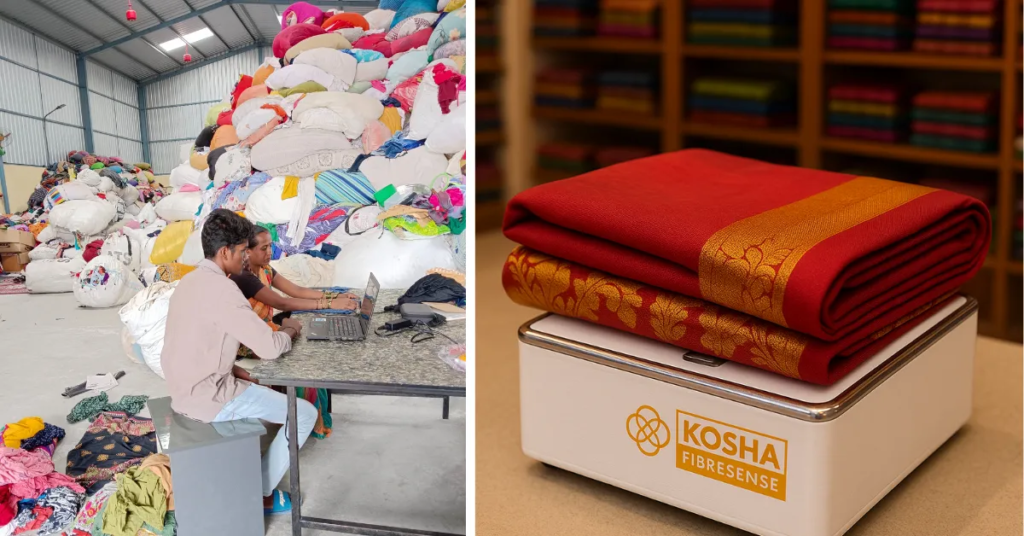
KOSHA.ai emerged as a response to mistrust in textile markets and the struggles artisans faced in proving authenticity.
“We started talking about frustrations we had quietly carried within us for years,” says Ramki. “Why was the textile value chain so opaque? Why was it so difficult to establish the truth? And could technology ever work for the smallest producers rather than only the biggest companies?”
Their skill sets aligned perfectly—Vijaya brought deep experience in textiles, production clusters, and artisan livelihoods, while Ramki excelled at building resilient, scalable systems.
“I remember thinking, here is someone who sees the same cracks in the system and refuses to believe they’re permanent,” Ramki adds. That day, without any formal plan or intention, KOSHA.ai began to take shape.
Technology that safeguards authenticity
When KOSHA.ai officially started operations in 2020, counterfeit products were widespread. Powerloom imitations were sold as handloom, and blended fibres were often falsely marketed as pure silk. Even experienced buyers were misled.
“Weavers told us customers no longer trusted them. Without trust, their livelihood collapsed,” Vijaya explains.
“We believe circularity begins with truth. If you cannot identify a fibre, you cannot recycle it. If you cannot prove authenticity, artisans cannot earn fairly. Technology must be the custodian of truth,” says Ramki.
This urgent need inspired the creation of WeaveSENSE, an IoT-based device designed to attach directly to traditional handlooms. Early prototypes were built in 2020; by April 2021, an MVP was ready. The device officially launched in 2022.
WeaveSENSE records loom-specific signatures, weaving rhythms, timestamps, and short video clips. These are converted into an immutable digital trail, providing provenance and proof of authenticity. A QR code on the final product lets customers view real-time footage of their saree or fabric being woven.
One of the strongest adopters of this technology has been Biraja Handloom Producer Company in Jajpur. Its CEO, Ranjan Guin, says confidently,
“Earlier, buyers doubted whether our products were genuinely handmade. With WeaveSENSE, we show them the weaving video itself. Customers feel justified paying a premium, and we feel respected proving the authenticity of our craft.”
This marked KOSHA’s first major milestone—not technology replacing tradition, but technology protecting it.
Turning industrial waste into opportunity
While WeaveSENSE solved the problem of authenticity, a deeper crisis persisted. Waste handlers and recyclers were struggling due to unreliable manual sorting.
“Workers showed us they identified fibres by touch,” Vijaya recalls. “With today’s complex synthetics, that method simply cannot work.”
Accuracy of fibre identification sometimes fell as low as 60%. Recyclers—who require precise fibre compositions for spinning, felting, or chemical recycling—often rejected batches, causing financial losses for both workers and recycling units.

This crisis sparked the development of FibreSENSE. The journey began with laboratory work in June 2023, followed by a prototype in February 2024, paid pilots by September 2024, and finally the MVP and full launch in April 2024.
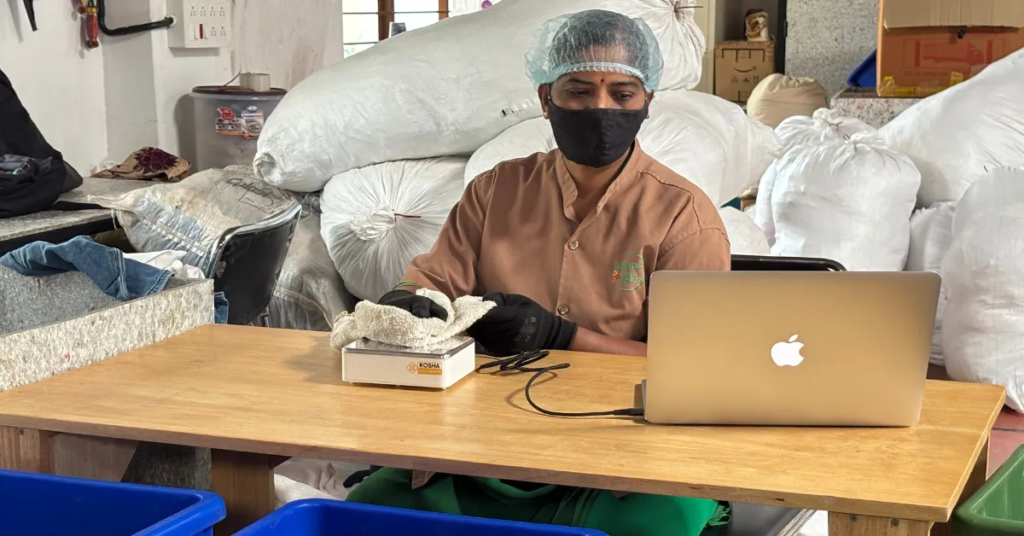
FibreSENSE uses near-infrared spectroscopy combined with AI-driven chemometric models to determine fibre composition in seconds. By projecting NIR light onto a textile piece, it analyses the absorption and reflection patterns to identify each fibre’s unique “molecular signature.”
“Every fibre speaks a different language,” Ramki explains. “FibreSENSE is the interpreter. In seconds, it tells you whether a fabric is cotton, polyester, wool, silk, viscose, or a blend—and in what proportions.”
Unlike traditional laboratory testing, FibreSENSE is instant, non-destructive, and affordable. Integrated with KOSHA’s traceability platform, it allows brands, recyclers, and regulators to track fibre origins, recycling processes, and CO₂ savings.
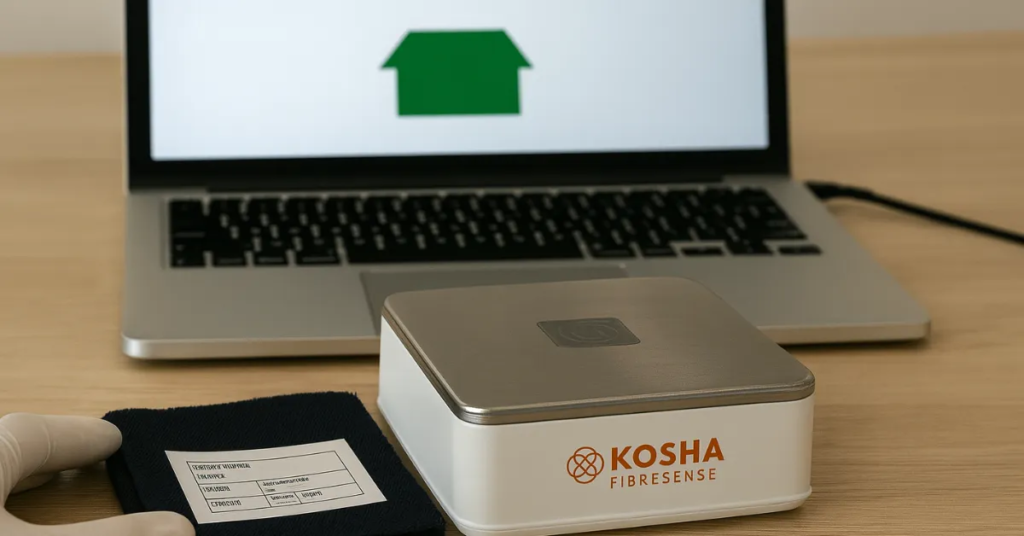
One of the earliest adopters was Green Worms Waste Management Enterprise in Kozhikode, which works across 12 districts. Project Head Gopika Santhosh notes:
“Earlier, something that looked like cotton turned out to be rayon. We were often wrong. After KOSHA’s device came in, our team felt informed. They could see results instantly, and it validated their judgement.”
She adds,
“FibreSENSE helps us supply exactly what recyclers or paper-makers need—80 to 90 percent polyester, or specific cotton–poly blends for felt. It has made us more accurate and more confident.”
Soon, the wider community began changing too. “When we realised eight percent of household dry waste was textiles, we began awareness campaigns. Now households segregate textiles correctly. People finally understand textile waste has value.”
Collaborations built on sustainability and empathy
One of KOSHA.ai’s key partnerships is with Creative Dignity, led by Meera Goradia, a widely respected voice in India’s craft ecosystem.
Meera speaks of the team with warmth:
“What struck me was that they were a deep-tech team with extraordinary empathy. They understood the smallest producer, something rare in technology circles.”
Together, they launched a pilot covering 50 looms in Rajasthan—quantifying the sustainability footprint of handloom for the first time.
“We want to map carbon emissions, water use, and also capture social and cultural value—employment, community cohesion, the dignity of labour,” Meera explains. “Handloom has always been sustainable, but now we will have the data to prove it.”
This project is helping shape a framework for craft-sector sustainability grounded in Indian realities.
The numbers reveal the impact — and the people behind it
In only seven months since FibreSENSE’s commercial launch, KOSHA achieved:
- 10,000 kg textile waste diverted from landfills
- 35,000 kg CO₂ emissions prevented
- 1,200+ artisans empowered through WeaveSENSE
- 5,000 ESG credentials verified across clusters
Yet, the founders insist the true impact cannot be captured by metrics alone.
“We never began with the ambition of ‘impact metrics,’” says Vijaya. “Our work grew because the ecosystem needed honesty—in fibres, in labour, and in sustainability claims.”
“Every recognition—from H&M Foundation, Social Alpha, Villgro, Mercedes-Benz, or even the Prime Minister’s mention in Mann Ki Baat—came because the real work was happening quietly in clusters,” Ramki adds.
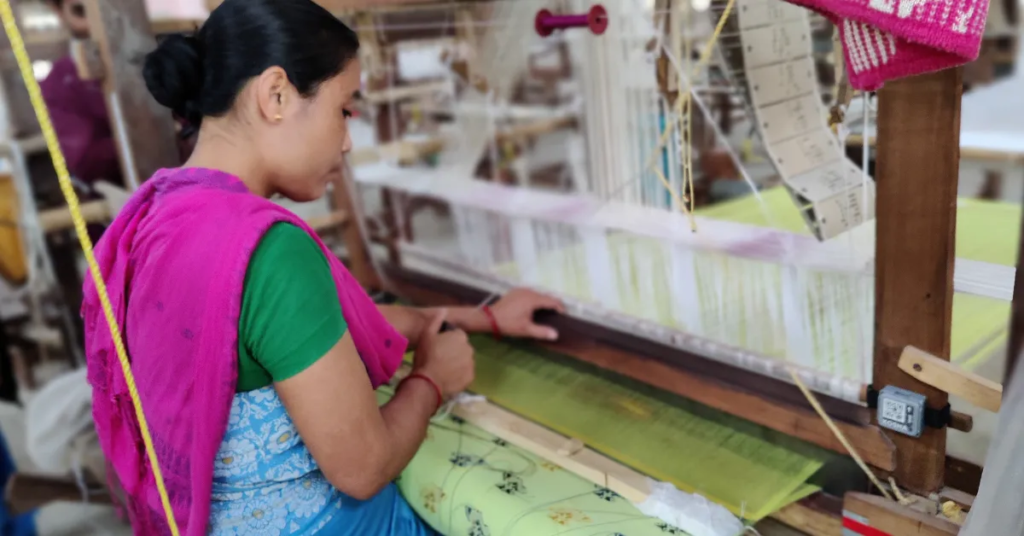
Artisans themselves describe the transformation vividly.
At Biraja Handloom, CEO Ranjan says, “Customers now see how our sarees come to life. They see the artisan’s hands and efforts.”
Sudhanshu, an Ikat weaver from Odisha, echoes the sentiment:
“Earlier, authenticity was guesswork. Now we have clarity. Customers see the processes and materials used. When I go to exhibitions, buyers scan the QR code—they’re happy, and they end up buying the saree.”
Circularity as a human responsibility
Circularity is often framed as a scientific or environmental necessity. But for KOSHA.ai, it is fundamentally about people.
Vijaya says, “We started this journey because we couldn’t accept that artisans creating exquisite products earned so little. Today, whether it is waste pickers in Kerala or weavers in Odisha, the goal is the same—to give people their agency back.”
KOSHA.ai’s story—beginning from a chance meeting during a run, growing through confronting the textile waste crisis, evolving into powerful scientific tools—is ultimately a story about people.
The waste pickers who needed accuracy.
The weavers who needed validation.
The artisans who needed visibility.
The industry that needed honesty.
And founders who believed technology should restore dignity—not replace it.