

Members of the British Textile Machinery Association (BTMA) reflect on 2025 as a year of strong technological progress, innovation, and global engagement, even as market conditions remained uncertain and volatile. Across advanced machinery, digitalisation, testing technologies, and sustainability-driven solutions, BTMA members have continued to push boundaries in technical textiles and textile manufacturing.
“Our members have been very active over the past 12 months and this has resulted in new technologies for the production of technical fibres and fabrics, the introduction of AI and machine learning into process control systems and significant advances in materials testing,” says BTMA CEO Jason Kent. “There’s real excitement about what can be achieved in 2026 as we look ahead to upcoming exhibitions such as JEC Composites in Paris in March and Techtextil in Frankfurt in April.”

Advancing Composites Manufacturing
Momentum within the composites sector has been particularly strong. Cygnet Texkimp has earned a nomination for a 2026 JEC Innovation Award following its collaboration with McLaren Automotive on the ART rapid tape-deposition system. The technology enables dry fibre tape placement at speeds of up to 2.5 metres per second, significantly reducing scrap, shortening cycle times, and enhancing structural performance across composite-intensive vehicle platforms.
As the world’s largest independent manufacturer of prepreg production machinery, Cygnet Texkimp also delivers a broad portfolio of handling and converting systems for the composites industry. The company is additionally licensed to design and manufacture the DEECOM® composite recycling system developed by BTMA member Longworth Sustainable Recycling Technologies. This zero-emission, low-carbon pressolysis solution uses pressure and steam to reclaim fibres and resin polymers from production waste and end-of-life composites.
Other BTMA members supporting the composites value chain include Emerson & Renwick, applying advanced print, forming, vacuum, and coating technologies to carbon fibre processing, and Airbond, a specialist in pneumatic yarn splicing for high-value carbon and aramid fibres. Slack & Parr continues to supply high-accuracy gear metering pumps to the manmade fibre sector, processing a wide range of polymers with precision and consistency.
Resource-Efficient Gel Spinning
Further progress in high-performance fibre production has been achieved by Fibre Extrusion Technology (FET), which introduced a new manufacturing process for ultra-high molecular weight polyethylene (UHMWPE). The patented system uses supercritical carbon dioxide for solvent extraction, delivering notable resource and efficiency gains.
“Current UHMWPE systems are huge in scale and extremely complex,” says FET R&D Manager Jonny Hunter. “That makes the supply chain inflexible and limits new product development. These disadvantages have been addressed in our new FET-500 series lab and small-scale gel spinning system.”
Digital Quality Assurance and Inspection
BTMA members are also transforming quality assurance through automation and data-driven manufacturing. Shelton Vision has advanced automated fabric inspection with the latest generation of its WebSpector system. Using patent-pending image processing, the solution delivers reliable real-time defect detection on complex patterned fabrics, even under distortion, shear, or stretch.
Originally developed for plain fabrics, WebSpector now supports intricate designs such as camouflage and is widely used in automotive interiors, woven airbags, performance wear, fashion, denim, upholstery, mattress ticking, window furnishings, and carbon fibre composites.
Continuous Colour Monitoring
A similar evolution from intermittent checks to continuous monitoring is taking place in colour management through C-Tex innovations. Mills can now implement laboratory-grade colour measurement directly in production.
“What we are doing is taking a lab capability and putting it into production,” says Managing Director Rob Ricketts.
Working alongside Shelton, C-Tex has integrated inline defect detection with continuous colour variation analysis, allowing both parameters to be evaluated simultaneously and shared across supply chains.
“This visibility is a big breakthrough,” says Ricketts. “It’s well established in automotive, but now it’s coming to textiles too.”
Intuitive and Sustainable Testing Solutions
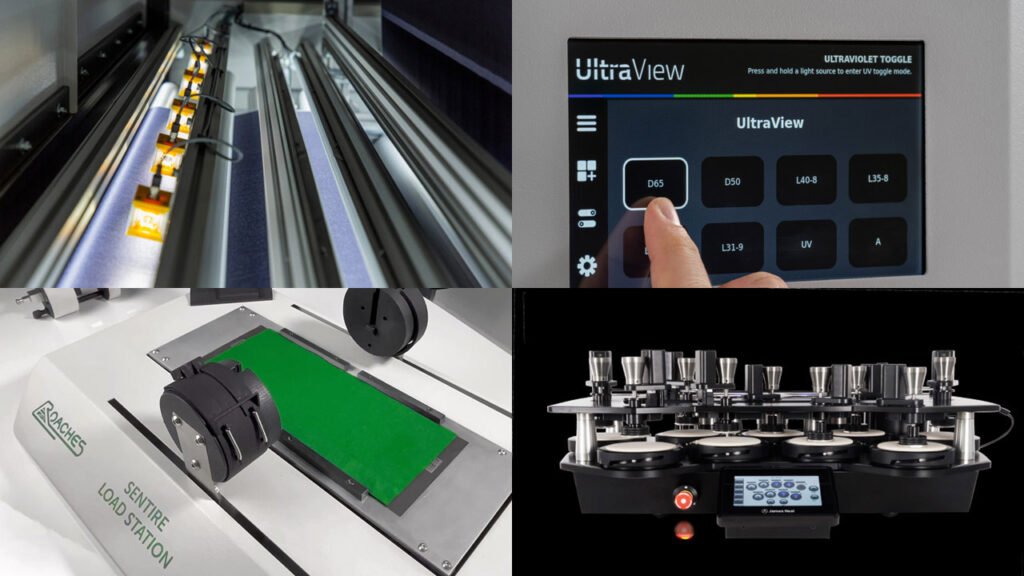
Testing innovation remains central to BTMA’s value proposition. James Heal has introduced its Performance Testing collection, designed to simplify and accelerate tests such as airflow and water resilience. Water repellency testing has been further enhanced through the TruRain system, which significantly reduces wastewater and energy consumption.
During 2025, James Heal also launched the Martindale Motion, a nine-station instrument with independently controlled lifting heads. This allows multiple tests to run simultaneously and unattended, including overnight operations, improving laboratory efficiency.
Colour accuracy is addressed through the VeriVide DigiEye system, offering non-contact colour measurement, digital imaging, and advanced LED illumination for precise and shareable results.
Measuring Fabric Tactility Objectively
One of the industry’s longstanding challenges—objectively measuring fabric handle—has been addressed by Roaches International with its Sentire fabric handle tester.
“No two people will describe how a fabric feels in the same way and the lack of a common language to describe fabric tactility poses communication challenges across the complex global fashion and textile supply chain,” says Roaches International MD Sean O’Neill. “The Sentire has been developed to allow our customers to objectively measure qualities such as softness, smoothness, drape and stiffness and market response during 2025 has been extremely positive.”
A Converging Future
Looking ahead, BTMA sees a clear convergence between advanced machinery, intelligent software, and rigorous testing frameworks.
“Across the BTMA we’re seeing a convergence of advanced machinery, intelligent software and rigorous testing,” he says. “Our members are responding to today’s challenges around efficiency, sustainability and quality, while laying the foundations for a more transparent, data-driven and resilient textile manufacturing sector. Despite market uncertainty, there is genuine confidence about what lies ahead for British textile machinery and its global customers.”
Founded in 1940, the British Textile Machinery Association continues to promote British textile machinery manufacturers globally, acting as a vital bridge between its members and the evolving textile manufacturing ecosystem.