
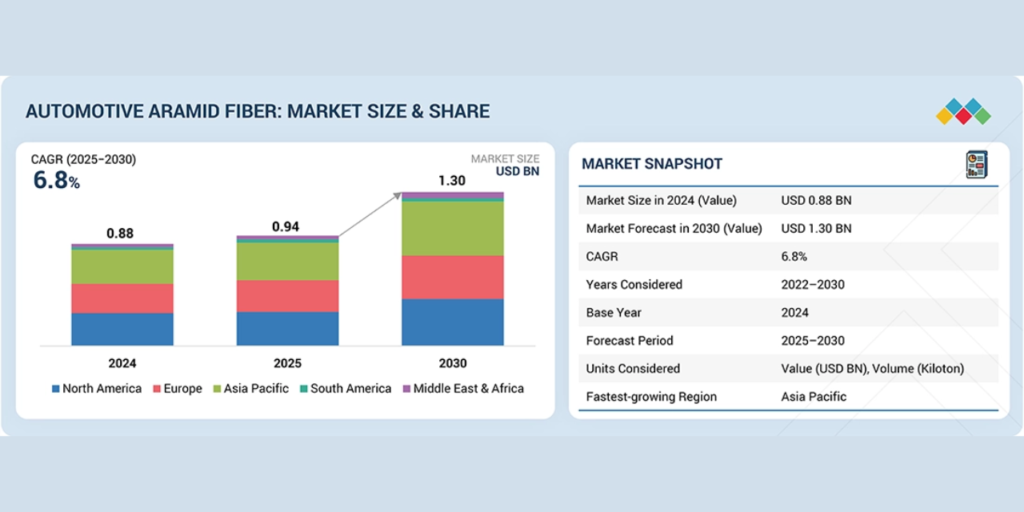
The global automotive aramid fiber market is on a strong growth trajectory and is projected to reach USD 1.30 billion by 2030, rising from USD 0.94 billion in 2025, registering a compound annual growth rate (CAGR) of 6.8%, according to a new industry report.
The study, “Automotive Aramid Fiber Market by Type (Para-Aramid, Meta-Aramid), Application (Brake Pads & Clutch Facings, Reinforced Tires, Hoses, Belts & Gaskets, Racing Vehicle Components, Heat Shields & Insulation), and Region – Global Forecast to 2030,” highlights increasing demand for high-performance, lightweight materials as a key driver shaping market expansion.
Aramid fibers are gaining widespread adoption in the automotive sector due to their exceptional strength-to-weight ratio, heat resistance, and durability. These properties make them ideal for use in critical vehicle components such as tires, brake pads, belts, gaskets, hoses, and thermal insulation systems, where performance, safety, and reliability are essential.
Market growth is being further accelerated by the global automotive industry’s transition toward electric vehicles (EVs) and fuel-efficient mobility solutions. As manufacturers focus on reducing vehicle weight to improve energy efficiency, emissions performance, and driving range, aramid fibers are increasingly replacing traditional materials in both conventional and high-performance vehicle applications.
In addition to safety and efficiency benefits, aramid fibers support sustainability goals by enabling lightweight vehicle design, which contributes to reduced fuel consumption and lower carbon emissions over a vehicle’s lifecycle.
Key Market Players
Major companies operating in the automotive aramid fiber market include DuPont (US), Teijin Limited (Japan), Kolon Industries, Inc. (South Korea), Hyosung Advanced Materials (South Korea), Yantai Tayho Advanced Materials Co., Ltd. (China), Toray Industries, Inc. (Japan), among others.
The report also outlines key market objectives, including market sizing and forecasting across regions, analysis of drivers, restraints, opportunities, and challenges, evaluation of micro-market trends, assessment of competitive strategies, and tracking of product launches, partnerships, investments, and technological advancements shaping the global automotive aramid fiber landscape.
Source: Makets And Markets