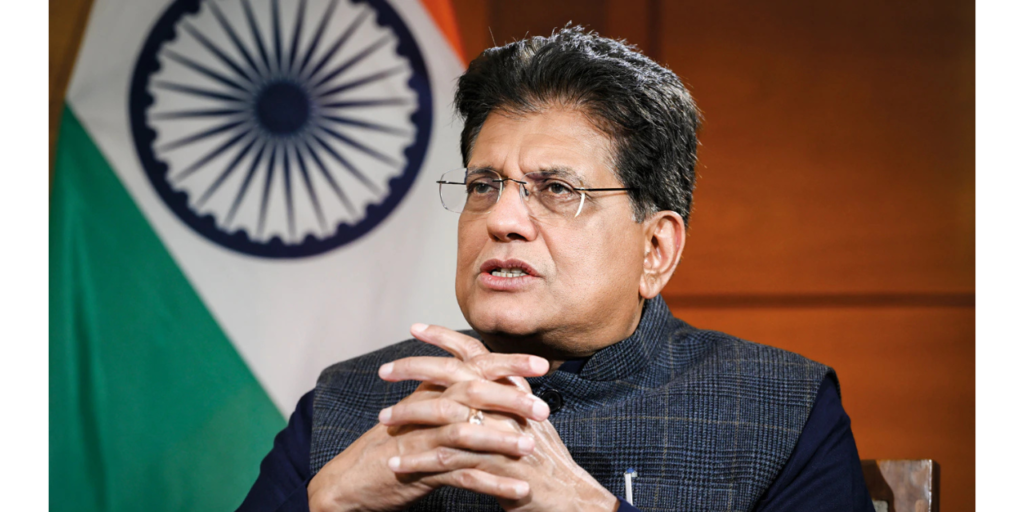
Union Minister of Commerce and Industry Shri Piyush Goyal addressed the first National Quality Conclave, organised by the Department for Promotion of Industry and Internal Trade (DPIIT) in partnership with the Quality Council of India (QCI). Speaking virtually, he emphasised that quality must anchor India’s manufacturing and export ecosystem in line with Prime Minister Shri Narendra Modi’s “zero defect, zero effect” vision.
Union Minister of Commerce and Industry Shri Piyush Goyal stated that quality should define India’s manufacturing and export framework, describing Prime Minister Shri Narendra Modi’s “zero defect, zero effect” vision as central to the country’s development trajectory during the Amrit Kaal. Referring to the goal of Viksit Bharat 2047, he said India’s aspiration to become a $30–35 trillion economy by 2047 is based on three pillars — zero defect (quality), zero effect (sustainability), and equitable opportunity (inclusivity).
Addressing the first National Quality Conclave, organised by DPIIT in partnership with QCI, Shri Goyal said that sustainable progress requires India to establish itself as a producer of high-quality goods and services rather than remain primarily a consumer market. He noted that Brand India should represent quality, reliability and trust. Citing India’s position as the world’s fastest-growing large economy for the past four years and its expected rise to the third-largest GDP within the next two to two-and-a-half years, he stated that achieving the $2 trillion export target — comprising $1 trillion in merchandise and $1 trillion in services within six to seven years — depends on maintaining high quality standards.
Shri Goyal said that nine Free Trade Agreements concluded in the past three to three-and-a-half years with 38 developed countries now cover nearly two-thirds of global GDP and trade. He noted that these agreements create opportunities in sectors including textiles, leather, footwear and pharmaceuticals, provided products meet global benchmarks. He added that India’s share in global trade remains limited even in labour-intensive sectors and encouraged industry to utilise expanded market access.
He referred to earlier instances where Indian consumers sought “export quality” goods and stressed the need to replace dual standards with uniform quality benchmarks for domestic and export markets. He acknowledged the efforts of QCI and DPIIT in conducting consultations across clusters and sectors to promote quality awareness.
Outlining a five-pillar agenda, Shri Goyal called for clearly defined standard operating processes with compliance and inspection from raw material to finished product stage; skilling and re-skilling of the workforce to reduce wastage and improve productivity, including in textiles; gap analysis and benchmarking against global best practices; streamlined testing and certification processes to reduce time and cost; and development of shared infrastructure, including modern automated testing facilities in manufacturing clusters.
He stated that financial resources would not be a constraint for establishing quality testing infrastructure and urged industry to utilise support under the Export Promotion Mission (EPM) for international approvals and compliance requirements such as REACH regulations, CBAM verification, SPS and TBT measures, and other non-tariff barriers. He added that such measures would assist micro and small enterprises in meeting international standards.
Quoting Prime Minister Shri Narendra Modi, Shri Goyal reiterated that India should be globally recognised as a guarantee of quality. He referred to the need to move away from a “chalta hai” mindset and adopt a culture of excellence across organisational levels.
Union Minister of State for Commerce and Industry Shri Jitin Prasada said that as global opportunities increase, India must transition toward quality-led manufacturing and that platforms like the National Quality Conclave will support this process.
Secretary, DPIIT, Shri Amardeep Singh Bhatia stated that strengthening Bharat’s industrial ecosystem requires coordinated engagement between government, industry and institutions based on quality-driven policy frameworks. He described quality enhancement as a long-term requirement for building global trust and integrating into supply chains.
Chairperson, QCI, Shri Jaxay Shah stated that quality must extend beyond audits and certifications to become embedded in daily shopfloor practices and described it as central to Viksit Bharat 2047.
The National Quality Conclave is structured around consultations with industry and MSMEs to gather shop-floor and supply-chain inputs for policy development and sector-specific quality roadmaps. Series 1 of the Conclave covered four priority sectors — textiles, leather, footwear and pharmaceuticals — selected for export potential, MSME participation and employment contribution.
The Conclave followed a three-stage engagement process over two months across more than twenty cities. In the leather sector, 25+ nationwide consultations and 15+ Gunvatta Manthan dialogues were held with participation from 65+ industry stakeholders and MSMEs. The textiles sector included 30+ nationwide consultations and 10+ Gunvatta Manthan dialogues engaging 10+ stakeholders and MSMEs. The pharmaceuticals sector involved 7+ nationwide consultations with 55+ stakeholders and MSMEs. Overall, the programme covered 14 manufacturing clusters and engaged more than 50 government and regulatory bodies.
DPIIT and QCI indicated that the Conclave forms part of an ongoing series of sector-focused engagements aimed at addressing quality challenges, strengthening coordination and advancing quality-led industrial growth. The outcomes will contribute to a National Quality Roadmap for Manufacturing to guide coordinated action among government, regulators and industry.