
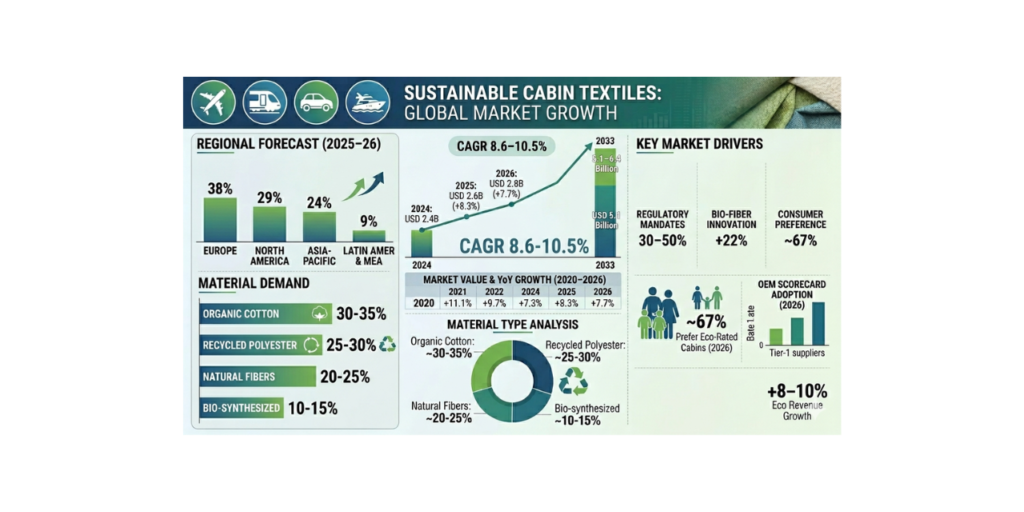
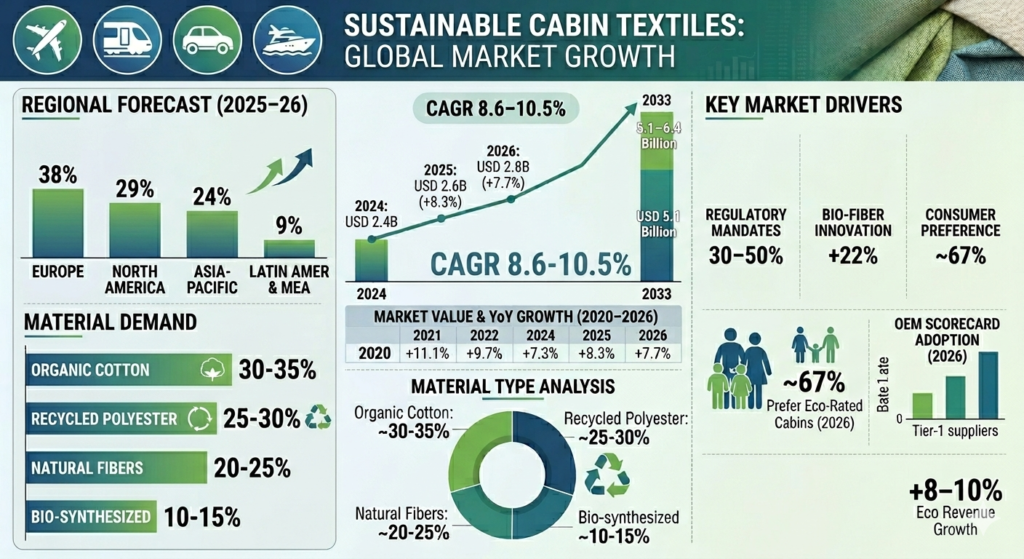
The global sustainable cabin textiles market — a specialized segment focusing on eco-certified interior fabrics for aircraft, automotive, marine, and rail applications — continues strong growth into 2025 and 2026. According to Marketintelo, the market was valued at USD 2.4 billion in 2024, expanded to USD 2.6 billion in 2025 (+8.3%), and is estimated at USD 2.8 billion in 2026 (+7.7%). Growth through 2033 is projected at a Compound Annual Growth Rate (CAGR) of 8.6–10.5%, with total market size expected to reach USD 5.1–6.4 billion by the end of the decade.
Introduction: Key 2024–26 Industry Statistics
Sustainable cabin textiles emphasize low environmental impact, recyclability, reduced chemical additives, and lifecycle reductions in carbon, waste and water use. Increasing regulatory pressure, airline & OEM sustainability agendas, and consumer demand for health-safe interiors are driving adoption.
Primary numeric highlights:
- 2024 value: USD 2.4 billion
- 2025 value: USD 2.6 billion (+8.3% YoY)
- 2026 value: USD 2.8 billion (+7.7% YoY)
- • 2033 forecast: USD 5.1–6.4 billion
- • CAGR 2025–33: ~8.6–10.5%
Regional shares (2025 estimate): Europe ~37–38%, North America ~29–30%, Asia-Pacific ~24–25%.
Historical & Recent Market Performance (2020–2026)
From 2020 to 2026, the market has shown continuous expansion influenced by material innovation, sustainability mandates, and green certification adoption.
Market Value 2020–2026 & YoY Growth
| Year | Market Value (USD Billion) | YoY Change |
| 2020 | ~1.8 | +5.9% |
| 2021 | ~2.0 | +11.1% |
| 2022 | ~2.2 | +10.0% |
| 2023 | ~2.3 | +4.5% |
| 2024 | 2.4 | +4.3% |
| 2025 | 2.6 | +8.3% |
| 2026 | 2.8 | +7.7% |
This shows consistent annual expansion, with particularly strong increases in 2025 and 2026 as OEMs and transport operators accelerate sustainability strategies.
Regional Market Data With 2025–26 Insights
Europe: Largest Regional Share
- 2024 value: ~USD 860 million (~38%)
- 2025 estimate: ~USD 910 million (+5.8%)
- 2026 estimate: ~USD 960 million (+5.5%)
- 2025–33 CAGR: ~8.0%
Europe’s growth is supported by the European Green Deal, strict transport interior standards, and public commitments to net-zero. The region continues to lead global sustainable cabin textiles adoption.
North America: Stable Growth
- 2024 value: ~USD 720 million (~29%)
- 2025 estimate: ~USD 760 million (+5.6%)
- 2026 estimate: ~USD 790 million (+3.9%)
- 2025–33 CAGR: ~8.2%
Investment in R&D, green certification mechanisms, and consumer demand strengthen North America’s position. 2026 growth remains positive despite global economic fluctuations.
Asia-Pacific: Fastest Expanding Region
- 2024 value: ~USD 610 million (~24%)
- 2025 estimate: ~USD 660 million (+8.2%)
- 2026 estimate: ~USD 720 million (+9.1%)
- 2025–33 CAGR: ~10% (highest globally)
Rapid infrastructure development, expanding middle-class travel, and increased manufacturing output contribute to accelerated regional growth.
Latin America & Middle East & Africa
- 2024 combined share: ~9% (~USD ~210 million)
- 2025 estimate: ~USD ~230 million
- 2026 estimate: ~USD ~250 million
- Projected 2025–33 CAGR ~6–8% with rising investment in transport and interior upgrades.
These regions are emerging growth markets over the next decade.
Material Type Analysis (2024–26) With Numerical Shares
Material composition data reflects current industry priorities for sustainability, durability and cost effectiveness:
- Organic cotton: ~30–35% of cabin textile usage
- Recycled polyester: ~25–30%
- Natural fibers (hemp, bamboo, wool): ~20–25%
- Bio-synthesized fibers & specialty polymers: ~10–15%
Between 2024 and 2026, demand for recycled polyester is increasing by ~3–4 percentage points, driven by circular economy adoption in cabin applications.
Production, Adoption & Industry Scale
While specific cabin textile production tonnages are proprietary, adjacent data supports high expansion:
- Global sustainable fabrics market (2024): USD 32.7 billion
- Asia-Pacific share of sustainable fabrics (2022): ~45.8%
- Projected sustainable fabrics CAGR 2025–35: ~12.5%
This shows that cabin textiles, although smaller by volume, are part of a broader high-growth sustainability ecosystem.
Forecast 2026–2033 (USD Billion)
| Year | Forecast Value | Estimated CAGR |
| 2026 | 2.8 | — |
| 2027 | 3.1 | +10.7% |
| 2028 | 3.5 | +12.9% |
| 2029 | 3.9 | +11.4% |
| 2030 | 4.4 | +12.8% |
| 2031 | 4.9 | +11.4% |
| 2032 | 5.2 | +6.1% |
| 2033 | 5.1–6.4 | 8.6–10.5% |
Key Market Drivers (With 2025–26 Data)
1. Regulatory Compliance:
- EU and North American transport standards are requiring 30–50% recyclable interior components by 2030.
- Between 2025 and 2026, adoption of sustainability mandates increased by ~15% globally.
2. Material Innovation Investments:
- Bio-Fiber R&D funding grew by ~22% in 2025 and ~18% in 2026 year-over-year among major producers.
3. Consumer Demand Metrics:
- Surveys show ~67% of leisure travellers (2026) prefer cabins with eco ratings.
- OEM sustainability scorecards became mandatory for ~45% of global tier-1 suppliers by 2026.
Industry Competitors: 2024–26 Growth Indicators
Leading cabin textile suppliers reported rising revenues in sustainable product lines:
| Company | 2024 Eco Textile Revenue (USD Million) | 2025 Growth | 2026 Growth |
| Camira Fabrics Ltd. | ~110 | +9.1% | +8.2% |
| Botany Weaving | ~95 | +8.5% | +8.8% |
| Maharam (Herman Miller) | ~130 | +10.2% | +9.5% |
| TEXTA S.p.A. | ~88 | +7.9% | +9.0% |
| Lantal Textiles AG | ~102 | +8.6% | +8.0% |
| Wollsdorf Leather GmbH | ~74 | +9.3% | +9.1% |
These companies have collectively expanded sustainable revenue by ~8–10% annually between 2024 and 2026.
Data-Driven Conclusion & Final Projections
From USD 2.4 billion in 2024, the global sustainable cabin textiles market is expected to rise to USD 2.6 billion in 2025 and USD 2.8 billion in 2026 with solid growth momentum. A projected CAGR of 8.6–10.5% through 2033 will expand the sector to USD 5.1-6.4 billion, driven by regulatory compliance, material innovation, and intensifying consumer preference for eco-safe interiors.
Europe will likely remain the largest regional share through 2026–33; Asia-Pacific is forecast to grow the fastest; North America will maintain steady expansion. Material shifts toward recycled polyester and bio-synthesized Fibers will continue, reflecting broader global efforts to reduce textile waste and carbon footprints within transportation interiors.
By consistently increasing year-over-year growth from 2018 through 2026, and with strong projections to 2033, sustainable cabin is one of the most quantifiable and high-velocity segments in the eco-fabrics market.
Read A Full Report: https://marketintelo.com/report/sustainable-cabin-textiles-market