
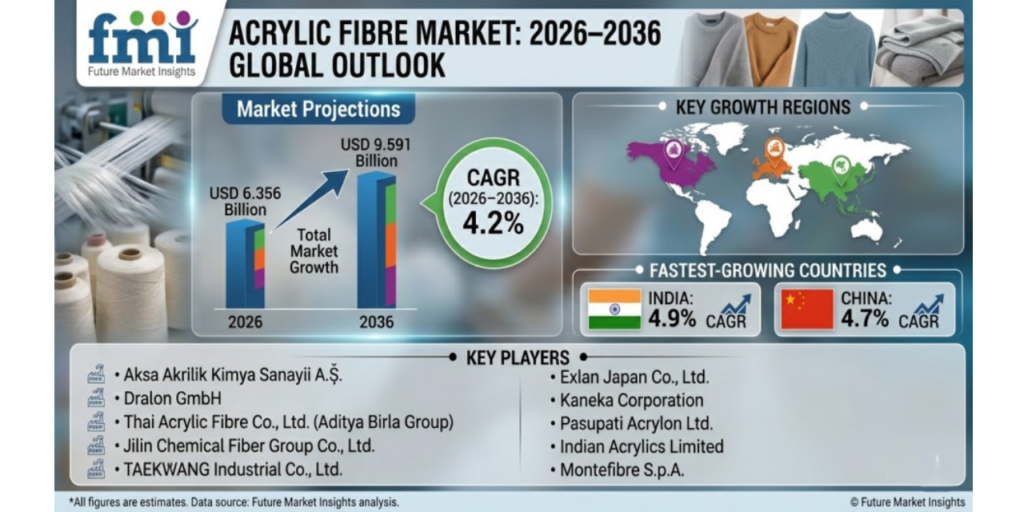
India and China lead expansion as demand rises in apparel and home textiles
The global acrylic fibre market is projected to grow from USD 6.356 billion in 2026 to USD 9.591 billion by 2036, registering a CAGR of 4.2%, according to Future Market Insights (FMI). Growth is supported by demand from apparel and home textile sectors, particularly in emerging economies. Acrylic fibres continue to be used as a cost-effective alternative to natural fibres due to their durability and performance characteristics.
The global acrylic fibre market is expected to expand steadily over the forecast period, increasing from USD 6.356 billion in 2026 to USD 9.591 billion by 2036, at a CAGR of 4.2%, as per analysis by Future Market Insights (FMI).
Acrylic fibres are widely used in apparel and home textile applications due to properties such as wool-like texture, durability, UV resistance, and cost efficiency. These characteristics support their use across price-sensitive consumer segments.
Market Snapshot (2026–2036):
- Market size in 2026: USD 6.356 billion
- Market size in 2036: USD 9.591 billion
- CAGR (2026–2036): 4.2%
- Leading fibre form: Staple (~60% share)
- Dominant end-use: Apparel (~55% share)
- Key growth regions: Asia Pacific, Europe, North America
- Fastest-growing countries: India (4.9% CAGR), China (4.7% CAGR)
The market is projected to witness consistent growth through 2030, supported by increasing consumption of knitwear, expansion of organized retail, and rising demand for home textiles. From 2030 to 2036, further growth is expected to be influenced by sustainability initiatives, including recycled acrylic fibre adoption, gel-dyeing technologies, and applications in technical textiles.
Staple fibre accounts for approximately 60% of the market, driven by its adaptability in spinning processes and compatibility with blending applications. It is widely used in knitwear and home textile production.
The apparel segment represents around 55% of total demand, supported by consumption of sweaters, winterwear, and cost-effective fashion products.
Regionally, Asia Pacific remains the primary growth centre. India and China are leading markets due to expanding textile manufacturing capacity, increasing domestic consumption, and export activity. Turkey continues to strengthen its role as an exporter to Europe, while South Korea, the United States, and Japan contribute through technical textile and specialty applications.
Market Drivers:
- Demand for affordable knitwear and home textiles
- Growth of organized retail and e-commerce
- Increasing adoption of acrylic fibres in emerging markets
Opportunities:
- Development of recycled acrylic fibre and circular economy initiatives
- Expansion into technical textile applications such as automotive, filtration, and outdoor fabrics
- Advancements in bio-based acrylonitrile and sustainable production technologies
Trends:
- Adoption of gel-dyeing and solution-dyeing technologies to reduce water usage
- Development of functional and antimicrobial fibres
- Increasing use in technical and industrial textile applications
Challenges:
- Competition from polyester and other synthetic fibres
- Environmental concerns related to microplastic shedding
- Volatility in raw material prices
Country Growth Outlook (CAGR 2026–2036):
- India: 4.9%
- China: 4.7%
- Turkey: 4.5%
- South Korea: 4.3%
- United States: 3.9%
- Japan: 3.8%
The market structure is moderately concentrated, with companies focusing on fibre performance, sustainability, and product innovation. Key areas of competition include dyeability, softness, durability, and thermal resistance. Manufacturers are also investing in recycling technologies and advanced dyeing processes to strengthen their positions.
Key Players in the Acrylic Fibre Market:
- Aksa Akrilik Kimya Sanayii A.Ş.
- Dralon GmbH
- Thai Acrylic Fibre Co. Ltd. (Aditya Birla Group)
- Jilin Chemical Fiber Group Co. Ltd.
- TAEKWANG Industrial Co. Ltd.
- Exlan Japan Co. Ltd.
- Kaneka Corporation
- Pasupati Acrylon Ltd.
- Indian Acrylics Limited
- Montefibre S.p.A.
Souce: Future Market Insights, Inc.