
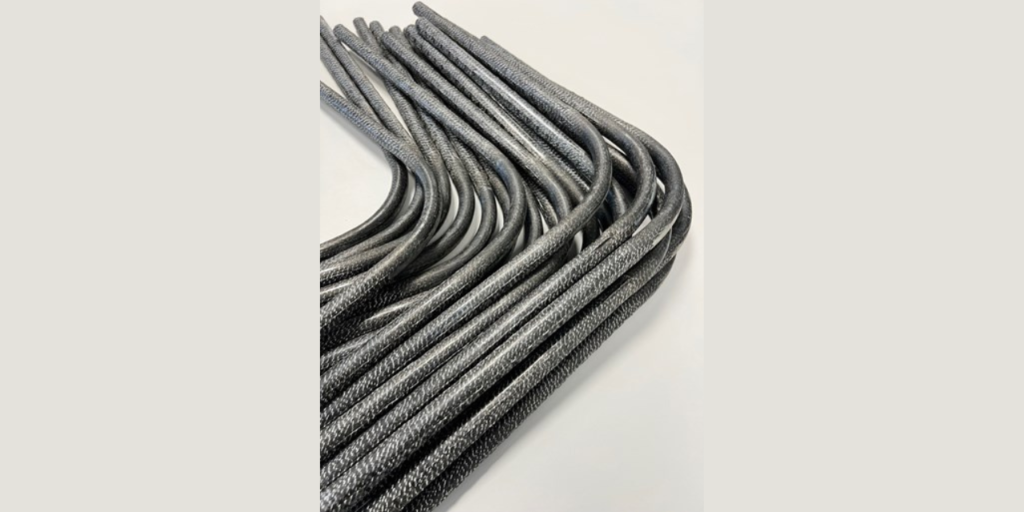
Reese-solutions GmbH, based in Stade, Germany, has developed a process for manufacturing thermoplastic composite tubes with bending cycle times of less than 30 seconds. The technology is part of a consortium effort focused on producing composite-reinforcing rods using carbon staple fibers in a thermoplastic matrix. The development supports high-volume production across multiple industrial applications.
Reese-solutions GmbH is involved in a consortium that has introduced a method for producing composite-reinforcing rods using carbon staple fibers longer than 60 mm combined with thermoplastic materials. These rods are available in diameters of 6, 8, and 12 to 16 mm. The manufacturing process involves pultrusion followed by thermoforming through a bending operation.
The reinforcing rods incorporate recycled carbon fiber and thermoplastics, enabling automated production processes with reduced energy consumption and lower personnel requirements. This contributes to cost reduction in manufacturing.
The resulting products are designed for use as load-path-oriented reinforcements in injection-molded components, as alternatives to steel reinforcements in construction, and as structural elements in sports equipment. Production volumes are supported by pultrusion speeds exceeding 1 m/min and thermoforming cycle times of less than 30 seconds per bend.
Reese-solutions describes its role as a development service provider and manufacturer, focusing on thermoplastic composite materials. The company’s activities cover the full product development cycle, including feasibility studies, concept development, variant optimization, multidisciplinary design, prototyping, and series production.
The company processes materials such as PP, PA6, PA12, PPA, PPS, and various PAEKs for bending and forming plastic tubes. Using CNC-based bending processes, it can shape extruded and continuous fiber-reinforced tubes by applying localized heat and forming them within short timeframes. With existing tooling, production can be carried out cost-effectively, including for single units. Tube diameters as small as 3 mm are also achievable.
Additional capabilities include functionalization through injection molding, overmolding, and the integration of flanges and inserts. Reese-solutions supplies composite tubes to sectors including transportation—such as aviation, trucking, shipping, and agricultural machinery—as well as sports and leisure, and the HoReCa (hotels, restaurants, and cafés/catering) industry.