
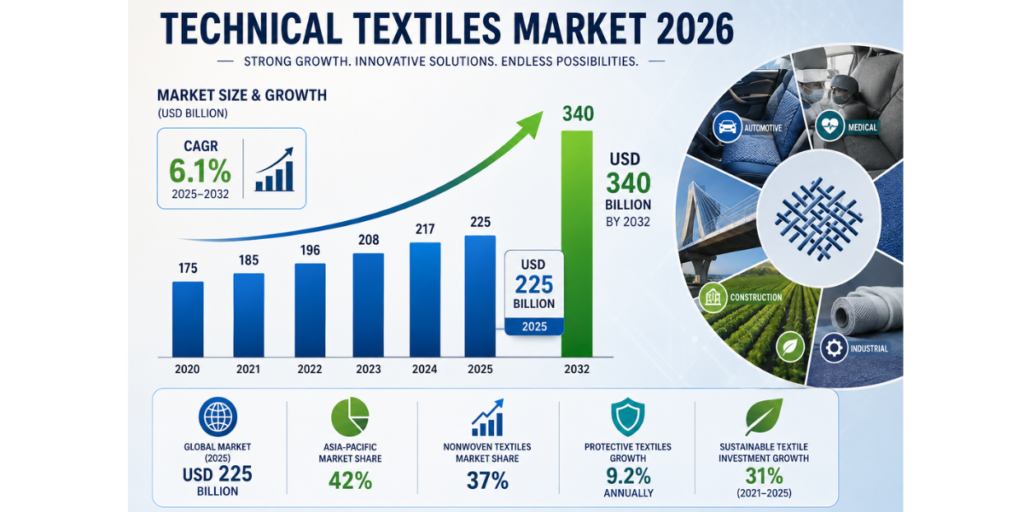
The global technical textiles industry is entering a strong growth phase in 2026, fueled by rising demand across healthcare, automotive, construction, defense, agriculture, aerospace, and industrial manufacturing. Advancements in smart fabrics, sustainable material technologies, and high-performance engineering are transforming technical textiles into one of the fastest-growing segments of the global textile industry.
Unlike traditional textiles that focus mainly on aesthetics, technical textiles are engineered for functionality, durability, and specialized industrial performance. In 2025, the global technical textiles market was valued at nearly USD 225 billion and is projected to surpass USD 340 billion by 2032, growing at a CAGR of 6.1%.
Technical Textiles Driving Industrial Transformation
Technical textiles are now widely used in over 12 major sectors including automotive, healthcare, construction, defense, sports, industrial filtration, geotextiles, packaging, and environmental protection. Industrial applications alone accounted for approximately 63% of global technical textile consumption in 2025.
The increasing shift toward lightweight materials, sustainable production, and high-efficiency industrial solutions is accelerating market adoption worldwide.
Automotive Sector Accelerates Demand
The automotive industry remains one of the strongest growth drivers for technical textiles. Manufacturers are increasingly replacing heavier components with textile composites to improve fuel efficiency and electric vehicle battery performance.
Technical textiles can reduce vehicle weight by 15% to 25%, while global electric vehicle production increased by 35% in 2025. Automotive textile applications such as airbags, seat belts, insulation systems, tire reinforcement, and fiber-reinforced composites are expected to push the automotive textiles market beyond USD 52 billion by 2030.
Medical Textiles Witness Rapid Expansion
Healthcare continues to be a major contributor to technical textile growth. Medical textiles are widely used in surgical gowns, PPE kits, implantable fabrics, wound care products, hygiene applications, and antimicrobial textiles.
The global medical textiles segment crossed USD 38 billion in 2025, supported by rising healthcare spending and aging populations worldwide. Between 2020 and 2025, global PPE demand surged by 240%, while antimicrobial textile adoption rose by 31%.
The growing need for disposable and hygienic medical products continues to strengthen long-term demand for advanced textile materials.
Smart Textiles Open New Innovation Opportunities
Smart and wearable textiles are becoming a rapidly expanding innovation category within the industry. These advanced materials integrate sensing, monitoring, and temperature-regulating capabilities into textile structures.
Applications include health-monitoring wearables, conductive fabrics, military sensing garments, and temperature-responsive apparel. The smart textile market is projected to exceed USD 15 billion by 2030, supported by increasing investments in wearable technology research and development.
Research funding for smart textile technologies increased by approximately 27% between 2022 and 2025, highlighting growing interest in next-generation textile innovation.
Sustainability Becomes Industry Priority
Sustainability has emerged as a central focus for technical textile manufacturers. Companies are increasingly adopting recycled polyester, bio-based fibers, water-efficient dyeing technologies, and low-carbon manufacturing systems.
Between 2021 and 2025:
- Recycled fiber utilization increased by 29%
- Water consumption in advanced textile facilities declined by 18%
- Sustainability targets expanded across 70% of large textile manufacturers
The sustainable technical textile segment is projected to grow at an annual rate of 8.3% through 2032 as environmental regulations and consumer demand continue to rise globally.
Infrastructure Growth Fuels Geotextile Demand
Global infrastructure development is significantly increasing demand for geotextiles used in roads, drainage systems, erosion control, and soil stabilization projects.
Infrastructure spending exceeded USD 4 trillion globally in 2025, while geotextile demand increased by 18% between 2024 and 2026. In Asia-Pacific alone, construction textile consumption rose by 24%.
Geotextiles improve road durability, reduce erosion, and lower long-term maintenance costs, making them increasingly valuable for large-scale infrastructure projects.
Asia-Pacific Maintains Market Leadership
Asia-Pacific remains the dominant regional market with approximately 42% global market share. Strong manufacturing ecosystems in China and India continue to support regional leadership.
China contributes nearly 32% of global technical textile production, while India’s technical textile exports grew by 11.5% in 2025. Government incentives, industrial expansion, and rising domestic demand are driving further growth across the region.
North America continues focusing on high-performance aerospace, defense, and medical textile applications, while Europe leads sustainability-driven textile innovation and recycling initiatives.
Industry Challenges Remain
Despite strong growth momentum, the industry still faces several challenges. Raw material price volatility continues impacting synthetic fiber costs, while advanced manufacturing equipment requires substantial capital investment.
Recycling technical textiles also remains complex due to mixed material compositions, with only around 23% of global technical textile waste currently being recycled.
Future Outlook
The future outlook for technical textiles remains highly positive. By 2032, smart textile adoption could rise by 150%, while sustainable textile production may account for nearly 45% of total industry output.
Emerging innovations including nanofibers, conductive fabrics, AI-powered quality inspection systems, and biodegradable industrial textiles are expected to reshape the global textile landscape over the next decade.
As industries increasingly prioritize lightweight, durable, and sustainable materials, technical textiles are expected to play a critical role in the future of manufacturing, healthcare, infrastructure, and advanced industrial applications.