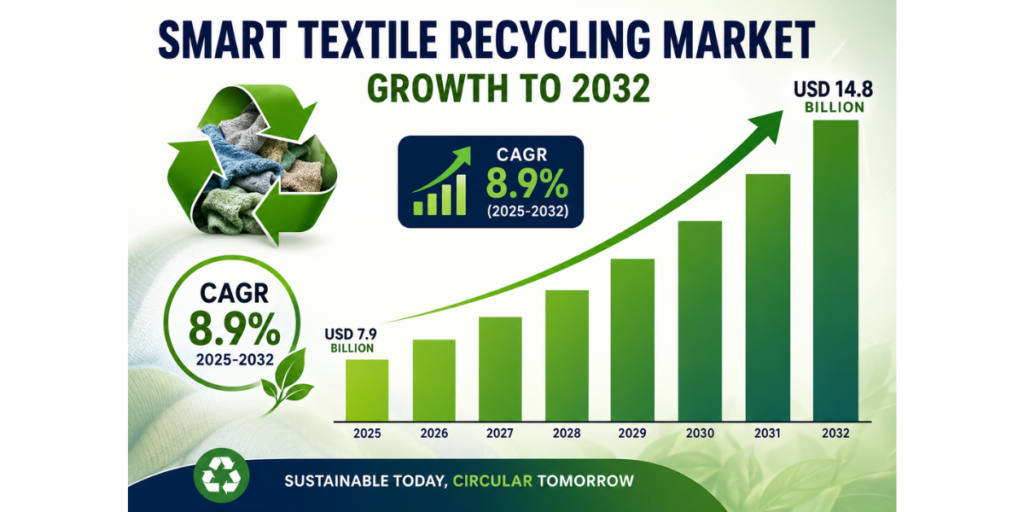
The global smart textile recycling industry is experiencing rapid growth as rising textile waste, stricter environmental regulations, and advances in AI-powered recycling technologies accelerate the transition toward a circular textile economy.According to recent market estimates, the global smart textile recycling market was valued at approximately USD 7.2 billion in 2024 and is projected to reach nearly USD 14.8 billion by 2032, expanding at a CAGR of 8.9%. The market is gaining momentum as governments, fashion brands, and recycling companies invest heavily in automated sorting systems, chemical recycling technologies, and digital traceability infrastructure.
Rising Textile Waste Drives Recycling Demand
Global textile waste generation surpassed 134 million tons in 2025, highlighting the growing environmental pressure facing the apparel and textile industry. Despite increasing sustainability efforts, only around 12% of textile waste is currently recycled worldwide, while nearly 87% still ends up in landfills or incineration facilities annually.The growing waste crisis has accelerated demand for smart textile recycling solutions capable of recovering high-value fibers while reducing environmental impact.
AI and Automation Transform Recycling Operations
Artificial intelligence and automation are becoming central to next-generation textile recycling systems. AI-powered optical sorting technologies can now identify textile blends with more than 95% accuracy, significantly improving recycling efficiency.In 2025, more than 2,800 smart recycling facilities worldwide integrated machine-learning-based fiber recognition systems. AI-enabled textile sorting efficiency improved from 62% in 2018 to 91% in 2025, while automated robotic recycling systems helped reduce operational costs by nearly 22%.Digital textile identification technologies also reduced sorting errors by approximately 34% between 2019 and 2025.
Blockchain and RFID Improve Traceability
Digital traceability is emerging as another major growth driver for the industry. Blockchain integration in textile recycling increased traceability rates from 18% in 2020 to 49% in 2025, helping improve transparency across fashion supply chains.At the same time, RFID-enabled garments improved recycling efficiency by nearly 27%, especially among premium apparel brands adopting closed-loop manufacturing systems.The adoption of smart sensors and RFID-based textile tracking technologies increased by 38% during 2024 alone.
Chemical Recycling Investments Accelerate
Chemical recycling technologies are witnessing significant investment growth due to their ability to recover fibers from complex blended materials that traditional mechanical recycling struggles to process.Investments in enzymatic recycling and depolymerization technologies reached approximately USD 1.9 billion in 2025, compared to USD 940 million in 2021. Waterless chemical recycling technologies are also gaining traction as manufacturers seek more sustainable and resource-efficient solutions.The recycled polyester segment represented nearly 46% of total recycled textile output in 2025, driven by increasing demand from apparel manufacturers and global fashion brands.
Europe Leads Global Market
Europe currently dominates the global smart textile recycling market with approximately 31.4% market share in 2025. The European Union allocated more than USD 2.1 billion toward textile circularity programs between 2022 and 2025.
Germany, France, and the Netherlands collectively processed over 8.7 million tons of recyclable textiles in 2025, supported by strong sustainability regulations and advanced recycling infrastructure.
North America generated nearly USD 2 billion in market revenue during 2025, while the United States alone produced over 17 million tons of textile waste annually.
Asia-Pacific Emerges as Fastest-Growing Region
Asia-Pacific remains the fastest-growing regional market, with projected CAGR of 10.8% through 2032. Countries including China, India, Japan, and South Korea are rapidly expanding investments in automated recycling infrastructure.China processed nearly 26 million tons of textile waste in 2025, while India’s recycled textile exports exceeded USD 1.4 billion, highlighting growing regional opportunities in sustainable textile manufacturing.
Industry Trends Reshaping the Market
Several major trends are transforming the smart textile recycling industry:
AI-enabled robotic textile sorting
RFID and QR-based garment tracking
Blockchain-enabled recycling certification
Closed-loop fashion manufacturing
Waterless chemical recycling technologies
Global venture capital investment in smart textile recycling startups exceeded USD 3.3 billion between 2021 and 2025. More than 420 textile recycling startups were actively operating globally in 2025, compared to only 180 companies in 2018.
Future Outlook
The smart textile recycling market is expected to maintain strong growth momentum over the next decade as landfill restrictions tighten and sustainability regulations expand globally.
By 2032:
Global market value could exceed USD 14.8 billion
Recycled textile processing volume may surpass 62 million tons annually
AI-powered sorting systems could achieve 98% accuracy
Chemical recycling may account for 44% of recycled textile output
Asia-Pacific may represent nearly 36% of global demand
As sustainability becomes central to the fashion and textile industry, smart textile recycling is expected to play a critical role in building a more circular, technology-driven, and environmentally responsible global supply chain.