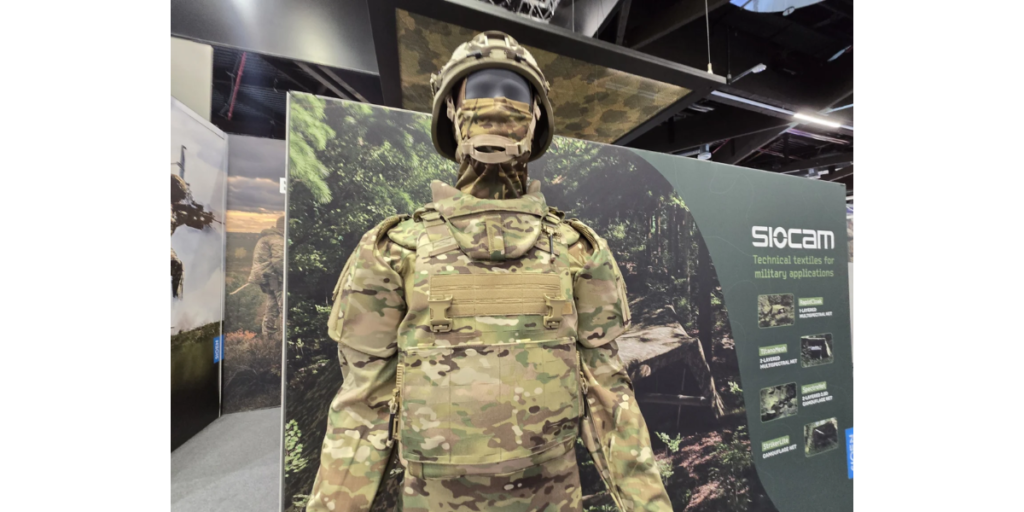
Sioen Industries, a family-owned textile manufacturer with origins dating back to 1907, is continuing its development of advanced military protective textiles and Personal Protective Equipment (PPE) in response to evolving defense requirements and modern battlefield conditions.
The company’s expansion into coated textiles began in the 1960s, followed by the development of an apparel division integrating technical fabrics with finished protective garments. Over time, the business also expanded into chemical processes, including inks and colorants used in textile production.
Today, the company operates across multiple sectors, including civilian textiles, security applications, and defense systems. According to Kristof Daels, Business Development Manager, diversification remains central to the company’s strategy.
“We believe diversification is essential,” says Kristof Daels. “If you depend on one market and lose a major project, the impact can be significant. By working across sectors, we remain stable and adaptable.”
The company remains family-owned and is currently under its third generation of leadership. Long-term employee retention and technical continuity form part of its operational structure, supporting research and development activities while maintaining manufacturing stability.
Sioen Industries combines internal product development with selective acquisitions aimed at strengthening technical capabilities in targeted markets. The company focuses on producing durable and high-performance textile solutions for demanding operational environments.
Recent geopolitical developments and increased defense investments across Europe have contributed to growing demand for military protective textiles and PPE. Sioen Industries has participated in several European defense programs, including clothing system contracts and camouflage-related initiatives developed through collaborations with industrial partners.
Modern battlefield threats, including drone surveillance and fragmentation weapons, are influencing the development of protective systems. The company states that explosions create risks not only from metal fragments but also from environmental debris such as soil particles, requiring broader protection capabilities.
“Protection is critical, but so are weight and mobility,” explains Kristof Daels. “If equipment becomes too heavy or restrictive, it limits a soldier’s effectiveness. The challenge is finding the right balance.”
The company applies what it describes as a “triple helix” innovation model, integrating collaboration between industry, research institutions, and defense organizations. According to the company, military organizations define operational requirements while universities and research centers contribute scientific expertise.
“We don’t define the requirements ourselves,” notes Kristof Daels. “The end users do. Our role is to translate those needs into effective technologies.”
Product testing includes internal evaluations for comfort, mobility, and thermal performance, while advanced simulations such as explosive testing are conducted in external laboratories according to NIJ testing standards.
Although Sioen Industries maintains vertically integrated operations covering chemical processes, textile production, and garment manufacturing, the company also works with external suppliers and development partners.
“No company can do everything alone,” says Kristof Daels. “Suppliers bring valuable expertise. By combining their strengths with ours, we achieve better results.”
The company also supports broader European collaboration in defense innovation to reduce duplication and improve efficiency across development programs.
“If knowledge and expertise are shared, everyone benefits,” Kristof Daels says. “Stronger cooperation can lead to better protection systems for all.”
According to the company, future development will continue to focus on balancing protection, mobility, durability, and operational effectiveness through advanced materials and collaborative research.
“Innovation requires both realism and imagination,” reflects Kristof Daels. “You have to understand today’s challenges but also think about what will be possible tomorrow.”
Sioen Industries stated that ongoing work in lightweight materials, durability, and camouflage technologies will remain central to supporting evolving defense and protection requirements.