India, a growing movement is reshaping the relationship between fashion designers and indigenous artisans, with collaborations increasingly based on creative partnership rather than traditional craft outsourcing. This shift was highlighted in the exhibition “No ‘One’ Maker: Textiles as Community,” which showcased how designers and indigenous artists are working as equal collaborators to create innovative textile expressions rooted in cultural heritage.
The exhibition demonstrated that contemporary Indian textiles are evolving through shared authorship, where artisans contribute not only technical expertise but also artistic vision. Rather than treating indigenous communities as anonymous makers, the showcased projects celebrated their identities, creativity, and cultural narratives.
One of the standout collaborations featured Warli artist Balu Jivya Mashe working alongside designer Rimzim Dadu, where traditional Warli paintings were enhanced with Dadu’s signature metallic embroidery. The fusion created a striking dialogue between tribal art and contemporary textile design.
Similarly, Bhil artist Bhuri Bai collaborated with luxury textile label Harago to reinterpret her iconic dotted paintings through the traditional Bandhej tie-dye technique. The project transformed familiar motifs into large-scale sculptural textile installations, blending folk art with modern craftsmanship.
Another highlight was the vibrant patchwork quilts created by women from Karnataka’s Siddi community in partnership with designer Anitha N. Reddy. Each quilt featured bold color combinations, unique compositions, and the maker’s name stitched directly into the fabric, emphasizing authorship and individuality.
Reflecting on the collaboration, Reddy said the initiative was never about offering assistance but about growing together while ensuring the community’s authentic artistic voice remained intact.
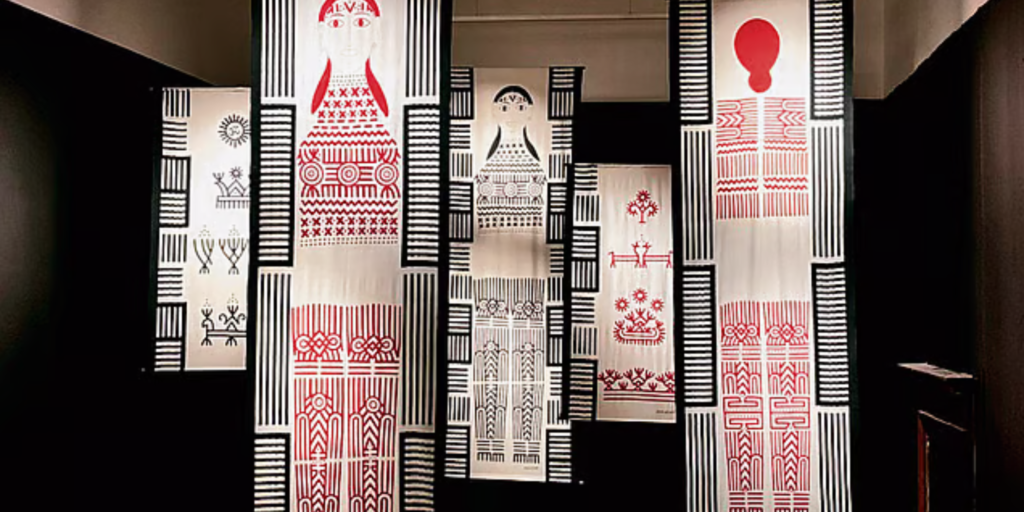
The exhibition also explored the reinterpretation of Godna tattoo art through a partnership between design duo Abraham & Thakore and artist Mangala Bai Marawi. Traditional tattoo motifs were painted onto vertically suspended double-ikat textiles, creating sculptural pieces that symbolized the human body without directly depicting it.
Marawi described the collaboration as an opportunity to expand her artistic practice onto an entirely new medium, allowing traditional motifs to find fresh expression through textiles.
Textile brand Morii presented another innovative collaboration with artisan Mansukh Pitambari Khatri, where familiar block-printing elements were enlarged and reconfigured to introduce movement into traditionally repetitive patterns. Founder Brinda Dudhat explained that the goal was to preserve the craft while adding subtle contemporary interpretations.
The exhibition’s broader message challenged the common perception that Indian textiles require modernization. Instead, it emphasized that traditional textile practices are already contemporary when artisans are recognized as equal creative partners.
This philosophy echoes earlier international collaborations, including projects by artists Manu Parekh and Madhavi Parekh with The Chanakya School of Craft for Dior’s Paris Haute Couture Week 2022, where Indian folk traditions were showcased on one of fashion’s most prestigious global platforms.
Curator Sreyansi Singh stressed the importance of recognizing indigenous artists as equal contributors rather than anonymous representatives of their communities. She argued that artisans should be acknowledged as artists in their own right, with their work celebrated beyond live craft demonstrations.
The exhibition ultimately illustrates how collaborative textile practices are redefining India’s creative landscape by combining traditional knowledge with contemporary design. These partnerships not only preserve cultural heritage but also create innovative works that neither designers nor artisans could achieve independently, setting a new benchmark for inclusive and sustainable creative collaboration.