
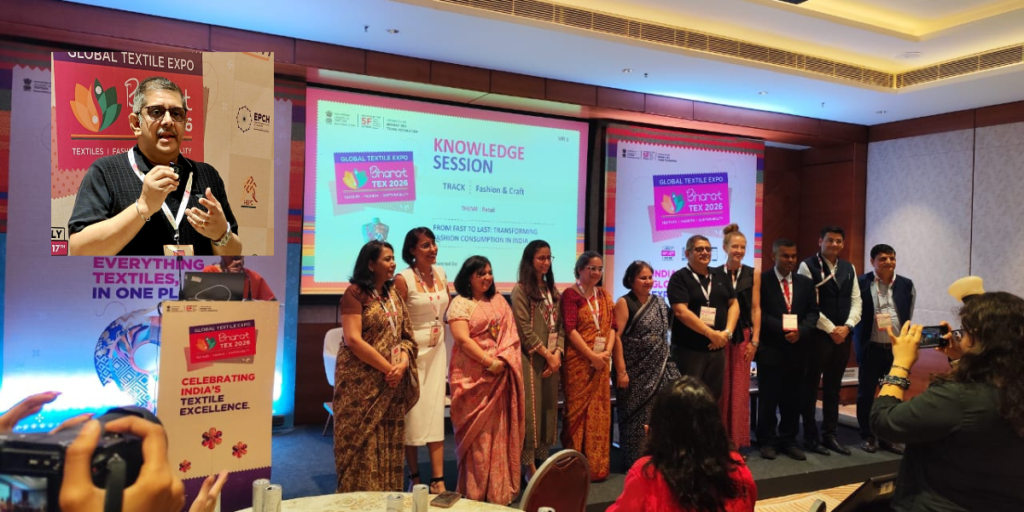
Bharat Tex 2026 hosted a thought-provoking knowledge session titled “From Fast to Last: Transforming Fashion Consumption in India,” bringing together industry leaders, policymakers and academics to discuss how India can build a sustainable textile and fashion ecosystem while working towards its ambitious $350 billion textile economy.
The session, coordinated by Dr. (Prof.) Sanjay Shrivastava, Dr. Varsha Gupta, and Dr. Vishu Arora under the UNIDO–Ministry of Textiles project, focused on promoting durable fashion, circular economy practices and responsible consumption as key pillars of India’s future textile growth.
Sustainable Growth Requires Durable Fashion
The panel emphasized that India’s long-term textile growth depends not only on increasing production but also on transforming consumer behaviour by extending garment life, reducing textile waste and eliminating hazardous chemicals from fashion supply chains.
Experts agreed that moving away from fast fashion towards durable, repairable and recyclable clothing will be essential to achieving sustainability goals while strengthening the country’s textile industry.
India’s Traditional Circular Practices Offer a Competitive Advantage
Dr. Patsy Perry from Manchester Metropolitan University highlighted that while most pre-consumer textile waste is already recycled globally, post-consumer textile waste remains a major challenge.
She pointed to the large volume of unused clothing stored in households and stressed that reducing unnecessary consumption is more effective than simply improving waste management.
According to Dr. Perry, India already possesses a unique advantage through long-standing traditions such as chindi, garment repair, reuse and upcycling, practices that naturally align with today’s circular economy principles.
Policy Frameworks to Drive Circular Fashion
Industry experts stressed that government policy will play a critical role in accelerating sustainable fashion adoption.
Dr. Naresh Tyagi, President of the Confederation of Indian Textile Industry (CITI), discussed the imbalance between global brand expectations and low-cost manufacturing systems, while Dr. Raj Kishore Nayak of RMIT University Vietnam highlighted the limited influence of Cut-Make-Trim (CMT) manufacturers operating on narrow profit margins.
The panel recommended stronger implementation of:
- Extended Producer Responsibility (EPR)
- Ecodesign for Sustainable Products Regulation (ESPR)
- Product durability standards
- Transparent care and product labelling
These measures would encourage manufacturers to produce longer-lasting garments while improving accountability across the value chain.
Supporting Artisans and Local Supply Chains
The discussion also highlighted India’s extensive network of nearly 11 crore Self-Help Group (SHG) entrepreneurs, which could play an important role in strengthening local textile value chains.
By directly connecting artisans with consumers, experts said India can reduce supply chain complexity while preserving traditional craftsmanship and creating sustainable livelihoods.
Dr. Tyagi encouraged consumers to adopt mindful purchasing habits by choosing quality garments, maintaining them properly and extending their useful life.
Storytelling Over Greenwashing
Another major focus was consumer communication and sustainability marketing.
Darshana Gajare of Lakmé Fashion Week said brands need to move beyond technical sustainability data and instead communicate through relatable stories around repair, reuse, swapping and personal styling.
The panel also warned against greenwashing, noting that misleading sustainability claims can undermine consumer trust. Experts stressed that genuine sustainability must balance environmental, social and economic responsibilities rather than relying solely on marketing messages.
Young Designers Driving Sustainable Fashion
The session concluded on an optimistic note, highlighting the growing role of emerging designers and younger consumers in promoting sustainable fashion.
Designers are increasingly creating timeless, versatile garments designed for longer use, while many younger consumers are embracing vintage clothing, second-hand fashion and experience-driven lifestyles over excessive consumption.
Participants concluded the session by taking a Sustainable Consumption Pledge, committing to ethical sourcing, waste reduction and support for artisan craftsmanship.
The discussions reinforced that India’s journey towards a $350 billion textile economy will require collaboration between policymakers, industry, designers and consumers, combining traditional knowledge with modern sustainability practices to build a more circular and resilient fashion industry.