
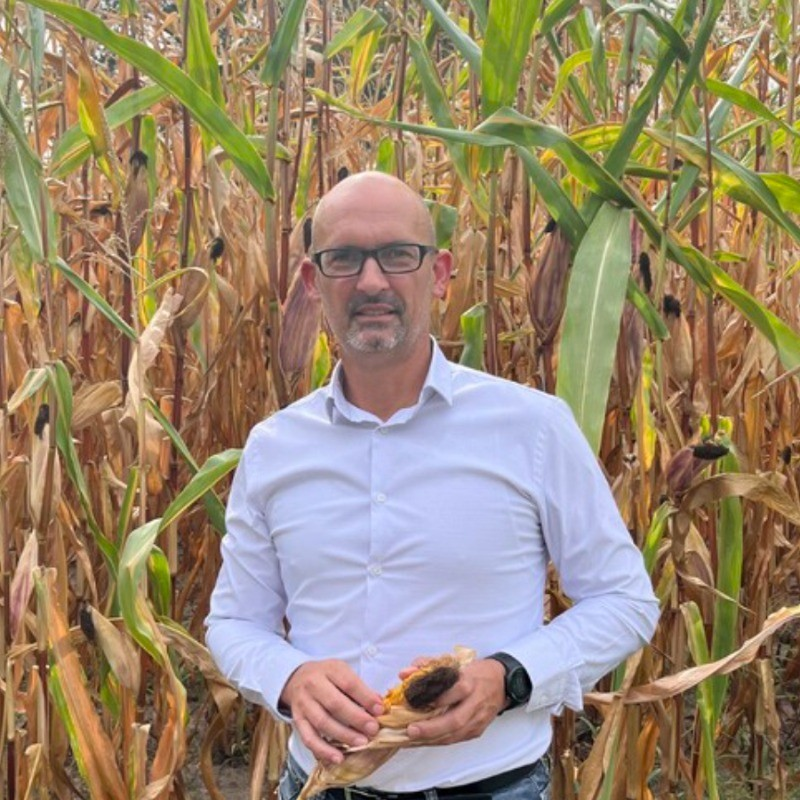
Patrick Van Waes, Global Marketing Director, Susterra® propanediol
The TVC Media Team had the privilege to meet Patrick Van Waes, Global Marketing Director for Susterra® propanediol at Primient Covation, ahead of the Renewable Biomaterials Conference. With 26 years of expertise in sustainable coatings and brand innovation, Patrick shares insights on how Susterra® propanediol—a petroleum-free, renewably sourced diol from regenerative corn—delivers a remarkably low carbon footprint of 0.709 kg CO₂eq while powering industries from footwear to data centres. His vision bridges technical excellence with market momentum in the renewable carbon economy.
Susterra® has been positioned as a solution for defossilization in multiple industries. How would you describe its unique value proposition in the renewable materials space?
Susterra® 1,3-propanediol is a 100% bio-renewable monomer building block that enables the development of versatile applications in elastomers, resins and polymers – making it applicable for industries such as footwear, alternatives for leathers, coatings and adhesives. In addition, it can also be used as a bio-solvent in heat transfer fluids. Beyond its versatility to support sustainability across several sectors, Susterra® is also available in large volumes, addressing a common challenge that often hinders the industry from replacing fossil fuels with bio-renewable ingredients at scale.
A recent third-party peer-reviewed LCA showed Susterra®’s carbon footprint at just 0.709 kg CO₂eq. How significant is this achievement for industries working toward Scope 3 emissions reduction targets?
Many companies have stringent 2030 greenhouse gas/scope 3 reduction goals, particularly looking towards 2050, and reducing scope 3 emissions is often one of the most challenging hurdles towards becoming more climate-friendly. Susterra® can reduce up to 86% of emissions when replacing fossil alternatives – or even more when the biogenic content can be taken in account – making it a valuable solution for many industries. With Susterra®, businesses can meet their carbon footprint reduction goals while also achieving functionality and performance.
Susterra® is applied across many sectors, from footwear polymers to data centre cooling. Which applications or industries are currently driving the strongest demand?
All industries are challenged to identify more environmentally friendly solutions, with renewable materials as a key consideration.
For an industry like footwear, a very low percentage of all shoes produced is recycled. Therefore, footwear brands looking to achieve greater sustainability may seek renewable materials for production, and Susterra® can be a key ingredient for select components.
Data centres – which have grown significantly in prominence with the rise of AI – have a supply and demand challenge: the more they are utilised, the more heat they produce that needs to be cooled. More sustainable cooling solutions, like Susterra®, can substantially reduce their impact.
Footwear, in particular, is a high-visibility industry for sustainability. How is Susterra® partnering with sportswear and lifestyle brands to support their material innovation and carbon goals?
Susterra® works along the entire value chain to create awareness and integrate more sustainable alternatives in the footwear industry. We connect directly with designers and product developers to highlight Susterra® solutions for midsoles and insoles, which are already available today. Further down the chain, we collaborate with PU and TPU producers globally – from chemical multinational companies to specialised start-ups – to develop bio-based alternatives for their current fossil-based offerings. For example, we have partnered with insole and midsole producers to incorporate Susterra® for bio-based PU and TPU materials, achieving up to 70% bio-based content.
Certifications such as USDA BioPreferred®, Ecovadis, and EPA Design for the Environment add credibility. Which certifications have been most impactful in accelerating market adoption?
Our USDA certification as a 100% bio-based product is a key element to generating awareness and accelerating adoption across several industries. We are also proud to be part of corn farming sustainability programs, including Truterra, which promotes regenerative agriculture practices. Responsible farming under Truterra’s program enables the production of Susterra® as a bio-based ingredient without any impact on land use or the food chain.
Beyond performance metrics, how does Susterra® help B2B companies communicate sustainability benefits all the way down to the consumer level?
We partner with our customers and brands to properly communicate the various elements of sustainability with their audiences to help ensure understanding. Key elements of the Susterra® story include its use as a 100% bio-based and bio-renewable ingredient, its participation in the Truterra program for regenerative farming of all corn needed for Susterra®, its low carbon footprint as assessed by a recent third-party peer-reviewed LCA, and its non-toxic and biodegradable features.
Additionally, we support B2B companies that may need to clarify any misconceptions around the production of Susterra®. For example, there have been no land use changes since 1938; instead, we are able to grow yields year-over-year by improving farming techniques – with no impact on the food chain.
You bring deep experience from the coatings and paints industry, where you launched new ingredient brands and innovations. How has that background shaped your marketing approach for biomaterials like Susterra®?
A commonality throughout my career has been rooting marketing in simple communications that help audiences understand the value of a sustainable alternative. This is particularly true for educating end-users of a product, where sales associates and merchandising teams can play a critical role in communicating the benefits of sustainability combined with functionality and performance. For consumers, marketing needs to focus on three unique selling points; less is more in communicating the end benefits.
To support brands, I’ve always believed in the power of internal alignment – between product developers, designers, and sales/marketing/communications teams. From reinforcing key messaging to preparing training materials, brands can ensure all teams are sharing the same narrative with customers.
The renewable materials sector is becoming increasingly competitive. How do you ensure that Susterra® stands out as a differentiated solution in the global market?
A key differentiator for Susterra® is its large-scale production and availability. The replacement of petroleum-based materials requires huge capacities for bio-renewable materials and building blocks. And while some consumer brands are ready to go all-in, the availability of sustainable materials is an issue. Primient Covation can move quickly at scale – with a production capacity of 77,000 metric tons per year – enabling the availability of Susterra® in large quantities.
Given Susterra®’s broad set of industrial applications—from coatings to deicing fluids—what role do collaborations and industry partnerships play in scaling adoption?
Industry partnerships across the value chain are critically important to scale adoption. As an example in the footwear industry, Susterra® collaborates with SK-Chemicals as the building block base to produce 100% bio-based Polyether Polyol; a TPU producer incorporates this into a formulation to bring both sustainability and performance into a specific sports shoe brand. For the brand to shift from niche application to a large portfolio of shoes, the entire value chain needs to expand its capabilities and increase the volume of bio-based materials vs. current capabilities today, which are largely based on petroleum. It can be done, and it must be done.
Looking to the future, how do you envision Susterra® and Primient Covation contributing to the growth of the renewable carbon economy highlighted at the Renewable Materials Conference?
The Renewable Materials Conference is a collaborative forum to connect with other industry leaders and align on where sustainability needs to go, and what we can do today to help get there. We’re also active members of the Renewable Carbon Initiative, which brings global companies together to fast-forward renewable materials in the consumer market.
These opportunities enable our Susterra® team to showcase the versatile applications we have across diverse industries to support renewable production with a bio-based raw material. In footwear alone as an example, we recently demonstrated the range of Susterra® applications – including a bio-PU covered golf ball, a 66% Susterra®-based midsole for a trail running shoe, and a biodegradable sneaker using Susterra® in the midsole/outsole and insole. These are just a few of the many applications that are moving brands – and consumers – forward towards a more sustainable future.