

Dinesh Marewad
Senior Scientist,
Wool Research Association

Dr Mrinal Choudhari
Additional Director,
Wool Research Association
Abstract
Plastic mulches are widely used in agriculture for weed suppression, moisture conservation, and crop yield enhancement, but they pose serious disposal and environmental challenges. This study investigates the use of Coarse Deccani wool, an underutilised by-product of Indian sheep rearing, as a sustainable, biodegradable mulch material. Nonwoven wool mulch mats were developed and applied in groundnut (Arachis hypogaea L.) cultivation. The study assessed the physical properties of wool mulch, its effects on soil temperature, moisture retention, weed suppression, and groundnut yield. Results showed significant improvement in soil water conservation and moderate weed control, with a noticeable reduction in irrigation frequency. Groundnut pod yield increased by approximately 15% compared to control plots without mulch. The wool mulch degraded completely after one season, enriching soil organic matter and micronutrients. This demonstrates the potential of coarse Deccani wool as a cost-effective, eco-friendly mulch for sustainable groundnut cultivation.
1.0 Introduction
Groundnut (Arachis hypogaea L.) is a key oilseed and food legume crop widely grown in semi-arid and tropical areas, especially in India. Its yield is highly affected by soil moisture, temperature changes, weed competition, and soil physical conditions during crucial phases such as flowering, pegging, and pod formation. In rainfed and low-irrigation systems, moisture deficiency and elevated soil surface temperatures often cause poor peg penetration, fewer pods, and unstable yields. Therefore, adopting agronomic practices that conserve soil moisture, control soil temperature, and enhance the soil microenvironment is vital for maintaining and increasing groundnut productivity. (Patel et al., 2018 and Mane B. N et al 2010).
Mulching is a widely used agronomic method to modify the soil–plant–atmosphere system. Covering the soil surface, mulches help reduce evaporation, inhibit weed growth, regulate soil temperature, prevent soil crusting, and enhance water-use efficiency. In groundnut farming, both organic mulches—such as straw, crop residues, and grasses—and synthetic options, primarily polyethene films, have been shown to boost yields and resource efficiency. However, organic mulches can be bulky, vary in quality, decompose quickly, and compete with other uses such as fodder. Plastic mulches, while good for moisture retention and weed suppression, raise environmental issues because they are non-biodegradable, leave plastic residues in the soil, are difficult to dispose of, and contribute to microplastic pollution. Growing regulatory restrictions and sustainability goals are encouraging the development of eco-friendly, biodegradable alternatives to plastic mulches. (Prem Ranjan, et al 2017, El-Beltagi, et al 2022, Henry Y, et al 2017)
Natural fibre-based mulches offer a promising option in this area. Sheep wool, in particular, has attracted growing interest due to its unique physical, chemical, and biological properties. Wool fibres are notable for their high-water retention, effective thermal insulation, and slow breakdown in soil. Chemically, wool is a protein fibre rich in keratin, containing about 10–14% nitrogen along with sulfur and trace nutrients. As it biodegrades gradually, wool can serve as a slow-release source of nitrogen and organic matter, potentially enhancing soil fertility and microbial activity. Research on wool-based mulches for horticultural and vegetable crops has shown they can improve soil moisture retention, stabilise soil temperature, promote plant growth, and reduce weed growth- all while avoiding the environmental issues linked to plastic mulches. (Cao, X et al, 2024, Allafi, F et al 2022)
India has large sheep populations that produce significant amounts of coarse and carpet-grade wool, which are often underused or deemed low-value due to limited textile industry demand. Specifically, Deccani sheep, mainly raised in the Deccan Plateau regions of Maharashtra, Karnataka, Telangana, and Andhra Pradesh, produce coarse wool that is generally unfit for clothing. Consequently, this wool is often undervalued, underprocessed, or discarded, resulting in economic setbacks for local herders. Converting Deccani coarse wool into agro-textile products, such as biodegradable mulch mats, offers dual benefits: it provides an eco-friendly alternative to plastic mulches. It serves as an additional source of income for sheep farmers and rural businesses.
This study develops and evaluates biodegradable mulch from Deccani coarse wool for groundnut farming. It aims to process wool into mulch mats, analyse their physical and chemical properties, and assess their effects on soil, crop growth, yield, water efficiency, and soil health compared to traditional methods. The research promotes sustainability, adds value to a neglected resource, and supports climate-resilient, circular bio-economy practices in dryland agriculture.
2.0 Materials and Methods
2.1. Wool sourcing and preprocessing:
The Deccani sheep wool used in this study was collected from regional shepherds in the Deccan Plateau of India during the usual shearing season of post-monsoon. Upon collection, the raw wool was visually examined, noting key parameters like greasy fleece weight, average staple length, and visible contaminants such as vegetable matter, dust, and manure to assess quality and variability. The wool was cleaned by scouring with a mild non-ionic detergent solution at 40–50 °C to remove grease, dirt, and impurities, then thoroughly rinsed with clean water until the pH reached neutrality. After cleaning and conditioning, the fibres were mechanically opened and carded to produce a uniform, evenly distributed fibre web.
2.2 Preparation of Mulch Mat:
Needle-punched nonwoven wool mulch mats are made by converting carded Deccani wool fibres into a uniform fibre web with a specified mass per unit area. Several layers of this web are stacked to achieve an areal density of roughly 200-500 g/m². The layered web is mechanically consolidated through needle-punching, where barbed needles pierce the web repeatedly, causing fibres to interlock along the thickness without chemical binders. Parameters like needle type, penetration depth, stroke frequency, and punch density are adjusted to control fibre entanglement, porosity, and the mat’s mechanical strength.
2.3 Characterisation of Coarser wool fibre and developed mulch:
Characterisation of coarser wool fibre involves a comprehensive assessment of its physical, mechanical, and biodegradable properties to establish its suitability for agro-textiles, as per ASTM and IS standards.
Table 1. Physical and Mechanical Properties of the Coarser Wool
| Sr. No | Testing | Greasy Coarser Wool | Cleaned Coarser Wool | Methods |
| 1 | Avg. Fibre Diameter (microns) | 42.16±0.55 | 41.32±0.55 | OFDA |
| 2 | Avg. Single Fibre Length (mm) | 59±2 | 59±2 | IS 1954 |
| 3 | Moisture Content (%) | 10.51 | 15.44 | ASTM D2654-22 |
| 4 | Moisture Regain (%) | 11.75 | 18.26 | ASTM D1576 |
| 5 | Tensile Strength (N) | 0.36 N | 0.27 N | ASTM D1294 |
| 6 | Elongation (%) | 40.04 | 44.67 | ASTM D1294 |
| 7 | Ash content (%) | 9.3 | 4.22 | IS 1349 |
| 8 | Vegetable Matter (%) | 0.97 | 0.41 | IS 1349 |
Table 2. Physical and Mechanical Properties of the coarser wool fibre Mulch mat with different GSM.
| Sr. No | Characteristic | Coarser wool-based Mulch Mat | Method / Standard |
| 1 | Length (m) | 30 | IS 1954 |
| 2 | Width (m) | 1.6 | IS 1954 |
| 3 | Basis weight (areal density) g/ m² | 200-500 | IS 15891 (Part 1) |
| 4 | Thickness (mm) | 4-8 | IS 15891 (Part 2) |
| 5 | Moisture regains (%) | 14-18 | |
| 6 | Water absorption capacity (%) | 220-300 | |
| 7 | Air permeability (mm/s) | 200-600 | ISO 9073-15:2008 |
| 8 | Water permeability (mm/s) | 1.0 – 3.5 | |
| 9 | Tensile Strength N/5cm | 62-76 | IS 15891 (Part 3) |
| 10 | Elongation at break (%) | 26-34 | IS 15891 (Part 3) |
| 11 | Biodegradability (%) 180 Days | 93.6 | ISO 17566: 2019 |
2.4 Field Experimental Design:
The present investigation was conducted at the Instructional Farm of the Department of Irrigation and Drainage Engineering, Mahatma Phule Krishi Vidyapeeth, Rahuri. Geographically, the farm lies at 19′ 20′ 42 N and 74′ 38’ 41 E, at 511 m above mean sea level.
The experiment consisted of different mulches as follows,
- M1: Bio-degradable Mulch (100 % wool)
- M2: Silver-Black-Plastic mulch
- M3: Control (no mulch).
The FRB design of the field experiment included three main treatments and three replications. Each plot was 1.2 m × 3 m in size, in an open field. A 50 cm buffer strip was maintained between two beds to facilitate cultural operations, such as weeding, spraying, and harvesting.
Table 3. Agronomical Details of Crop
| Common name | Groundnut |
| Botanical name | Arachis hypogaea L. |
| Variety | Phule Unnati |
| Season | Summer |
| Crop duration | 120 days |
| Crop spacing | 30 cm x 15 cm |
| Planting system | Raised bed system |
| Sowing date | 30 January 2024 |
| Harvesting period | 13th June to 16th June 2024 |
Observations were recorded systematically throughout the crop growth period to evaluate the performance of treatments under prevailing agro-climatic conditions.
- Meteorological Observations
Climatological data collected from the Phule Jal Software, MPKV, Rahuri, during the growth period
- Maximum and minimum air temperature (°C)
- Relative humidity (%)
- Wind speed (m s⁻¹)
- Sunshine hours (h day⁻¹)
During the growing period, the maximum temperature ranges from 41.4°C to 29.4°C, and the minimum from 28.93°C to 16.28°c. Relative humidity varies between 74% and 17% (max) and 21% and 7% (min). Wind speed ranges from 0.2 to 8.2 km/hr, and sunshine hours from 2.7 to 12.1 days. The maximum reference evapotranspiration with the Penman-Monteith method is 13.84 mm/day, and the minimum 4.94 mm/day. Higher ETr values result from elevated temperatures, lower humidity, more sunshine, and increased wind speed during early groundnut growth.
- Soil Observations
Soil samples were collected before sowing and after harvest from representative locations in each experimental plot for the physical and Chemical Properties of the Soil.
Table 4. Chemical properties of soil under coarser wool mulch
| Chemical Properties of Soil | Value | |
| Before cultivation | After Harvesting | |
| pH | 7.65 | – |
| EC (dSm-1) | 0.42 | – |
| Available N (kg ha-1) | 155.93 | 160.45 |
| Available P (kg ha-1) | 40.45 | 37.93 |
| Available K (kg ha-1) | 225.75 | 226.30 |
| Organic carbon | 0.98 | 1.03 |
| Bacterial count 106 (cfu/gm soil) | 22.46 | 30.59 |
| Fungal count 104 (cfu/gm soil) | 13.75 | 25.18 |
Table 5. Physical properties of soil
| Sr. No. | Physical Properties | Values | |
| 1 | Soil Texture | i) Sand %ii) Silt %iii) Clay % | 27.42 %20.2 %52.35 % |
| 2 | Textural class of soil | Clay Loam | |
| 3 | Permanent Wilting Point (%) | 17.14 | |
| 4 | Field Capacity (%) | 37.25 | |
| 5 | Bulk Density (gm cm-3) | 1.38 | |
- Crop Growth Observations
Crop growth observations were systematically recorded at predefined growth stages to evaluate the influence of different mulching treatments, namely wool mulch, silver–black plastic mulch, and no mulch (control), on crop growth and development. Key growth parameters encompassed seed emergence, plant height, the number of branches per plant, and crop normalised difference vegetation index (NDVI), all of which collectively indicate crop vigour and physiological health.
Seed emergence counts were similar across all treatments, showing that mulching didn’t negatively impact germination. Wool mulch had a seed emergence of 74.83, very close to silver–black plastic mulch at 76.00 and the no-mulch control at 74.75. This indicates that all treatments created favourable soil conditions for early crop growth.
Plant height measurements consistently favoured mulched treatments throughout the crop’s growth period. At 30 days after sowing (DAS), plants with wool mulch reached 10.53 cm, slightly exceeding the control at 9.97 cm. This difference became more noticeable in later stages. At 60 DAS, wool mulch produced the tallest plants at 22.53 cm, followed by silver–black plastic mulch at 21.25 cm, and no mulch at 19.95 cm. Similar patterns appeared at 90 and 120 DAS, with wool mulch plants remaining taller- 38.03 cm at 120 DAS- compared to 36.75 cm with plastic mulch and 35.45 cm in the control. The superior plant height with wool mulch likely results from better soil moisture retention, moderated soil temperature, and increased nutrient availability. The number of branches per plant followed a pattern similar to plant height, with wool mulch demonstrating superior performance at all observation stages. Increased branching under wool mulch indicates better vegetative growth and favourable microclimatic conditions around the roots. Conversely, the control treatment showed relatively fewer branches, likely due to greater soil moisture fluctuations and weed competition.
NDVI measurements taken at 60, 90, and 120 DAS reinforce the growth patterns observed. Wool mulch consistently showed the highest NDVI (0.88) across all stages, suggesting better canopy development, increased chlorophyll content, and enhanced photosynthesis. Silver–black plastic mulch had slightly lower NDVI values (0.86), while the no-mulch treatment recorded the lowest or similar values (0.85–0.86). The consistently higher NDVI with wool mulch highlights its effectiveness in maintaining crop vitality throughout the growing season.
Observations of crop growth clearly show that wool mulch improved vegetative development, plant vitality, and physiological functions more than plastic mulch and no mulch. The findings imply that wool mulch fosters a better soil–plant environment, resulting in consistent growth benefits throughout the crop cycle.
Table 6. Observation during the crop Growth
| Sr. No | Parameter | Wool Mulch | Silver-Black-plastic mulch | No Mulch (control) | |
| 1 | Seed Emergence (Count) | 74.83 | 76.00 | 74.75 | |
| 2 | Plant Height(cm) | 30 Days | 10.53 | 10.58 | 9.97 |
| 60 Days | 22.53 | 21.25 | 19.95 | ||
| 90 Days | 30.83 | 29.55 | 28.25 | ||
| 120 Days | 38.03 | 36.75 | 35.45 | ||
| 3 | No. of Branches per plant (After Sowing) | 30 Days | 10.53 | 10.58 | 9.97 |
| 60 Days | 22.53 | 21.25 | 19.95 | ||
| 90 Days | 30.83 | 29.55 | 28.25 | ||
| 120 Days | 38.03 | 36.75 | 35.45 | ||
| 4 | Crop Normalised Difference Vegetation Index (NDVI) | 60 Days | 0.88 | 0.86 | 0.85 |
| 90 Days | 0.88 | 0.86 | 0.86 | ||
| 120 Days | 0.88 | 0.86 | 0.85 | ||
- Post-Harvest
Post-harvest observations were documented to evaluate how mulching treatments affected yield and quality factors such as dry matter accumulation, pod development, yield characteristics, shelling percentage, oil content, and protein content. These factors together influence the crop’s productivity and economic worth.
Dry matter per plant was greatest with wool mulch (174.97 g), then silver–black plastic mulch (172.61 g), and lowest in the no-mulch control (164.97 g). The increased dry matter in wool mulch indicates improved photosynthate generation and better biomass distribution throughout the crop growth period.
Wool mulch increased mature pods (49.17) vs. plastic (46.92) and no mulch (43.00). It also resulted in fewer immature pods (3.67), indicating better crop maturity. The control had the most immature pods (5.33), hinting at reproductive stress.
The hundred kernel weight, a key measure of seed quality and size, was greatest with wool mulch (119.57 g), then silver–black plastic mulch (108.39 g), and lowest with no mulch (104.56 g). This increase is likely due to improved moisture availability and nutrient absorption during kernel growth under wool mulch.
Yield performance clearly favoured wool mulch over other treatments. The pod yield with wool mulch reached 37.61 q ha⁻¹, significantly exceeding plastic mulch at 33.24 q ha⁻¹ and no mulch at 28.18 q ha⁻¹. This pattern was also seen in kernel yield, showing that wool mulch successfully converted vegetative growth benefits into greater economic returns.
The shelling percentage, indicating how effectively kernels are recovered from pods, was highest with wool mulch at 37.61%, versus plastic mulch at 33.24% and the control at 28.18%. This higher shelling percentage under wool mulch indicates improved kernel development and reduced pod waste.
Quality parameters like oil and protein content followed a similar pattern. Wool mulch showed the highest oil content at 49.95% and protein at 23.04%, followed by silver–black plastic mulch with 48.30% oil and 21.54% protein, and no mulch with 46.92% oil and 19.93% protein. The improved quality of wool mulch emphasises its effectiveness in enhancing nutrient uptake and metabolic processes.
The gross monetary returns of groundnut production were significantly affected by the different treatments. Treatment M2 showed the highest gross monetary returns of Rs. 171741/ ha, while M1 had Rs. 211877 /ha. Treatment M3 exhibited the lowest gross monetary returns of Rs. 143174/ha.
Table 7. Observations after harvesting
| Treatments | Dry matter accumulation/ plant (gm) | Mature pods/plant | Immature pods/plant | Hundred kernel weight/bed (gm) | Pod yield (q/ha) | kernel yield (q/ha) | Shelling (%) | Oil content (%) | Protein content | |
| Wool mulches | 174.97 | 49.17 | 3.67 | 119.57 | 37.61 | 37.61 | 37.61 | 49.95 | 23.04 | |
| Silver-Black-plastic mulch | 172.61 | 46.92 | 5.17 | 108.39 | 33.24 | 33.24 | 33.24 | 48.30 | 21.54 | |
| No Mulch | 164.97 | 43.00 | 5.33 | 104.56 | 28.18 | 28.18 | 28.18 | 46.92 | 19.93 | |
Conclusion
This study shows biodegradable mulch from Deccani wool is a sustainable, effective alternative to plastic for groundnut cultivation. Evaluation of fibre, soil, crop, and economic data confirms its feasibility and good performance in semi-arid areas.
The needle-punched nonwoven wool mulch had high moisture absorption (220–300%), good permeability, thermal insulation, and biodegradability (93.6% in 180 days). These properties improved soil conditions by conserving moisture, moderating temperature, and increasing aeration. Consequently, crops under wool mulch grew better, with greater height, more branches, and higher NDVI values than those with plastic mulch or no mulch.
Yield and post-harvest data confirmed the agronomic benefits of coarser wool mulch. Wool-mulched plots had more dry matter, mature pods, fewer immature pods, higher kernel weight, and increased pod and kernel yields. There were also improvements in shelling, oil, and protein content, indicating better productivity and quality. These gains led to higher gross returns, making wool mulch economically competitive and superior to plastic mulch and control.
This study shows wool mulch benefits soil health, with slight increases in nitrogen, carbon, and microbes, as wool fibres slowly release nutrients. Unlike plastic mulch, it fully decomposes in one season, avoiding pollution and supporting the circular economy.
Benefits of Coarser Wool Mulch
- Agronomic benefits: Improved soil moisture retention, better crop growth, higher yield, and enhanced quality parameters in groundnut cultivation.
- Soil health improvement: Gradual biodegradation enriches soil organic matter and supports beneficial microbial activity.
- Environmental sustainability: Fully biodegradable, eliminates plastic waste, and prevents microplastic contamination of agricultural soils.
- Water-use efficiency: Reduced evaporation and lower irrigation requirement, particularly valuable in water-scarce and semi-arid regions.
- Economic value addition: Productive utilisation of low-value Deccani coarse wool, generating additional income opportunities for sheep farmers and rural enterprises.
- Circular bio-economy support: Converts an underutilised livestock by-product into a high-value agro-textile input.
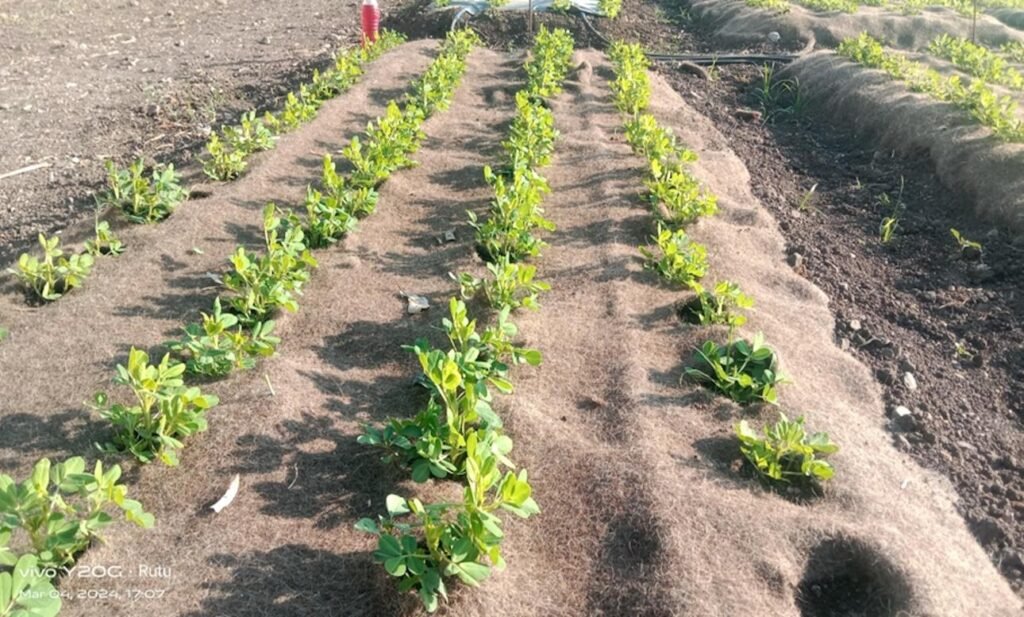
Fig. Ground Nuts Field images.
References:
- Patel, D. R., Patel, G. G., & Patel, J. C. (2018). Performance of groundnut varieties during summer season. Journal of Oilseeds Research, 35(1), 45–48.
- Mane, B. N., Mhaskar, N. V. and Patil, B. P. (2010). Studies on sowing time, variety and mulching on growth, yield attributes and yield of groundnut under lateritic soil of South Konkan coastal zone. Journal of Soils and Crops. 20(1): 69-76.
- Prem Ranjan, G. T. Patel, Manjeet Prem and K R Solanke, (2017) Organic Mulching – A Water Saving Technique to Increase the Production of Fruits and Vegetables, Current Agriculture Research Journal, ISSN: 2347-4688, Vol. 5, No. (3) , Pg. 371- 380.
- El-Beltagi, H.S.; Basit, A.; Mohamed, H.I.; Ali, I.; Ullah, S.; Kamel, E.A.R.; Shalaby, T.A.; Ramadan, K.M.A.; Alkhateeb, A.A.; Ghazzawy, H.S. (2022) Mulching as a Sustainable Water and Soil Saving Practice in Agriculture: A Review. Agronomy, 12, 1881.
- Henry Y. Sintim and Markus Flury, (2017) Is Biodegradable Plastic Mulch the Solution to Agriculture’s Plastic Problem? Environmental Science Technology, 51, 1068−1069.
- Mane, B. N., Mhaskar, N. V. and Patil, B. P. (2010). Studies on sowing time, variety and mulching on growth, yield attributes and yield of groundnut under lateritic soil of South Konkan coastal zone. Journal of Soils and Crops. 20(1): 69-76.
- Cao, X.; Li, L.; Zhang, F.; Zhang, F.; Song, X.; Zhao, W.; Dai, F. (2024), Green Development of Natural Fibre-Based Paper Mulch from Recyclable Cow Dung and Flax Straw Waste. Agronomy , 14, 290.
- Allafi, F., Hossain, M. S., Lalung, J., Shaah, M., Salehabadi, A., Ahmad, M. I., & Shadi, A. (2022). Advancements in Applications of Natural Wool Fiber: Review. Journal of Natural Fibers, 19(2), 497–512
- S.C. Sharma, A. Sahoo and Roop Chand, (2019), Potential use of waste wool in agriculture: an overview, Indian Journal of Small Ruminants, 25(1): 1-12.