
“Maharashtra has been the foremost leading state in terms of development, economic planning and attracting investments. With a forward-looking approach towards the development, Maharashtra is pioneering India’s developmental journey towards 5 trillion-dollar economy”, said Mr. Kaustubh Dhavase, Chief Advisor to the Chief Minister of Maharashtra at the Diplomatic Roundtable along with Ambassadors and Consul Generals of over 30 countries here at the 10th Global Economic Summit and WTCA Asia Pacific Conference which saw participation of more than 50 World Trade Centres across the Asia Pacific region, cementing the position of the state of Maharashtra as the region of convergence of ideas, investments, trade and progress.
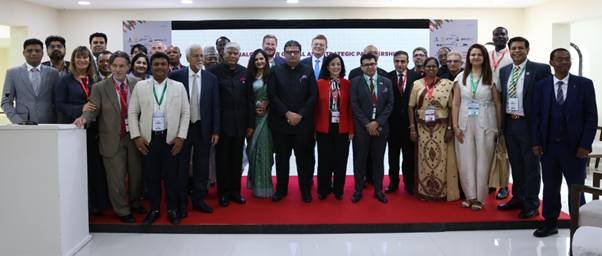
Mr. Kaustubh Dhavase, Chief Advisor to the Chief Minister of Maharashtra, along with Ambassadors, High Commissioners and Consul Generals at the Diplomatic Roundtable at the 10th Global Economic Summit
Mr Dhavase further stated that, “Barring Covid years, CAGR growth rate of the state has been in double digits, positioning the state as the engine of India’s growth over the past 12 years. This growth is powered by the exponential focus on creating infrastructure- social as well as physical, transforming the landscape of the state. We are creating a completely new ecosystem of development where infrastructure is the pillar. For example: the conception of a coastal road network by land reclamation, which will run parallel to our suburban railway network, which carries on an average of 9 million passengers daily, thereby boosting urban mobility”.
Speaking on the goal of Maharashtra to be a trillion-dollar economy, Mr Dhavase spoke on the consistent zeal of policymakers to carry out reforms to boost the economic productivity of the state. Outlining the forward-looking vision of the Chief Minister, he also spoke on the development of Navi Mumbai and further sub cities in it, like Edu City for foreign universities, Innovation and IT city for service sectors, a new Navi Mumbai airport to strengthen domestic as well as international connectivity and the Wadhawan port to boost sea trade.
Welcoming all the foreign ambassadors and consuls general, Mr Dhavase invited investments and business opportunities for the state of Maharashtra. The roundtable was attended by diplomats from Bangladesh, South Africa, Egypt, Thailand, Ghana, Ukraine, Argentina, Malaysia, Japan, Mali, UK, Vietnam, Yemen, Kuwait, Belarus, Ecuador, Czech Republic, Sri Lanka, Guyana, Tanzania and Uganda.
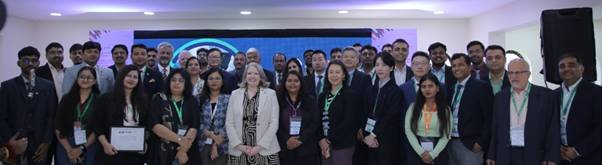
Representatives of World Trade Centres from the Asia Pacific Region at the inaugural session of the WTCA Asia Pacific Conference held on the sidelines of the 10th Global Economic Summit and 6th World Trade Expo
The WTCA Asia Pacific Conference was also organised, which brought together distinguished leaders from over 50 countries of the World Trade Centres Association network to share perspectives on how the WTC community continues to uplift regional economies, catalyse investment, enhance infrastructure, and strengthen connectivity-driven innovation.
The conference featured topic-specific panel discussions involving WTCs from across the region. Speaking on the role which WTCs play in facilitating trade and connectivity, Ms Crystal Edn, Executive Director, Member Services, World Trade Centre Association, gave her insights on how the whole WTC movement is helping countries and regions form trade partnerships, thereby facilitating dialogue with the active participation of the World Trade Centres. Mr Scott Wang, WTC Vice President, said that “The WTC community give a platform to its members to showcase the unique opportunities which lie in their respective states.” He further added that, “the objectives of holding events at World Trade Centre are never to make money but to uplift societies through trade promotion activities”.
Mr Vijay Kalantri, Chairman of World Trade Centre, Mumbai and Board Director, World Trade Centre Association at New York, welcomed the participation of World Trade Centres across the regions for the conference. Speaking on the occasion, Mr Kalantri said, “The whole WTCA movement has brought exponential benefits for global trade. WTC Mumbai is the first World Trade Centre from India and one of the pioneers of the movement, which strengthened the roots of World Trade Centres here in the region. India, being the largest growing economy, is proud to host this conference to strengthen dialogue and focused engagement. Mr Kalantri further said, “The Asia-Pacific region is particularly dynamic. The region accounts for nearly 40 percent of global merchandise trade, and by 2030, it is expected to contribute over 60 percent of global growth. Yet, this growth must translate into shared well-being. With a strong network of WTCs in the region, this region will sustain this growth and will help in bringing prosperity”.
The conference also saw the premier accreditation of WTC Kochi and the accreditation of WTC Goa, WTC Jaipur, and WTC Bhubaneshwar. Along with this, WTC Coimbatore, WTC Future City, WTC Hinjawadi, WTC Kozhikode, WTC Nashik, WTC Thane and WTC Nhava Sheva were added as new members in the community.
The discussions at the conference began with an engaging dialogue on how World Trade Centres play a transformative role in uplifting communities through exhibitions, events, and business engagement programmes. It highlighted the power of events to generate economic vibrancy, emphasising that events and exhibitions at WTCs are more than trade showcases; they are strategic platforms that empower SMEs and create opportunities to connect with global markets. Through sector-specific initiatives in healthcare, manufacturing, innovation, and services, WTCs across the Asia Pacific region continue to serve as important channels for knowledge exchange and business expansion. The speakers also noted that such events significantly contribute to employment, investment promotion, and the overall prosperity of local communities by connecting businesses with global stakeholders.
Building on this foundation of community impact, the discussions at the panel focused on the importance of purpose-driven WTC infrastructure in enabling sustained economic growth. It underscored how contemporary World Trade Centres have transformed into integrated trade ecosystems that combine intelligent real estate, sustainable design, innovation hubs, flexible workspaces, and logistics-linked facilities, sharing examples of successful WTC developments that serve as anchors for foreign investment, facilitate global trade, and position their respective regions as competitive international business destinations. The discussion reinforced the idea that WTC infrastructure is not merely about buildings; it is about designing environments that empower businesses, facilitate trade, and strengthen global competitiveness.
Further, the conference outlined the growing importance of digital platforms, cross-border business networks, advisory support, and B2B matchmaking in helping enterprises expand globally. It emphasised that WTCs act as connectors within the global innovation ecosystem, enabling SMEs and start-ups to access new markets, adopt emerging technologies, and collaborate internationally. The discussion also affirmed that connectivity, whether physical, digital, or institutional, is becoming the cornerstone of modern trade facilitation and a key driver of competitiveness for businesses across the region.