

Prof. Apurba Das,
Department of Textile and Fibre Engineering
IIT Delhi
Farmers need clothes that will keep them protected and comfortable when they work in their fields. These clothes should keep them protected from dangerous UV rays, different types of pesticides, dust, and bad weather. Farmers often wear clothes that are not perfect for their work, and sometimes they do not wear any clothes if they feel uncomfortable. Moisture control, along with ease in movement, thermophysiological comfort, and proper fit, is important in protective clothing, as demonstrated by this study. It is important to select appropriate materials and consider the effect of heat and moisture on the human body. Moisture management and moisture vapour transmission through the fabric are also important. For the development of protective clothing for the agricultural worker, it is important to consider the comfort with the protection.
2. The Concept of Comfort in Agricultural Protective Clothing
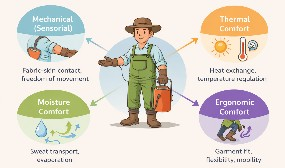
Comfort in clothing is a phenomenon that includes:
- Sensorial or low-stress mechanical comfort pertains to the tactile sensation of the fabric against the skin during movement.
- Thermal comfort has to do with managing body temperature and exchanging heat.
- Moisture comfort has to do with how perspiration moves and evaporates.
- Ergonomic comfort means that fitness, flexibility, and range of movement are all good.
To create agricultural protective textiles that can be worn for an extended period in real-world conditions, all these elements must be maximised simultaneously.
3. Comfort in Protective Fabrics for Farmers
3.1 Important Comfort Features:
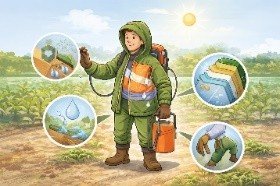
Protective clothing for farm workers must protect them from pesticides, dust, UV radiation, and the weather while also being breathable, light, and easy to move in. Breathable linings, such as the cotton hosiery used in waterproof coats, help sweat absorb and evaporate, which prevents overheating while using pesticides or threshing. A multi-layer clothing system, featuring a wind-resistant outer layer, a moisture-permeable middle layer, and an evaporative inner layer, makes it easier to adjust to varying temperatures. Design features like elasticised cuffs, adjustable hoods, and fits that do not limit movement make sure that the seal is tight while still allowing for movement.
3.2 Materials That Make Things More Comfortable:
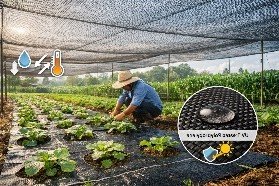
Lightweight polypropylene and polyethene textiles are strong, resistant to chemicals, and protect against UV rays. They also allow air flow, which reduces the risk of mildew in humid agricultural environments. Knitted terry or pile fabrics used in the inner layers help sweat evaporate and keep skin dry. Agro-textiles, such as ground covers and shade nets, utilise woven polypropylene fabrics treated with UV chemicals to create a more comfortable environment for farmers by stabilising microclimates.
3.3 Uses in Real Life:
Hooded jackets and cotton-lined inner clothes give pesticide applicators the best balance of safety and comfort. Aprons and full-sleeve clothing worn during threshing often have beak masks to keep dust out while yet letting air in. Agro-textiles, such as shade nets and ground covers, make labour more comfortable by lowering the amount of heat in the workplace.
4. Comfort and Safety
Farmers typically must choose between clothes that are comfortable and clothes that offer a lot of protection. Full-coverage protective suits do a good job of keeping pesticides out, but they often trap heat and moisture, which makes people uncomfortable and less productive. On the other hand, lightweight and breathable clothing makes one more comfortable, but it also increases exposure to chemicals and UV rays.
4.1 Main Trade-offs:
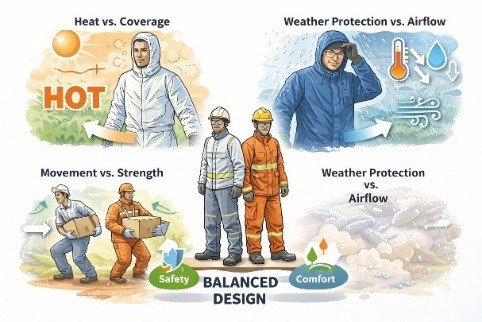
- Heat vs. Coverage: Full-body suits protect well but often make the body feel too hot, especially in humid weather.
- Movement vs. Strength: Light fabrics help people move easily, but stronger fabrics protect better and reduce movement.
- Weather Protection vs. Airflow: Clothes that block wind and rain usually reduce airflow, causing heat and sweat to build up.
- Balanced Design: Good protective clothing must balance safety, strength, and comfort so it can be worn easily during real work.
4.2 Ways to Lessen the Damage:
Layered clothing systems enable farmers to adjust their protection according to the job and weather conditions. Modern fabrics that combine breathability, UV protection, and targeted reinforcement eliminate trade-offs. Ergonomic clothing design, regular breaks, staying hydrated, and special protective layers can help ease discomfort while keeping safe.
5. Comfort in Agricultural Protective Clothing
5.1 Airflow and Ability to Let Air Through:
Air permeability allows air to flow more easily and prevents heat from accumulating, while water vapour transfer hinders sweat from remaining on the skin. Fabrics that do not let air through well feel wet when they get wet and may not protect against UV rays as well.
5.2 Material Properties:
Light, thin, and pale garments reflect more sunlight than heavy, dark fabrics. Cotton is very breathable, but it does not last long. On the other hand, polyester and polypropylene last longer and help maintain stable moisture levels. Stretch parts make it easier to move around, but they may not provide as adequate protection against UV rays if the fabric cover factor is lower.
5.3 Size, Weight, and Thermal Factors:
The best fit for clothes keeps them from rubbing against skin and adding extra weight, which lowers metabolic energy expenditure. Denser fabrics provide more protection but also make things hotter. Denser and thicker weaves exclude UV rays and dust, but they also slow down airflow; therefore, they need to be optimised.
6. Mechanical Feelings That Come with Clothing
6.1 Mechanical Stimuli and Skin Perception:
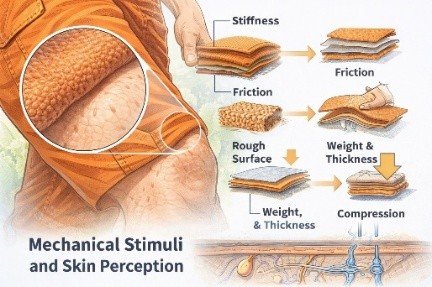
When moving, the fabric and skin touch each other, which creates mechanical sensations. The stiffness, surface roughness, friction, thickness, weight, and ability to compress of the fabric all have an effect on these feelings.
6.2 Types of Mechanical Sensory Perceptions:
Mechanical sensory sensations include:
- Pain from wearing something while exercising because it is stiff and heavy
- Itchy, prickly, and rash-like feelings caused by rough fibres and stiff finishes
- Pain from touch and pressure due to a tight fit or stiff layers
- Roughness and abrasiveness are associated with high surface friction.
This pain is worse in protective farming clothes made of coated or laminated textiles.
7. Comfort and Thermoreceptors
The human integumentary system consists of four types of thermally sensitive nerve endings: cold receptors, warm receptors, cold pain receptors, and hot pain receptors. These sensors can measure the absolute temperature and track its changes at the skin’s surface. Protective clothing alters how heat is transferred between the body and the environment. Too much insulation or not enough airflow can overstimulate thermal sensors, which can cause overheating and heat stress. Different parts of the body have different levels of thermal sensitivity, which can cause localised discomfort even when the average skin temperature seems acceptable.
8. Heat and Moisture Transfer
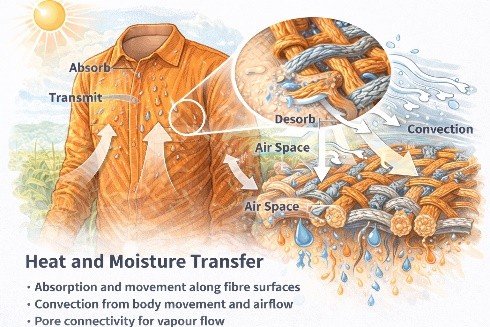
Sweat evaporation is the primary method by which farmers cool off while working. Textiles allow moisture vapour to pass through them by diffusing via the air spaces between the threads.
- Fibres’ ability to absorb, transmit, and desorb
- Adsorption and movement along the surfaces of fibres.
- Convection that happens because of body movement and air flow
Fabrics with more holes, connected pores, and poor moisture retention allow vapours to move more easily and keep warm.
9. Objective Evaluations for Comfort
9.1 Low Stress Mechanical Comfort:
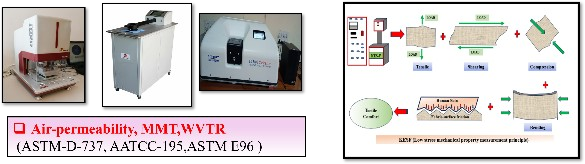
The Kawabata Evaluation System (KES) measures low-stress mechanical factors that affect comfort. The low-stress mechanical properties, like tensile, bending, shear stiffness, and surface frictional properties, are important to get a proper idea about fabric comfort. Good mobility and comfort can be achieved by lower bending and shear stiffness levels of clothing.
The Fabric Assurance by Simple Testing (FAST) system is easy to use, allowing you to check thickness, compression, bending length, extension, and dimensional stability. This makes it ideal for quality control and garment production.
9.2 Checking for Thermal and Moisture Comfort
ISO 11092 (Sweating Guarded Hot Plate) is the standard way to check for thermophysiological comfort. It measures-
- Thermal Resistance (Rct) – how well it stops dry heat from moving.
- Evaporative Resistance (Ret) is the Resistance to the transfer of moisture vapour.
(Lower Rct and Ret values indicate better cooling and sweat evaporation, which are crucial for protective clothing used in hot farming environments)
10. Test Parameters to Farmers’ Comfort Concerns
Important Metric Evaluation Method
- Limited movement, stiffness in bending and shear, KES / RAPID
- Pain and annoyance KES for Surface Friction
- Discomfort from pressure KES of Compressional Energy
- Stress from Resistance to heat, ISO 11092
- Discomfort from sweating and evaporative Resistance
11. Standards and Certifications for Agricultural Fabrics That Protect Crops
Agro-textiles are safe, high-quality, and effective due to their adherence to standards and certifications. The Agro Textiles Quality Control Order says that crop covers, bug nets, ground covers, mulch mats, and other related items must be certified by the Bureau of Indian Standards (BIS). AATCC 183 examines UV protection, while EN 13034 and ASTM F739 assess the ability of chemicals to permeate materials. Following the rules gives farmers more confidence and makes it easier for them to export.
12. Conclusions
Farmers need protective textiles that are comfortable in terms of their feel, functionality, moisture retention, and fit. Farmers may safely and continuously use protective clothing if one takes utmost care in understanding how sensory responses work, how thermoreceptors work, and how heat and moisture move from one place to another. This is made easier by using standardised tests like KES, FAST, and ISO 11092. Prioritising comfort as a fundamental performance standard ensures better compliance, higher productivity, and enhanced protection in agricultural contexts.