
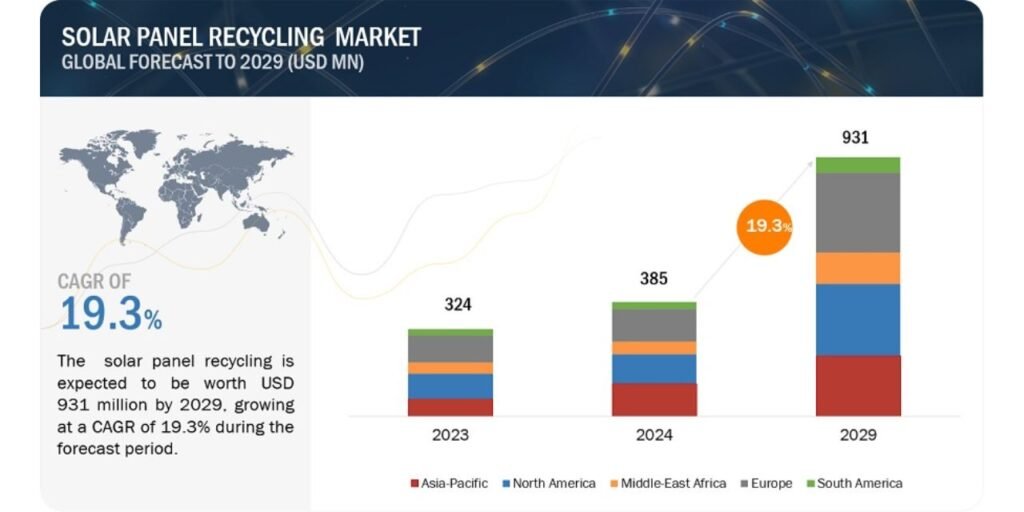
The report “Solar Panel Recycling Market by Type (Monocrystalline, Polycrystalline, Thin Film), Process (Thermal, Chemical, Mechanical, Laser, Combination), Shelf Life (Early Loss, Normal Loss), Material (Metal, Glass, Plastic, Silicone) – Global Forecast to 2029″, is projected to reach USD 931 million by 2029, at a CAGR of 19.3% from USD 385 million in 2024. The solar panel recycling market is poised for substantial growth in the foreseeable future, driven by a convergence of factors that underscore its critical importance in the transition to a more sustainable energy landscape. Central to this growth is the exponential increase in solar panel installations worldwide, fueled by the imperative to mitigate climate change and reduce dependence on fossil fuels. As solar energy becomes an increasingly integral component of the global energy mix, the volume of end-of-life solar panels reaching their operational lifespan is expected to surge, creating a pressing need for efficient recycling solutions.
Browse
- 229 Market data Tables
- 45 Figures
- 242 Pages and in-depth TOC on “Solar Panel Recycling Market – Global Forecast to 2029″
Some of the prominent key players are:
· First Solar (US)
· Reiling GmbH & Co.KG (Germany)
· The Retrofit Companies, Inc. (US)
· Rinovasol Global Services B. V. (Netherlands)
· We Recycle Solar (US)
· ROSI (France)
· SILCONTEL LTD (Israel)
· Etavolt Pte. Ltd. (Singapore)
· PV Industries Pty Ltd (Australia)
· Solarcycle, Inc. (US)
Driver: the demand for recovery and reuse of materials from the solar panel recycling
The burgeoning demand for the solar panel recycling market is primarily driven by the substantial increase in solar panel waste anticipated as the first generations of photovoltaic (PV) installations approach the end of their operational life, typically around 25 to 30 years. Since the early 2000s, there has been a significant global surge in solar installations, fueled by the push for renewable energy sources to combat climate change. Consequently, as these early installations begin to age out, the volume of decommissioned solar panels is set to rise dramatically, creating an urgent need for effective recycling solutions. This situation is further exacerbated by the inherent material composition of solar panels, which includes valuable but hazardous materials such as silicon, silver, and lead. The recycling of these materials is not only economically beneficial—recovering precious metals and high-quality silicon—but it is also critical for environmental protection, as improper disposal can lead to toxic chemical leaching and other forms of environmental degradation.
Moreover, the regulatory landscape is increasingly favoring the recycling industry. Governments around the world are implementing stricter waste management regulations and setting ambitious sustainability targets, which include mandates for the recycling of renewable energy installations. This regulatory framework compels manufacturers and installers to consider the end-of-life phase of solar panels more seriously, thereby bolstering the market for solar panel recycling. For instance, the European Union’s Waste Electrical and Electronic Equipment Directive (WEEE Directive) requires the collection and recycling of e-waste, which includes used solar panels.
“Metals accounted for the largest by material share of the solar panel recycling market in 2024” in terms of value.
Metals, especially aluminum, are prominently recovered from solar panel recycling, constituting a significant segment of the market due to various pivotal factors. Aluminum, widely used in the frames of solar panels for its excellent strength-to-weight ratio, corrosion resistance, and durability, is prevalent in solar panel construction. This prevalence ensures that a large volume of aluminum is available for recovery when panels are decommissioned. Recycling metals like aluminum from solar panels is relatively straightforward compared to other materials such as silicon or glass. Processes like shredding, magnetic separation, and other sorting technologies efficiently separate and purify these metals, making the recycling process economically viable and technically feasible.
The economic incentives for recycling metals are robust. Metals retain high resale values, and materials like aluminum and copper are in demand across various industries, including automotive, construction, and electronics. This broad market applicability enhances the economic attractiveness of metal recovery, driving investments and technological advancements in this recycling sector. Additionally, the environmental benefits of metal recycling are substantial. For instance, producing aluminum from recycled materials consumes about 95% less energy than manufacturing it from raw bauxite, which not only saves energy but also significantly reduces greenhouse gas emissions. This efficiency supports the sustainability goals of the renewable energy sector by conserving natural resources and minimizing environmental footprints.
“Europe is the largest market for solar panel recycling Market in 2024, in terms of value.”
Europe stands as the largest market for solar panel recycling, a status driven by a combination of advanced environmental regulations, high adoption rates of solar energy, and a proactive approach to the circular economy. The European Union has been a pioneer in implementing stringent environmental policies which mandate the responsible disposal and recycling of electronic waste, including solar panels. Legislation such as the Waste Electrical and Electronic Equipment Directive (WEEE Directive) requires the collection and recycling of electronic items, setting high recovery targets that foster a robust recycling infrastructure across member states. Furthermore, Europe’s commitment to sustainability and renewable energy has led to widespread installation of solar panels over the past few decades. As these installations age and reach the end of their operational life, the volume of solar panels needing disposal has surged, creating a significant demand for recycling services. This demand is well-supported by the continent’s advanced recycling technology and facilities, which are capable of efficiently processing large quantities of solar waste. Additionally, Europe’s focus on the circular economy — an economic system aimed at minimizing waste and making the most of resources — further reinforces its leadership in solar panel recycling. The European Commission has actively promoted circular economy principles, which encourage not just recycling but also the reuse of materials to reduce the environmental impact of raw material extraction and waste. This holistic approach enhances the viability and necessity of solar panel recycling within the European market.
Download PDF for Top Related Reports of Advanced Materials Industry:
· Satellite Solar Cell Materials Market