

Dr Dinesh Bhatia
Assistant Professor, Textile Engineering,
Jawahar Lal Nehru Government Engineering College, Sundernagar

Dr Ankush Sharma
Assistant Professor, Textile Engineering,
Jawahar Lal Nehru Government Engineering College, Sundernagar
Summary
Mulching is a useful agricultural technique for controlling soil parameters and enhancing crop health. Conventional organic materials such as wood chips, straw and compost are effective tools in farming, but nowadays modern farming frequently uses synthetic agro-textiles and plastic mulch films. These films, usually composed of materials such as polyethylene (PE), polypropylene (PP), or polyvinyl chloride (PVC), offer benefits like reduced pesticide use and consistent crop yield by controlling soil temperature, retaining moisture and suppressing weeds. These conventional mulches perform well in terms of performance but create pollution in the environment. At the end of the season, conventional mulch needs to be removed with personnel and equipment, followed by expenses for transportation, disposal, or recycling. High levels of soil and plant debris contamination make recycling difficult. These extra steps represent significant expenses in terms of time and money, which many farmers previously underestimated or ignored. Biodegradable mulch (BDM) films have the potential to ameliorate the problem of residue accumulation of PE plastic film in soil. However, some of the major obstacles preventing BDMs from being widely accepted include their high cost, poor customer dependability, and lack of aesthetic appeal in the industry.
Recycling synthetic PE films can also be important and provide a way to reduce a number of associated risks, however achieving the intended outcomes requires significant financial outlay. Another issue with limited recycling is the unacceptability of the used plastic film mulch (PFM) because of the attachment of chemicals and dirt. This article presents a number of possibilities that discuss the underlying process of biodegradation and aid in the development of affordable BDMs as a full substitute for the widespread usage of PE film in current production systems.
Economic and Environmental Implications of Conventional Mulches
Conventional plastic mulches are primarily composed of non-biodegradable polyethylene (PE) and have provided contemporary agriculture with enormous short-term economic benefits through better weed control, soil moisture conservation, soil temperature regulation, and, eventually, increased crop yield and quality. Due to their cost-effectiveness and agronomic efficiency, these mulches have been widely used since the 1950s, which has led to a fast-expanding agricultural film business worth billions of dollars worldwide. However, significant end-of-life care expenses outweigh these financial benefits. The primary challenge of these mulch is the high level of contamination (30-80% by weight) from soil, plant debris and agrochemical residues, which increases weight, transportation costs, landfill tipping fees and restricts recycling potential. The ongoing use of traditional plastic mulches has significant sustainability issues from an environmental concern. The breakdown of polyethylene mulches can take several hundred years, during which time they break down into microplastics that build up in soil and potentially enter food chains. Common disposal methods like open field burning or burial are illegal in many places due to environmental and health risks from toxic emissions and microplastic accumulation. Polyethylene mulch, while effective in agriculture, poses significant environmental risks due to the accumulation of plastic residues in the soil. Extended use can result in as much as 411 kg of plastic residue per hectare, leading to concentrations of up to 3.7 million microplastic particles per kilogram of soil. These residues are not inert and have been shown to disrupt soil biological activity, alter soil structure, and decrease water infiltration, causing long-term environmental damage.
Material Systems, Formats, and Commercial Options
Mulching materials are categorised into four primary groups, each presenting specific characteristics of performance and disposal methods: conventional polymers, oxo-degradable plastics, biodegradable mulches and bio-based textiles. The various materials used in mulches, along with functional strength and end-of-life pathways is presented in Table1.
Table 1. Mulch material families, functional strengths, and end-of-life pathways.
| Parameter | Conventional Polymers | Oxo-degradables | Biodegradable Mulches (BDMs) | Bio-based Textiles |
| Representative materials | LDPE, LLDPE, PP | PE/PP with pro-oxidant additives | PBAT/PLA, starch/PBAT, PHA | Paper, wool, jute, hemp, PLA/PHA nonwovens |
| Formats | Films, wovens | Films | Films, nonwovens | Nonwovens, mats |
| Primary strength | Low cost; high strength; strong soil warming | Rapid fragmentation | Comparable agronomic performance; no removal | Air- and water-permeable; soil-enriching |
| Primary weakness | Persistent microplastics; removal required | No true biodegradation; microplastic formation | Higher upfront cost; weather-dependent degradation | Lower soil warming; variable durability |
| End-of-life | Removal, landfill or incineration | Excluded by EN 17033 | Tilled into soil; microbial mineralisation | Soil biodegradation; organic matter input |
Commercial biodegradable mulches (BDMs) offer an eco-friendly alternative to traditional plastic, such as Polybutylene Adipate Terephthalate (PBAT) based blends that have been approved for soil biodegradability under standards like EN 17033 used in Mater-Bi (Novamont) and Ecovio (BASF). To lower processing obstacles, Polylactic Acid (PLA) blend is used in Bio-Flex (FKuR) for easy use with existing polyethylene extrusion lines. PLA Resins are typically blended with other polymers because it degrades slowly on its own in soil used in Ingeo (NatureWorks). The composition of various biodegradable mulches, along with durability range and key certifications are described in Table 2.
Table 2. Representative biodegradable mulch products and performance characteristics.
| Product | Composition | Key certifications | Durability Range | Notes |
| Mater-Bi (Novamont) | Starch + PBAT (± PCL) | EN 17033; OK Biodegradable Soil; EN 13432 | 2–6 months (15 µm); 9–12 months (18–20 µm) | Compatible with PE lines; reported net margins ~30% in Spain |
| Ecovio M2351 (BASF) | PBAT + PLA + fillers | EN 17033; OK Biodegradable Soil; EN 13432 | Down-gauged to 8 µm | Good processability; reported cost ~€505/ha |
| Bio-Flex FX 1135 (FKuR) | PLA blends (~10% biobased carbon) | EN ISO 17556; EN 13432 | Season-long | Drop-in replacement for PE |
| Ingeo PLA (NatureWorks) | PLA resin (used in blends) | EN 13432 | Slow soil degradation | Common blend component; C:N balance required |
Degradation Behaviour, Soil Interaction, and Mechanical Performance
The degradation behaviour mechanism and factors influencing the degradation of conventional and bio-based mulches are explained in Figure 1.
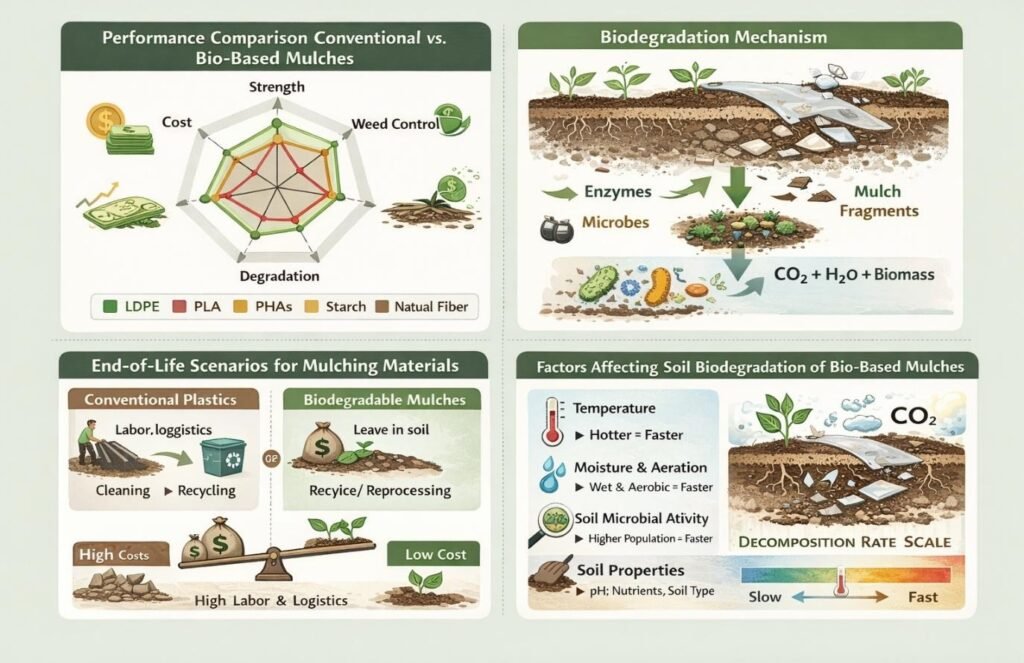
Figure 1: Comparative performance of conventional and bio-based mulches, their soil biodegradation mechanisms, end-of-life management pathways, and key environmental factors influencing degradation.
The soil degradation mechanism and performance comparison of bio-based mulches like starch, natural fibers, PLA and PHAs explained in the figure show better degradation behavior with some trade-offs in price, durability and performance during use in comparison to conventional polyethylene mulches (like LDPE), which offer better durability, higher strength, and weed control at a lower price with the issue of degradability. The biodegradation mechanism panel explains how bio-based mulches fragment in soil and are subsequently broken down by enzymes and microorganisms into carbon dioxide, water and biomass, integrating into natural biogeochemical cycles.
Application-Oriented Selection and Portfolio Approach
Material selection is increasingly focused on crop duration, climate, and management priorities rather than just productivity because yield differences amongst mulch systems are typically negligible. When the greatest amount of soil warming is needed, polyethylene is still useful, especially for early-season crops in cold areas. Nonwoven technologies offer superior permeability and heat stress mitigation, whereas biodegradable films offer comparable agronomic performance with less end-of-life load.
Agronomic and economic risk can be decreased by using a portfolio approach. Polyethylene or thicker, dark biodegradable sheets are beneficial for early-season tomatoes in chilly areas. Permeable PBAT-PLA films or nonwovens that reduce root-zone heat stress are superior for peppers produced in hot, dry climates. Paper or quickly deteriorating nonwovens go well with short-season leafy greens. Heavy spun-bond PLA or natural fibre mats that maintain long-term soil health and offer multi-season weed control are beneficial for organic orchards and perennial systems.