
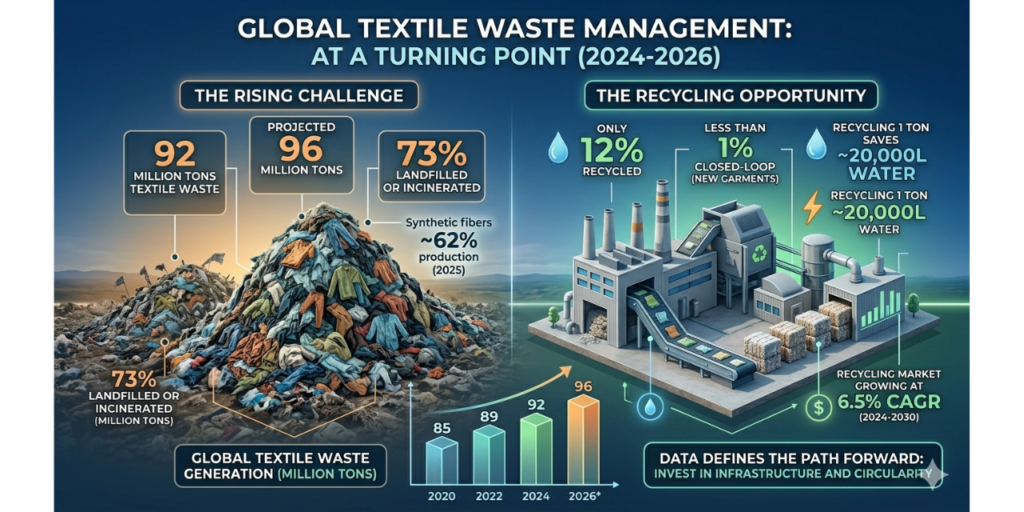
The global textile industry is facing a critical turning point as rising consumption, fast fashion cycles, and inadequate recycling systems continue to drive waste generation. According to Dataintelo, textile waste has reached alarming levels, making it not only an environmental issue but also a significant economic and operational challenge. With 92 million tons of waste generated annually and projections reaching 96 million tons by 2026, the scale of the issue highlights an urgent need for transformation.
Currently, around 73% of textile waste is either landfilled or incinerated, while only 12% is recycled—and less than 1% is reused in new garments. The industry is also responsible for nearly 10% of global carbon emissions, with synthetic fibers accounting for a majority share of production. However, recycling offers substantial benefits, including saving up to 20,000 liters of water per ton.
Rising Waste Volumes
Textile waste has steadily increased from 85 million tons in 2020 to 92 million tons in 2024, with projections indicating continued growth. Developed countries generate significantly higher waste per capita compared to emerging markets, reflecting consumption patterns and disposal behaviors.
Key Drivers of Growth
Several factors are contributing to the rise in textile waste. The expansion of fast fashion has led to increased production and reduced garment usage. Recycling systems remain inefficient, with minimal closed-loop recycling. The dominance of synthetic fibers, which take decades to decompose, further exacerbates the issue. Additionally, most consumers discard textiles rather than reuse them, and many regions lack adequate recycling infrastructure.
Environmental Impact
The environmental consequences are substantial. Textile production generates around 1.2 billion tons of CO2 annually and consumes vast amounts of water. Dyeing processes alone contribute significantly to industrial water pollution. Textile waste also occupies landfill space and releases methane, a potent greenhouse gas. Furthermore, textiles are a major source of microplastic pollution in oceans.
Waste Management Solutions
Various methods are being adopted to address textile waste. Recycling can significantly reduce energy consumption and emissions, while reuse and resale extend garment life and lower environmental impact. Mechanical recycling offers moderate recovery rates, while chemical recycling provides higher efficiency but at greater cost. Waste-to-energy solutions are also being explored to convert textile waste into usable energy.
Cost Analysis
Although landfill disposal remains the cheapest option, it has the highest environmental cost. Recycling methods require higher upfront investment but offer long-term economic and environmental benefits, reducing lifecycle costs and regulatory risks.
Market Trends and Growth Outlook
The textile waste management market is expanding steadily, expected to grow from USD 7.5 billion in 2024 to USD 11.2 billion by 2030 at a CAGR of 6.5%. Asia-Pacific leads growth, followed by Europe and North America, with increasing regulatory targets aimed at improving recycling rates.
Impact of Recycling Initiatives
Case studies show measurable improvements through structured recycling programs, including increased collection rates, reduced landfill dependency, cost savings, and lower emissions. Corporate initiatives are also contributing to waste reduction and sustainability goals.
Benefits of Effective Waste Management
Proper textile waste management can significantly reduce landfill use, conserve water and energy, lower emissions, generate revenue, and create employment opportunities across the value chain.
Challenges
Despite progress, challenges remain, including high sorting costs, difficulty in recycling blended fabrics, low collection efficiency, and limited consumer awareness.
Future Outlook
Looking ahead, textile waste is expected to exceed 110 million tons by 2030. However, advancements such as AI-driven sorting technologies and circular economy models could improve recycling efficiency and reduce overall waste generation. Increasing recycling rates and extending product lifecycles will play a crucial role in mitigating environmental impact.
Conclusion
The data clearly underscores both the scale of the textile waste problem and the potential solutions. By investing in recycling infrastructure, adopting circular practices, and improving consumer awareness, the industry can significantly reduce waste and move toward a more sustainable future.
Read A Full Report: https://dataintelo.com/report/textile-waste-management-market