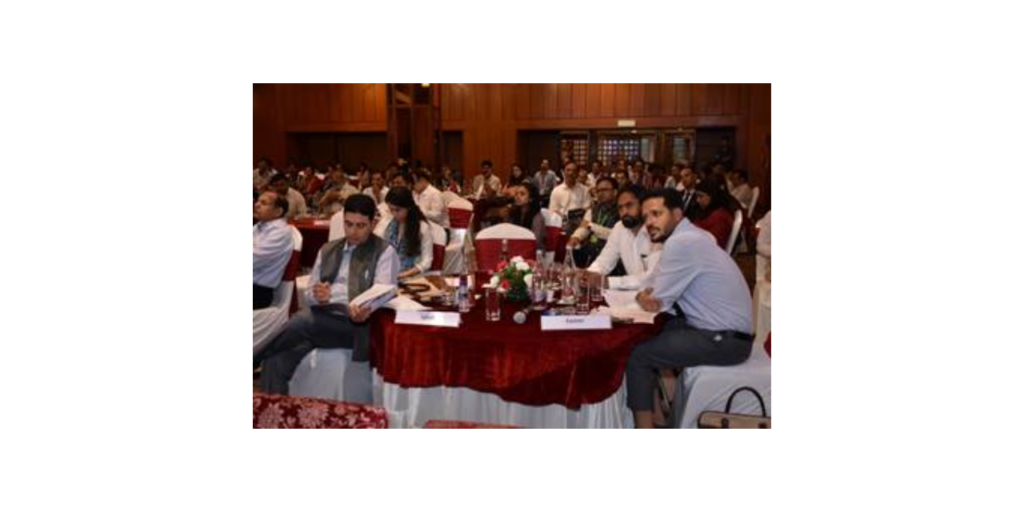
The Ministry of Textiles conducted a Northern Zone Stakeholder Consultation on the Union Budget 2026–27 in New Delhi on April 07, 2026. The meeting brought together over 200 participants from government, industry, academia and the textile sector. It focused on discussions related to schemes and initiatives announced in the Union Budget.
The Ministry of Textiles organised a Northern Zone Stakeholder Consultation on the Union Budget 2026–27 in New Delhi on April 07, 2026. The consultation was attended by more than 200 stakeholders, including representatives from State Governments, industry bodies, entrepreneurs, academia, textile research associations, Export Promotion Councils, as well as award-winning weavers and artisans.
The consultation is part of the Ministry’s ongoing process to deliberate on major schemes and initiatives outlined in the Union Budget 2026–27. It aimed to facilitate structured discussions on implementation approaches, identify operational challenges and develop a coordinated roadmap for the effective and timely execution of proposed measures.
To enable focused discussions, the consultation was organised into breakout sessions covering key priority areas. These included the Integrated Programme for the Textile Sector, incorporating the Textile Expansion and Employment (TEEM) Scheme, Tex-Eco Initiative and Mega Textile Parks; the National Fibre Mission; SAMARTH 2.0; and the National Handloom and Handicraft Programme (NHHP) along with the Mahatma Gandhi Gram Swaraj Initiative (MGGSI).
Setting the context, Shri Asit Gopal, Special Secretary and Financial Adviser, Ministry of Textiles, highlighted the importance of continuous engagement with States and stakeholders to ensure that the proposed schemes address field-level realities and implementation challenges. He noted that collaborative planning and convergence across institutions will be critical for achieving the intended outcomes of the Budget initiatives.
The consultation aligns with the Hon’ble Prime Minister’s vision shared during the Post-Budget Webinar, where he described the Union Budget as a strong framework for accelerating India’s journey towards “Viksit Bharat.” He emphasised the need to “Build More, Produce More, Connect More and Export More,” underscoring the importance of strengthening domestic production while expanding India’s presence in global markets.
Dr. M. Beena, Development Commissioner (Handlooms), urged stakeholders to actively share field-level challenges and practical solutions across different components of the proposed schemes. She noted that such consultations play a role in aligning policy objectives with implementation at the ground level and in strengthening the resilience and sustainability of the handloom sector.
Smt. Amrit Raj, Development Commissioner (Handicrafts), highlighted the Hon’ble Prime Minister’s vision of taking “gaon to global,” with a focus on quality across the value chain. She underlined the need to improve quality in production processes, product design, finishing, as well as supply chains and logistics to enhance global competitiveness.
In her concluding address, Smt. Neelam Shami Rao, Secretary, Ministry of Textiles, stated that India’s textile industry is expected to grow to USD 350 billion by 2030, with exports projected to expand significantly. She emphasised the importance of promoting innovation, strengthening convergence across schemes and developing an ecosystem that improves cost competitiveness and supports sustainable growth.
She also noted that the proposed schemes aim to support manufacturing, generate employment and enhance export competitiveness. She stressed the need to encourage innovation across value chains, position “India Handmade” in global markets and advance the creative economy.
Further, she highlighted the importance of maintaining credibility in Indian textiles through a focus on quality, sustainability and innovation. She added that inputs received during the consultation would be reviewed and considered in the design and implementation of upcoming schemes.
The consultation concluded with stakeholders expressing a commitment to collaborative efforts to strengthen the textile sector, improve livelihoods, generate employment and position “India Handmade” in global markets.