
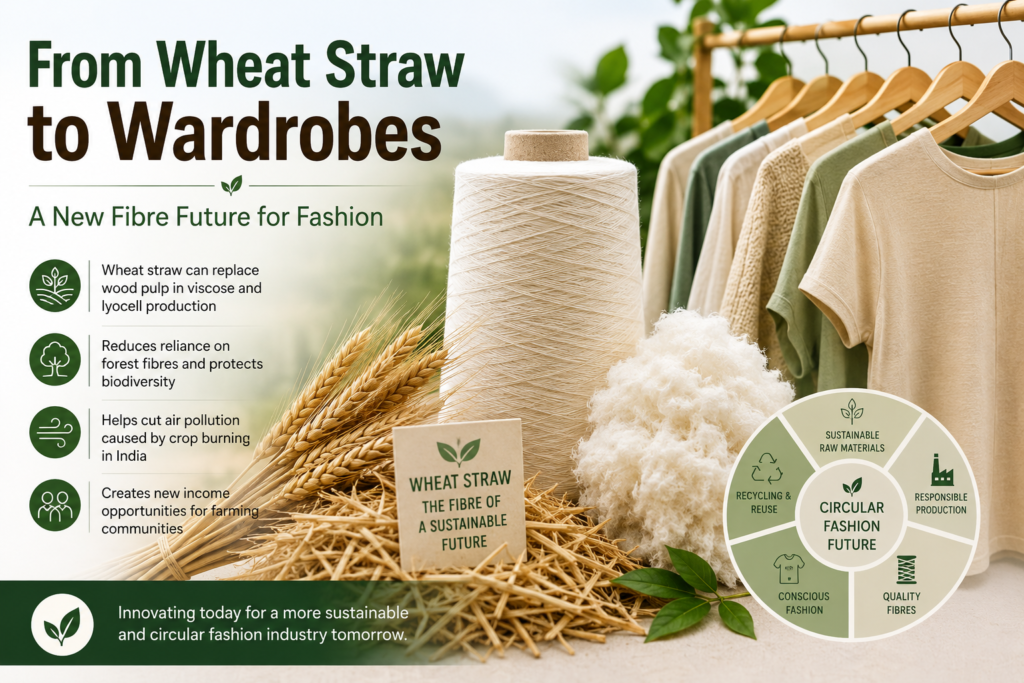
A new report released by Canopy highlights the growing potential of wheat straw as a sustainable alternative raw material for the fashion industry, demonstrating how agricultural waste can be transformed into high-quality viscose and lyocell fibres suitable for commercial apparel production.
The report, titled From Wheat Straw to Wardrobes: Fashioning a New Fibre Future, presents findings from Project Latvus, a pilot initiative testing whether pulp derived from Indian wheat straw could replace conventional wood pulp used in the production of man-made cellulosic fibres (MMCFs).
According to the report, wheat straw pulp successfully produced viscose and lyocell fibres that met technical, durability and performance standards required by global fashion brands. The project demonstrated that agricultural waste can directly substitute wood-based pulp while maintaining the quality, appearance and feel expected in commercial textile applications.
Reducing Dependence on Forest Fibres
Wood-derived pulp is widely used in MMCFs such as viscose and lyocell, which are often considered lower-impact alternatives to synthetic fibres like polyester. However, the report noted that more than 300 million trees are cut down globally each year to produce these fibres, including trees sourced from biodiversity-rich and climate-critical forests.
Canopy emphasized that shifting toward alternative feedstocks such as wheat straw could help reduce pressure on forests while supporting global biodiversity and carbon reduction goals.
Project Latvus Brings Together Global Fashion Players
Project Latvus brought together multiple stakeholders across the fashion supply chain, including Fashion for Good, H&M Group, C&A and Reformation, along with manufacturing and technology partners including Chempolis, TITK, Inovafil, Yee Chain, Shahi, Filpucci, Textile Genesis and A2P Energy.
The initiative aimed to connect every stage of production — from agricultural sourcing to fibre manufacturing and garment production — to identify barriers and accelerate commercial adoption of next-generation fibres.
Representatives from participating brands reported that the wheat straw-based fibres closely matched the look and feel of conventional lyocell while meeting performance expectations across multiple applications.
India Positioned as a Key Opportunity
The report highlights India’s significant opportunity to become a global leader in next-generation MMCF production due to its large agricultural residue supply and growing textile manufacturing ecosystem.
According to estimates cited in the report, more than 90 million tonnes of crop residue are burned annually in India, contributing to severe seasonal air pollution in northern regions. Redirecting agricultural waste toward fibre production could help reduce crop burning, lower PM2.5 pollution levels, and create additional income opportunities for rural farming communities.
Canopy also noted that scaling agricultural waste-based fibres could strengthen India’s circular textile economy while improving supply chain resilience.
Fashion Industry Encouraged to Support Scale-Up
Canopy is urging global fashion brands to support the commercial scale-up of MMCFs made from non-wood feedstocks. The organization believes pooled industry demand will help these materials achieve price parity faster and accelerate investment in large-scale production infrastructure.
Nicole Rycroft, Founder and Executive Director of Canopy, said the project demonstrates that the future of sustainable fibres is already emerging. She noted that diversifying raw material sources beyond forests offers a major opportunity to build a more resilient, circular and low-impact textile industry.
The report suggests that next-generation MMCFs could play an increasingly important role in helping the global fashion sector reduce environmental impact while supporting sustainable manufacturing innovation.