
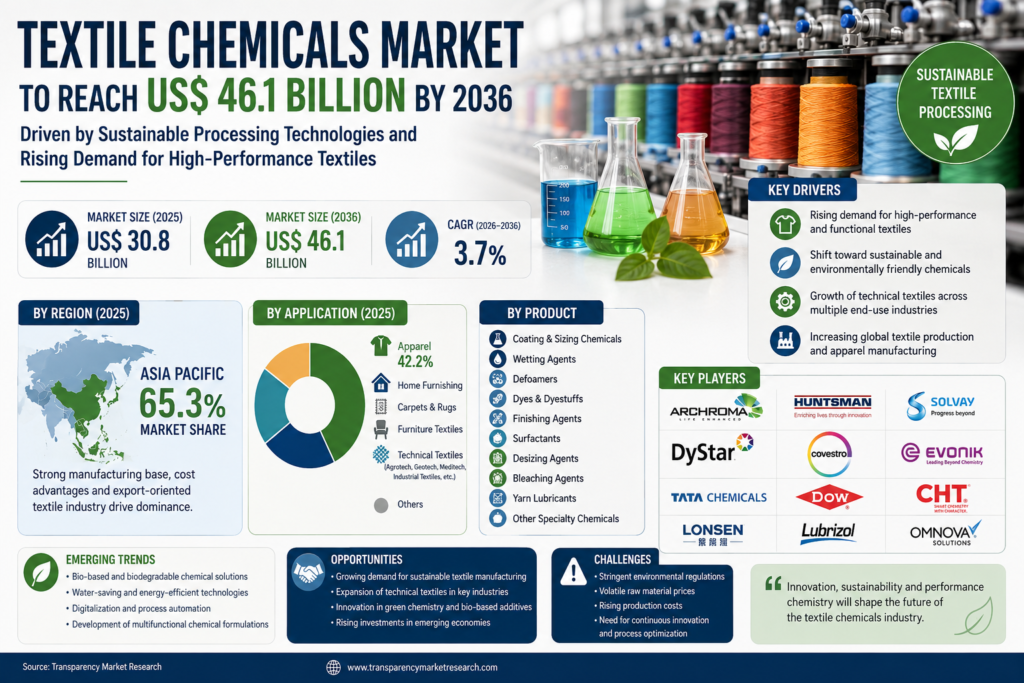
The global textile chemicals market is projected to reach US$46.1 billion by 2036, rising from US$30.8 billion in 2025, according to a latest market report by Transparency Market Research (TMR). The market is expected to expand at a compound annual growth rate (CAGR) of 3.7% from 2026 to 2036, driven by the growing adoption of sustainable textile processing technologies, rising demand for high-performance fabrics, and the expansion of technical textiles across industries.
Textile chemicals play a crucial role in modern textile manufacturing, supporting key processes such as pre-treatment, dyeing, printing, coating, and finishing. These chemicals help improve the quality, durability, softness, appearance, and performance of fabrics while enabling manufacturers to meet changing consumer and industrial expectations.
Sustainability and performance shaping market growth
The report highlights that the textile chemicals sector is undergoing a structural transformation as manufacturers move toward bio-based, biodegradable, low-toxicity, and water-saving formulations. Governments around the world are tightening regulations on wastewater discharge, hazardous substances, and carbon emissions, prompting textile mills and brands to adopt cleaner chemical solutions.
At the same time, demand for functional and high-performance textiles is accelerating. Consumers are increasingly looking for apparel and home textiles with properties such as moisture management, wrinkle resistance, UV protection, antimicrobial performance, flame retardancy, and stain resistance. These features require advanced specialty chemicals throughout the textile value chain.
The growth of technical textiles in sectors such as automotive, healthcare, construction, industrial safety, and agriculture is also creating new opportunities for textile chemical manufacturers. These applications often require specialized chemical treatments to enhance durability, thermal resistance, strength, and environmental performance.
Asia Pacific remains the dominant regional market
Asia Pacific continues to dominate the global textile chemicals market, accounting for 65.3% of total market revenue in 2025. The region’s leadership is supported by its strong textile manufacturing base, cost-efficient production ecosystem, access to raw materials, and export-driven apparel and fabric industries.
The apparel segment remained the largest application area, contributing 42.2% of the market share in 2025, underlining the continued importance of fashion and clothing production in driving chemical consumption.
Innovation and green chemistry to define the next phase
The future of the textile chemicals market will be shaped by sustainability, digitalization, and multifunctional product innovation. Chemical manufacturers are increasingly focusing on:
- Biodegradable and formaldehyde-free textile chemicals
- Water-saving dyeing and finishing technologies
- Low-emission and low-energy processing solutions
- Advanced surfactants and multifunctional finishing agents
- Smart chemical dosing and process automation
The report also points to growing innovation in smart textiles, antimicrobial fabrics, technical apparel, and home furnishing materials, all of which are expected to create fresh demand for specialty textile chemicals in the years ahead.
Key companies in the textile chemicals market
Major players operating in the global textile chemicals market include Archroma, Huntsman International, Solvay, DyStar, Covestro, Evonik, Lubrizol, Tata Chemicals, Dow, CHT Group, and Lonsen Inc. These companies are strengthening their positions through R&D investments, sustainability-led product development, capacity expansion, and strategic partnerships.
Recent developments highlighted in the report include collaborations focused on improving textile dyeing efficiency, expanding specialty chemical production, and accelerating research in sustainable textile treatment technologies.
Market outlook
With rising apparel demand, increasing use of technical textiles, and growing pressure on the industry to reduce environmental impact, the textile chemicals market is expected to maintain steady long-term growth through 2036. Rather than rapid expansion, the market is likely to evolve through gradual innovation, process optimization, and sustainability-driven transformation.
As textile manufacturers worldwide balance performance, cost-efficiency, and environmental responsibility, advanced textile chemicals will remain central to the industry’s next phase of development.