Weave The Future 4.0 Showcases India’s Vision for Sustainable and Circular Textiles
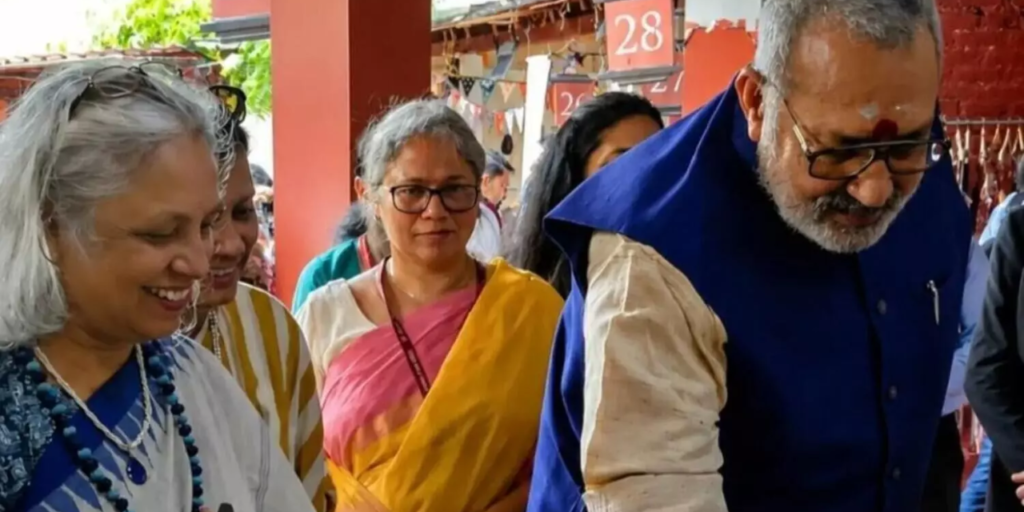
Union Minister of Textiles Giriraj Singh visited ‘Weave the Future 4.0: Upcycling Edition’ at Dilli Haat, INA, New Delhi, on July 13, highlighting India’s growing commitment to circular textiles, sustainable manufacturing and responsible resource management.
The Minister was accompanied by Neelam Shami Rao, Secretary, Ministry of Textiles; Dr. M. Beena, Development Commissioner (Handlooms); Amrit Raj, Development Commissioner (Handicrafts); Thomas McClenaghan, Minister Counsellor & Head of Sustainable Modernisation, European Union, along with senior officials from the Ministry of Textiles.
Addressing the gathering, Giriraj Singh emphasised that sustainability and circularity are becoming central to the future of India’s textile industry.
“As textile consumption continues to rise, it is imperative that we strengthen circular economy practices, promote responsible production and scale innovative solutions that transform textile waste into valuable resources. Initiatives such as ‘Weave the Future 4.0’ demonstrate how entrepreneurship, innovation and sustainability can converge to create both economic opportunities and environmental impact,” he said.
The Minister also stressed that the country’s textile workforce must benefit from sustainable growth through improved livelihoods and income opportunities while positioning India as a global leader in environmentally responsible textile manufacturing.
Platform for Circular Innovation
Organised by the Development Commissioner (Handlooms), Ministry of Textiles, Weave the Future 4.0: Upcycling Edition is the fourth edition of the initiative and focuses on the relationship between materials, communities and the environment.
Running until July 17, 2026, at Dilli Haat, the six-day exhibition features more than 100 brands, artisans, designers, recyclers, thrift collectives, startups and innovators from across India.
The exhibition highlights practical approaches to upcycling, recycling, repair, repurposing and circular design, showcasing how discarded materials can be transformed into valuable products through creativity and traditional craftsmanship.
Connecting Heritage with Sustainability
Dr. M. Beena, Development Commissioner (Handlooms), said the initiative has evolved into a national platform that bridges India’s rich handloom heritage with modern circular economy practices.
She noted that the event brings together artisans, students, designers, startups and recycling enterprises to explore innovative solutions for textile waste management while promoting sustainable consumption and entrepreneurship across the textile value chain.
Interactive Experiences for Visitors
Visitors to the exhibition can explore a wide range of sustainability-focused activities, including:
- Upcycled and recycled textile products by artisans and innovators
- Interactive installations on textile waste and circular economy
- Live demonstrations of repair, reuse and recycling techniques
- Workshops on sustainable design and craft innovation
- Discussions on circular fashion, conscious consumption and regenerative futures
One of the key attractions is the ‘Marammat’ workshop, organised in collaboration with Rafooghar. The hands-on session encourages participants to embrace repair as a creative and meaningful process using stitching, mending and fabric transformation techniques.
Through visible repairs and handcrafted interventions, the workshop promotes the philosophy that repairing textiles is not merely about fixing damage but about extending product life, reducing waste and reconnecting with materials.
With growing global attention on sustainable textiles, Weave the Future 4.0 demonstrates how India’s traditional knowledge, artisan skills and modern innovation can work together to build a more circular, resilient and environmentally responsible textile ecosystem.