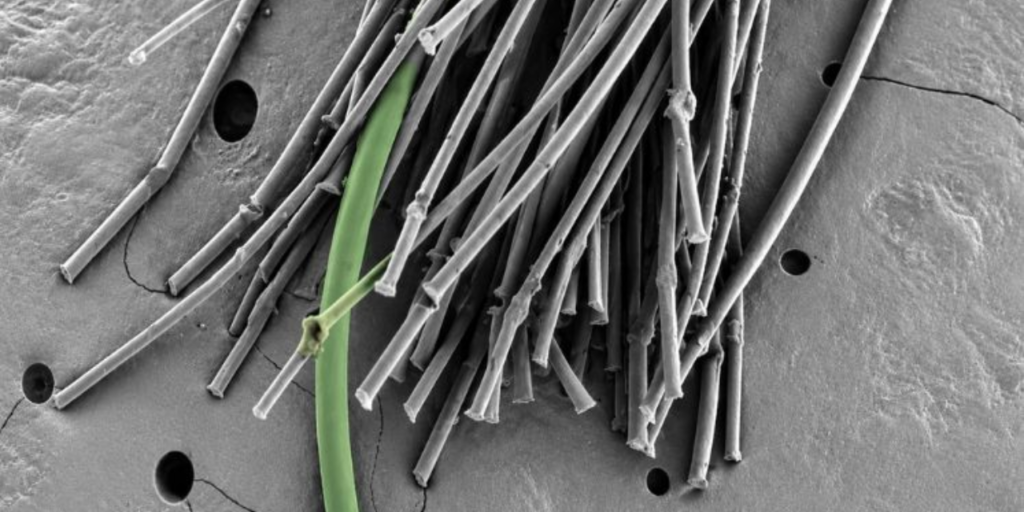
Researchers at the Massachusetts Institute of Technology (MIT) have developed a fully recyclable stretch yarn made entirely from polyethylene, offering a promising alternative to conventional spandex that could significantly improve textile circularity and reduce fashion waste.
The breakthrough addresses one of the biggest sustainability challenges in the apparel industry. Traditional stretch fabrics combine polyurethane-based spandex with polyester or nylon, making them difficult and expensive to recycle. Separating these mixed fibers requires chemical processing and often involves toxic solvents, resulting in most stretch garments ending up in landfills.
The MIT research team, led by Svetlana Boriskina from the Department of Mechanical Engineering, engineered the new yarn using two different polyethylene formulations. A softer polyethylene forms the elastic core, while a stiffer polyethylene creates the protective outer sheath. The materials are melted at approximately 350°F (177°C), extruded into ultra-fine fibers, and spun into yarn.
Because both layers belong to the same polymer family, the yarn can be melted and respun repeatedly without requiring fiber separation. Laboratory testing demonstrated that the material retained its strength and elasticity through ten complete recycling cycles, highlighting its potential for long-term reuse.
The innovation could transform the recycling of activewear, sportswear, leggings, compression garments and other stretch apparel, where conventional spandex has long been a barrier to textile recycling. With polyethylene already widely recycled through existing packaging infrastructure, garments produced using the new yarn may eventually be processed through current recycling systems without requiring dedicated textile recycling facilities.
The research team is now focusing on weaving and knitting the recyclable yarn into commercial fabrics to evaluate its real-world performance, durability, comfort and manufacturing compatibility.
For India’s textile industry, the development presents a strategic opportunity. As global brands increasingly seek circular and sustainable materials, Indian manufacturers can invest in polyethylene-based stretch fabric research and production to strengthen their position in the global activewear and performance textile market.
With sustainability becoming a major purchasing criterion for international apparel brands, innovations such as recyclable stretch yarns could help accelerate the transition toward circular textiles while reducing dependence on difficult-to-recycle blended fibers.