
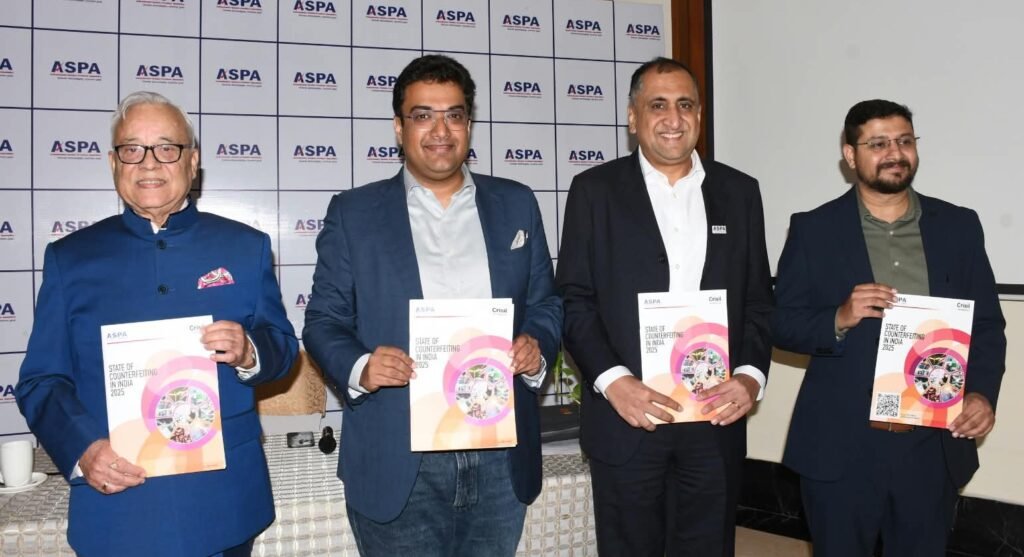
As counterfeiting continues to affect a wide range of everyday consumer products, the Authentication Solution Providers’ Association (ASPA) has called for stronger consumer awareness and easier product-authentication mechanisms.
The call follows the findings of the ASPA–CRISIL State of Counterfeiting in India 2025 report, presented at ASPA’s “Fake Free India” event in Hyderabad. The nationwide study surveyed 1,639 consumers across nine Indian cities and six major sectors.
The report found that 89% of consumers had purchased a counterfeit product at least once in their lifetime, while 35% encountered a counterfeit product during the past 12 months.
Counterfeiting Spans Multiple Consumer Sectors
The study found that counterfeit products are not restricted to a particular industry. Counterfeiting was reported across all six sectors covered by the research, including apparel, FMCG, automotive parts, consumer durables, healthcare products and agro-products.
Consumers perceived the highest prevalence of counterfeiting in:
- Apparel – 34%
- Consumer electronics – 31%
- Healthcare products – 28%
- FMCG – 25%
- Agrochemicals – 23%
- Automotive parts – 22%
The findings highlight the widespread nature of counterfeit products across everyday consumer categories.
93% Demand Greater Consumer Awareness
The report found that 93% of consumers believe more awareness campaigns are required to help people identify counterfeit products.
At the same time, 50% of respondents said they would never knowingly purchase a counterfeit product, indicating growing consumer willingness to avoid fake products when they can identify them.
However, the report also highlighted a significant authentication gap. While 62% of consumers said they now always check product authenticity before purchasing, many still depend on visual indicators rather than dedicated authentication technologies.
Around 59–66% of consumers rely on packaging quality and branding to determine whether a product is genuine. Only 34% check holograms, 23% check QR codes and 13% check digital identities.
ASPA said the findings point to the need for greater education around technologies such as secure packaging, serialization, QR-based authentication and track-and-trace systems.
Hyderabad Records Highest Recent Encounters
The study also revealed regional differences in consumer exposure to counterfeit products.
Among the nine cities surveyed, Hyderabad recorded the highest proportion of consumers—46%—who encountered a counterfeit product during the previous 12 months.
Chennai followed at 39%, while Bengaluru recorded 33%, highlighting a notable trend across the South Indian cities included in the research.
Overall, 74% of consumers believed counterfeiting had increased in their region over the past year, while respondents estimated that nearly 29% of products available in local markets could be counterfeit.
Authentication and Traceability Key to Consumer Protection
ASPA has stressed the importance of making authentication simple and accessible to consumers. Technologies including secure packaging, serialization, QR-based verification, digital authentication and track-and-trace systems can provide multiple layers of protection throughout the supply chain.
Ankit Gupta, President, ASPA, said the survey demonstrates that counterfeiting has become deeply embedded in the everyday consumer experience and that consumer awareness remains a critical gap.
He emphasised the need for brands, regulators and consumers to work together to strengthen authentication, improve consumer confidence and create safer markets.
Nakul Pasricha, Vice-President, ASPA, highlighted the growing importance of authentication and traceability in connecting consumer awareness with actual product verification.
According to Pasricha, authentication systems need to be accessible and intuitive while also improving supply-chain visibility.
Making Counterfeit Prevention a Consumer Movement
Prof. Bejon Kumar Misra, International Consumer Policy Expert and Honorary Member, ASPA, described counterfeiting as a consumer-protection issue in addition to an intellectual-property and brand-protection concern.
He called for consumers to be provided with simple, affordable and accessible tools to identify, verify and report suspicious products, rather than relying solely on general advice to purchase genuine products.
The report forms part of ASPA’s continuing work across its four pillars of Awareness, Advocacy, Research and Innovation.
Following the report’s launch in Mumbai in March 2026, ASPA is expanding its “Fake Free India” consumer awareness campaign to Hyderabad as part of its broader effort to raise awareness of counterfeiting and promote stronger authentication practices across India.