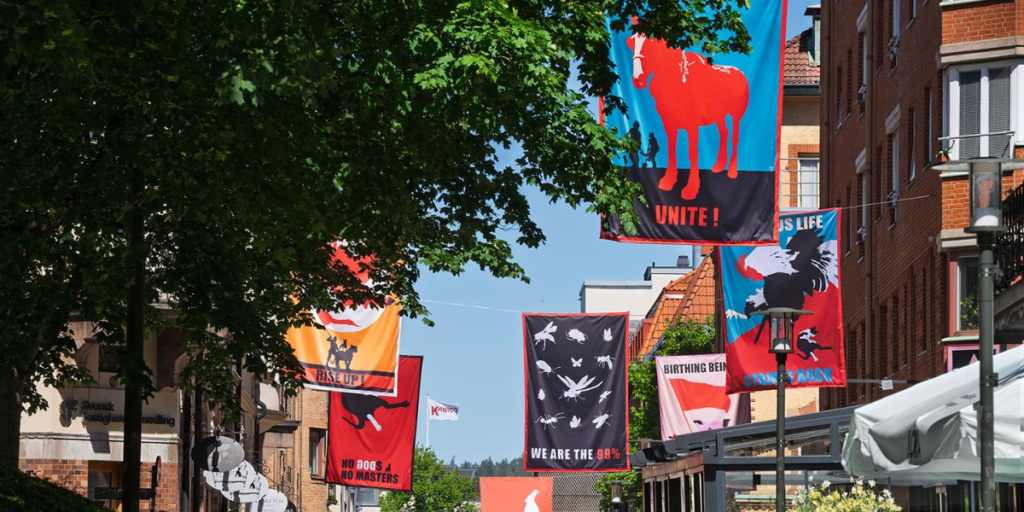
Sweden’s Borås Art Biennial 2026 will place textiles, industrial memory, labour histories and ecological transformation at the centre of its next edition, bringing together artists from across Europe, Africa, Asia and Australia for a citywide exhibition that reconsiders the legacies of industrial modernity through the lens of time, water and textile production.
Organised by Borås Art Museum in collaboration with the Swedish Museum of Textiles, the ninth edition of the biennial will unfold across the city centre and at the art and textile museums in Borås under the title Warps and Waves in the Fabric of Time. Curated by Taru Elfving, the exhibition brings together a group of international artists whose works examine how the textile industry has shaped societies, landscapes, labour and migration across generations and geographies.
The 2026 biennial takes Borås’ textile heritage as its starting point. Long recognised as one of Sweden’s historic textile centres, Borås grew rapidly during the Industrial Revolution, when some of the country’s first weaving mills were established in the city. Its industrial rise was closely tied to a long-standing cottage textile tradition, access to trade routes through the port of Gothenburg, a humid climate suitable for textile production, and the waters of the river Viskan, which sustained factory operations.
Against this backdrop, Warps and Waves in the Fabric of Time examines the ways industrialisation transformed not only production systems but also the very experience of time. The exhibition sets out to “unravel and mend” a fabric of time stretched between factory and river, past and present, local history and global circulation. Water functions as one of the exhibition’s central motifs, linking Borås’ industrial development to broader planetary systems, colonial trade routes and ecological interdependence.
Rather than focusing solely on machines and industrial progress, the biennial turns attention to the often-overlooked lives and labours that made textile modernity possible. Through installations, moving image, research-based practices and material storytelling, the participating artists trace connections between women’s work, migration, knowledge transfer, social justice struggles and the more-than-human forces that underpin industrial systems.
The exhibition also responds to urgent contemporary concerns. As environmental crises intensify and artificial intelligence and automation continue to reshape labour and production, the biennial reflects on questions of value, material circulation and work in a rapidly changing world. Instead of embracing either apocalyptic decline or techno-utopian optimism, the curatorial framework proposes a more nuanced exploration of future possibilities grounded in historical awareness, ecological responsibility and cross-cultural alliances.
The artistic journey of the biennial extends well beyond Sweden, connecting the Nordic-Baltic region with the Atlantic, West Africa, the Middle East and Southeast Asia. Through these transnational perspectives, the exhibition highlights the colonial histories, extractive economies and unequal wealth distribution that have long underpinned textile production and global trade. In doing so, it invites audiences to rethink linear narratives of industrial progress and imagine alternative futures shaped by repair, memory and interdependence.
The artist lineup for Borås Art Biennial 2026 includes Sampson Addae, Petra Bauer, Nanna Debois Buhl, Michelle Eistrup, Terike Haapoja, Kalle Hamm, Marcia Harvey Isaksson, Dzamil Kamanger, Maria Kapajeva, Sohorab Rabbey, Yasmin Smith and Paola Torres Núñez del Prado. Together, their practices weave a complex narrative of textile histories and environmental entanglements, offering new ways to read the social and ecological fabric of industrial society.
Curator Taru Elfving, based in Helsinki, is internationally known for her site-sensitive and research-led projects that explore the intersections of ecology, feminism and decolonial thought. Her appointment signals a strong conceptual direction for the biennial, one that positions Borås not only as a historical textile city but also as a contemporary site for critical reflection on labour, material culture and planetary futures.
With Warps and Waves in the Fabric of Time, Borås Art Biennial 2026 is set to become a major platform for conversations around textiles, industry, art and sustainability. By drawing together historical inquiry, artistic experimentation and urgent social questions, the biennial reinforces Borås’ unique place at the crossroads of textile heritage and contemporary cultural discourse.