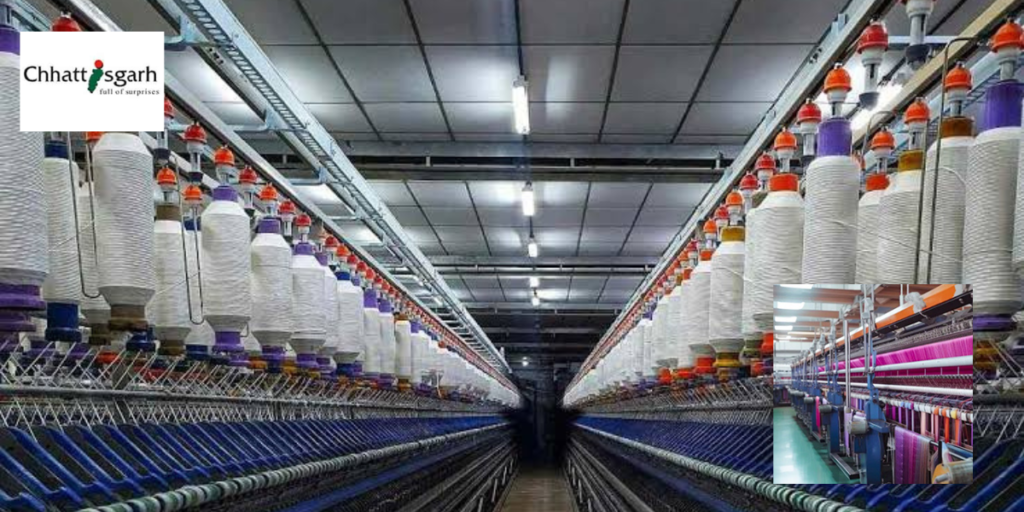
Chhattisgarh has secured investment commitments worth nearly ₹973 crore from four leading textile and garment companies under its Industrial Development Policy 2024–30, strengthening the state’s position as an emerging textile manufacturing destination. The projects are expected to generate more than 14,000 employment opportunities as investments move from commitments to on-ground execution.
The investment pipeline includes Saravana Mills’ ₹528 crore integrated textile and apparel manufacturing campus, Swift Textiles Pvt. Ltd.’s ₹235 crore manufacturing facility at the Nava Raipur Textile Park, and investments worth approximately ₹210 crore by Puneet Creations and Drishti Designs LLP. Together, the four companies account for total investment commitments of nearly ₹973 crore.
A major milestone was achieved with the bhoomipoojan of Swift Textiles’ ₹235 crore manufacturing facility, which will become the first garment manufacturing unit at the Nava Raipur Textile Park. The project signals the transition from investment announcements to project execution and reflects growing investor confidence in the state’s industrial development strategy.
Chief Minister Vishnu Deo Sai said the textile sector has significant potential to create employment, particularly for women and youth in rural and semi-urban areas. He stated that the government’s focus is on creating opportunities within the state so that people can access sustainable livelihoods closer to home.
Under the Industrial Development Policy 2024–30, Chhattisgarh has identified textiles and ready-made garments as priority sectors by offering investor incentives, ready industrial infrastructure and employment-linked support. The policy aims to position textiles as a major driver of manufacturing growth while encouraging large-scale job creation.
The four companies represent different segments of the textile value chain, from yarn production to garment manufacturing, and include suppliers to global retail brands such as H&M and Marks & Spencer. Once operational, the facilities are expected to integrate Chhattisgarh into international textile supply chains serving export markets.
The state government has introduced several incentives to encourage investments. Textile companies are eligible for incentives of up to 200% of Fixed Capital Investment, including a 35% capital incentive linked to employment generation. The policy also provides Employment Generation Assistance of ₹6,000 per month for each female employee and ₹5,000 per month for each male employee for five years, along with training assistance of up to ₹15,000 per employee.
Additional benefits include a 12-year electricity duty exemption, freight assistance and customised incentive packages for projects investing over ₹1,000 crore while generating more than 1,000 jobs. The state has also announced additional incentives for the first five anchor investors in the textile sector.
The 81-acre Nava Raipur Textile Park, along with the adjoining Readymade Garment Park, has been developed with plug-and-play infrastructure including land, power, water supply, waste treatment facilities and common utilities to help manufacturers commence operations quickly.
The park’s location along the Mumbai–Howrah railway corridor, proximity to Visakhapatnam Port, and connectivity to major commercial centres through air transport provide manufacturers with efficient logistics for both domestic distribution and export-oriented operations.
According to the state government, the early response from textile manufacturers demonstrates increasing industry confidence in Chhattisgarh’s industrial vision. With projects already entering the implementation stage, the state aims to strengthen its position as a competitive hub for textile manufacturing, employment generation and export-led industrial growth.