
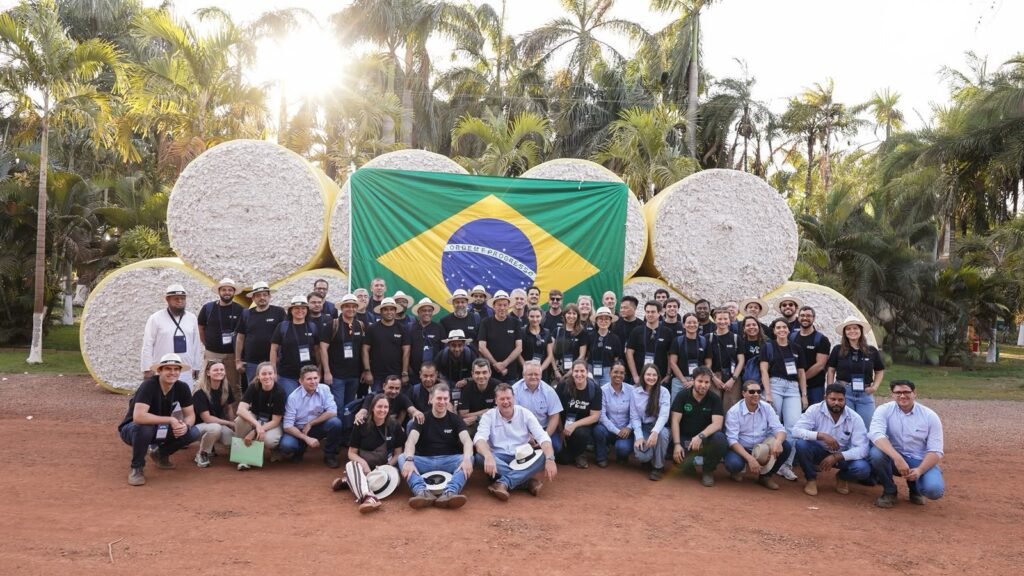
The Cotton Brazil Dialogues 2026 has concluded after bringing 50 international participants from 14 countries closer to Brazil’s cotton production through technical visits, workshops and direct interactions with growers and industry stakeholders.
Held since 2015, the initiative adopted an expanded format in 2026, featuring two immersion rounds in July and August and broadening participation beyond traditional spinning-mill buyers. The programme was led by the Brazilian Association of Cotton Growers (Abrapa) and the National Association of Cotton Exporters (Anea), with support from the Brazilian Trade and Investment Promotion Agency (ApexBrasil).
Of the 50 participants, 32 represented spinning mills, while 18 came from brands, retailers and NGOs. Representatives from research institutes and other strategic organisations also participated, creating a broader platform for dialogue across the global textile value chain.

Expanding the Dialogue Across the Textile Value Chain
The 2026 edition marked an important evolution in the initiative’s approach. Rather than focusing exclusively on traditional cotton buyers, the Cotton Brazil Dialogues brought together stakeholders who influence sourcing, production, research and sustainability decisions throughout the textile industry.
The programme provided participants with an opportunity to understand Brazilian cotton production directly from the field while engaging with producers, researchers and other industry representatives.
The objective was to strengthen relationships between Brazilian cotton producers and the international textile sector while promoting greater transparency and understanding of production practices.
Building Long-Term International Relationships
Gustavo Piccoli, President of Abrapa, said that expanding participation from brands, retailers, international organisations and researchers would help strengthen trust and long-term relationships with global markets.
He also highlighted Brazil’s growing position in the international cotton trade. According to Piccoli, Brazil recorded a historic 3.37 million tonnes of cotton exports during the 2025/26 commercial year, representing a 19% increase over the previous commercial year and reinforcing the country’s position as the world’s leading cotton exporter.
The direct engagement provided through the programme is intended to help international stakeholders better understand Brazil’s production systems and the challenges and opportunities facing its cotton sector.
First-Hand Experience Builds Confidence
Fernando Rati, Head of Cotton Brazil, emphasised the value of taking international participants directly into production environments.
According to Rati, seeing farms, production facilities and processes first-hand allows participants to move beyond presentations and gain a practical understanding of how Brazilian cotton is produced.
He noted that participants also appreciated the openness of Brazilian producers in discussing both achievements and challenges rather than presenting only positive aspects of production.
Continuous Improvement Through Industry Feedback
The field visits also provided Brazilian producers with an opportunity to receive feedback from different parts of the international textile supply chain.
Lisa Ventura, Head of International Partnerships at Abrapa, said the 2026 programme helped strengthen connections across the supply chain and generate discussions around the future of cotton and natural fibres.
Feedback gathered during both immersion rounds will be shared across Abrapa’s networks and used to identify areas for improvement in Brazilian cotton production. The insights are also expected to contribute to the development of the 2027 Cotton Brazil Dialogues.
From Brazilian Cotton Fields to Global Markets
The programme covered cotton-producing regions in Mato Grosso, Bahia and Goiás, as well as the Federal District.
Participants visited farms, cotton gins, laboratories and research centres and gained insights into several aspects of Brazilian cotton production, including:
- Cotton quality and processing
- Sustainability practices
- Traceability systems
- Agricultural technology
- Research and innovation
- Cotton ginning
- Production practices and supply-chain management
The technical visits were complemented by workshops and discussions, giving participants a broader view of the journey from cotton cultivation to the global market.
Strengthening Brazil’s Position in Global Cotton
The expanded Cotton Brazil Dialogues reflects the increasing importance of direct engagement between cotton-producing regions and the international textile value chain.
By connecting producers with spinners, brands, retailers, NGOs and researchers, the initiative aims to encourage greater transparency, strengthen international relationships and support continuous improvement in Brazilian cotton production.
The 2026 programme was coordinated by Abrapa and Anea, with support from ApexBrasil and state cotton producer associations, including the Mato Grosso Association of Cotton Producers (Ampa), Bahia Association of Cotton Producers (Abapa) and Goiás Association of Cotton Producers (Agopa).
As Brazil continues to expand its presence in global cotton markets, initiatives such as Cotton Brazil Dialogues are providing international stakeholders with a closer look at the country’s production systems and helping build stronger connections between farmers and the global textile industry.