
Millions of older buildings across India were constructed before modern seismic design standards became widely applicable. A new research project by the fischer Group of Companies, in collaboration with Purdue University, USA, demonstrates how targeted structural retrofitting could significantly improve the earthquake resistance of existing reinforced-concrete buildings.
The research focuses on strengthening vulnerable points within existing structures rather than relying solely on demolition and reconstruction. For earthquake-prone regions, this approach could provide a more practical and resource-efficient pathway towards improving structural resilience and protecting lives.
The Challenge of India’s Existing Building Stock
Earthquakes remain a significant threat across several parts of the world, including the Himalayan region of India. While modern buildings can be designed according to contemporary seismic standards, a large proportion of existing structures were built decades ago under different design requirements.
Upgrading every vulnerable building through demolition and reconstruction would be costly, time-consuming and resource-intensive. Retrofitting existing structures therefore offers an alternative approach that can focus investment on the most critical structural elements.
The objective is to identify vulnerable areas and reinforce them so that buildings can better withstand the forces generated during an earthquake.
Full-Scale Research at Purdue University
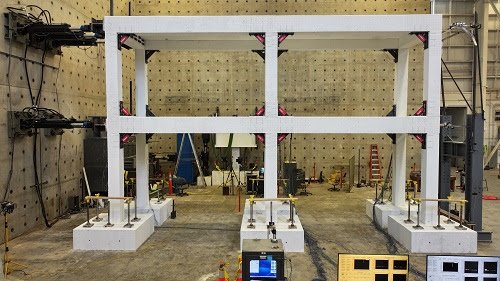
To investigate the effectiveness of targeted retrofitting, fischer and Purdue University conducted research involving full-scale reinforced-concrete structures.
The project was led by Prof. Akanshu Sharma, Associate Professor at Purdue University and former Endowed Professor at the Institute of Materials Science at the University of Stuttgart.
The research focused particularly on beam-column joints, which connect horizontal beams with vertical columns in reinforced-concrete frame structures.
These connections can experience substantial stresses and horizontal forces during seismic events. If critical joints fail, the consequences can extend beyond the individual connection and potentially compromise the stability of the wider structural system.
Strengthening Critical Structural Connections
The tested solution uses haunch elements in the form of steel diagonal braces to reinforce vulnerable beam-column connections.
These elements are integrated into the existing structural framework using injection mortar and threaded rods, allowing the critical areas to be strengthened without requiring extensive modification of the overall building.
According to Dr Margaritis Tonidis, former PhD Candidate at Purdue University and leading Project Engineer for the project, beam-column joints in reinforced-concrete frame structures experience particularly high stresses during earthquake-related horizontal loading.
The research indicates that strengthening these critical points can improve the performance of existing structures under seismic loading.
Targeted Retrofitting Instead of Major Structural Intervention
One of the key advantages of the approach is its focus on localised structural reinforcement.
Rather than undertaking extensive reconstruction, engineers can identify vulnerable load-bearing connections and reinforce them specifically. This can potentially reduce disruption for occupants while improving the structural resilience of existing buildings.
Dr Erik Johannes Stehle, Head of Development FiXperience at fischer, said the tests demonstrated that earthquake resistance can be significantly improved when vulnerable points in a building’s load-bearing structure are identified and reinforced.
The findings underline the importance of targeted intervention as part of broader strategies for strengthening existing building stock.
From Research to Real-World Application
The full-scale testing demonstrated improved structural performance under seismic loading, particularly around the reinforced joints.
The next challenge is translating these scientific findings into practical applications for existing buildings. This will require appropriate engineering assessment, structural design, installation expertise and compliance with applicable standards and regulations.
For earthquake-prone communities, however, the research provides an important indication that older structures do not necessarily have to be demolished to improve their resilience.
Relevance for India
The research has particular relevance for India, where large numbers of existing buildings coexist with varying levels of seismic vulnerability.
Mayank Kalra, Managing Director, fischer India, highlighted the importance of retrofitting for India’s existing building stock, particularly structures constructed before current seismic design standards were introduced.
He noted that strengthening critical structural points can provide a practical and potentially more sustainable alternative to demolition and reconstruction, while reducing disruption to building occupants.
The approach could become increasingly relevant as India continues to focus on creating safer and more resilient urban and rural infrastructure.
Towards More Resilient Buildings
Earthquake resilience is not only about designing new structures. It also requires addressing the vulnerability of buildings that are already occupied and form an essential part of communities.
The fischer–Purdue University research demonstrates the potential of targeted seismic retrofitting to strengthen vulnerable structural connections in existing reinforced-concrete buildings.
As research progresses towards real-world applications, such technologies could contribute to a broader shift from rebuilding after disasters towards proactive structural resilience and risk reduction.
For India, where seismic risk affects several regions and millions of people live and work in existing structures, scientifically validated retrofitting solutions could play an important role in building safer and more resilient communities.