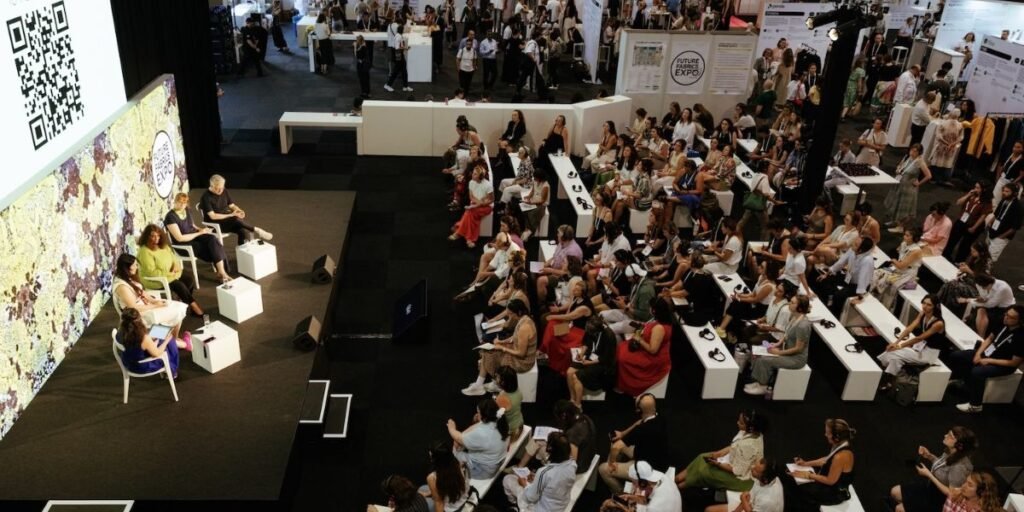
Future Fabrics Expo 2026 brought the global conversation on circular textiles to Brussels, showcasing a broad range of commercially available recycled and recyclable materials while highlighting both the promise and the challenges of building a truly circular textile industry.
Held on June 24–25, 2026, the event took place alongside the Textile Recycling Expo in Brussels for the first time, creating a wider platform for textile manufacturers, material innovators, recyclers and brands to explore the future of sustainable sourcing and circular product development.
The expo focused on one of the textile industry’s most urgent priorities: how to scale circularity through practical, commercially viable material solutions. From recycled cotton and polyester to recycled nylon, agricultural waste-based fibres and emerging bio-synthetic alternatives, the event showcased the growing diversity of next-generation textile inputs now entering the market.
Circular materials move closer to commercial reality
A key message from Future Fabrics Expo 2026 was that circular textiles are no longer limited to experimental innovation. A steadily growing number of recycling technologies and manufacturing processes are now enabling the conversion of post-consumer waste, pre-consumer textile waste, agricultural residues and alternative feedstocks into new fibres, yarns and fabrics suitable for commercial use.
The exhibition featured a diverse selection of material developers and fibre innovators that are helping reshape the textile supply chain. Among the companies showcasing their latest collections and brand collaborations were Circulose, Säntis Textiles, Södra, Lenzing, Spinnova, Circ, fibR-e by Kipas Textiles, Eeden and Samsara Eco.
These companies represent a broad cross-section of the circular materials ecosystem, ranging from regenerated cellulose and fibre-to-fibre recycling technologies to advanced recycled synthetics and alternative raw material platforms.
Brussels event explores barriers and opportunities in textile circularity
While the event highlighted the increasing availability of circular materials, it also pointed to the reality that the textile sector still faces major structural barriers in scaling circularity. Innovation in materials is advancing rapidly, but challenges remain in areas such as infrastructure, feedstock availability, sorting and recycling systems, commercial adoption, pricing competitiveness and alignment across the value chain.
By running alongside the Textile Recycling Expo, Future Fabrics Expo created a stronger link between material innovation and the broader recycling ecosystem, underlining the need for collaboration between fibre producers, recyclers, manufacturers and brands if circular models are to move beyond niche adoption.
Biodegradation and bio-synthetics gain attention
Another important theme at the Brussels expo was the role that biodegradation and bio-synthetic materials could play in the future of circular fashion and textile production.
As the industry continues to search for alternatives to conventional fossil-based synthetics, the conversation is increasingly shifting toward materials that can offer both performance and lower environmental impact. The expo examined how bio-synthetics may contribute to reshaping the textile landscape, while also raising questions around end-of-life management, biodegradation conditions, material traceability and the real-world impact of next-generation alternatives.
Industry shifts from sustainability messaging to material implementation
The growing number of commercially available recycled and recyclable textiles on display in Brussels suggests that the industry is moving beyond broad sustainability messaging toward more practical implementation. For fashion brands, knitwear manufacturers and sourcing teams, the challenge is no longer just identifying sustainable materials — it is selecting solutions that can be integrated into supply chains at scale without compromising performance, aesthetics, cost or traceability.
By presenting collections and brand collaborations rather than only concept-stage innovations, exhibitors at Future Fabrics Expo 2026 demonstrated that circular textiles are becoming more deeply embedded in product development and sourcing strategies.
A stronger circular textile ecosystem is taking shape
As textile brands and manufacturers face mounting pressure to reduce waste, improve recyclability and adopt lower-impact materials, events such as Future Fabrics Expo 2026 are becoming increasingly important as platforms for connecting innovation with market readiness.
The Brussels edition highlighted a clear shift in the industry: circularity is no longer a side conversation but a central part of future textile strategy. At the same time, the event made it equally clear that achieving circularity at scale will require more than new fibres alone. It will depend on aligned policy, investment in recycling infrastructure, stronger cross-industry collaboration and clearer pathways for commercial adoption.
With circular materials, biodegradation research and bio-synthetic development all gaining momentum, Future Fabrics Expo 2026 offered a snapshot of a textile industry actively rethinking how materials are sourced, produced, used and recovered in the years ahead.