
Washington, DC, June 2026 – The International Cotton Advisory Committee (ICAC), in its latest Cotton This Monthreport, projects a modest decline in global cotton cultivation, production, and trade during the 2026/27 season.
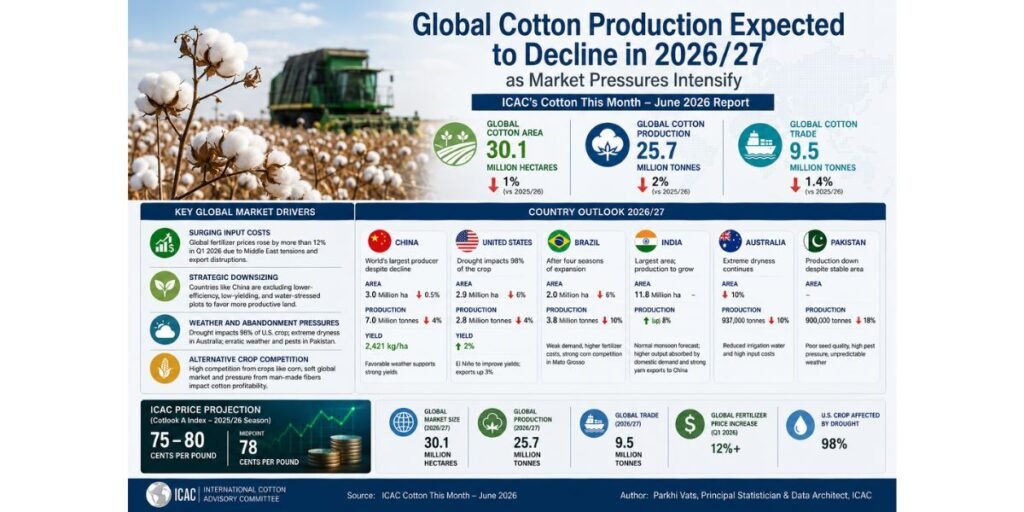
The outlook reflects growing challenges from rising production costs, adverse weather conditions, shifting planting strategies, and continued competition from alternative crops and man-made fibers.According to the report, global cotton area is expected to decrease by 1% to approximately 30.1 million hectares, while worldwide cotton production is forecast to decline by 2% to 25.7 million tonnes. Global cotton trade is also projected to contract by 1.4%, reaching around 9.5 million tonnes.
Rising Costs and Weather Risks Reshape Cotton Outlook
Several factors are influencing cotton production decisions across major producing regions. Global fertilizer prices increased by more than 12% during the first quarter of 2026, driven by geopolitical tensions in the Middle East and supply disruptions affecting key shipping routes.At the same time, many cotton-producing countries are reassessing cultivation strategies. China, for example, is reducing acreage in lower-yielding and water-stressed regions to improve overall productivity. Meanwhile, drought conditions, erratic weather patterns, and pest pressures continue to challenge farmers in several key markets.Competition from crops such as corn and ongoing pressure from synthetic fibers are also affecting cotton profitability, prompting some growers to reduce planted acreage.
Country-by-Country Production Outlook
China Maintains Leadership Despite Lower Output
China is expected to remain the world’s largest cotton producer despite a slight decline in acreage. Cotton area is projected to fall by 0.5% to 3 million hectares, while production may decrease by 4% to 7 million tonnes. Favorable weather conditions are expected to support strong yields, estimated at an industry-leading 2,421 kg per hectare.
United States Faces Drought Challenges
The United States is forecast to reduce planted cotton area by 6% to 2.9 million hectares, resulting in a 4% decline in production to 2.8 million tonnes. Although nearly 98% of the crop is currently affected by drought-like conditions, El Niño weather patterns are expected to improve yields by approximately 2%. Cotton exports are forecast to increase by 3%.
Brazil Adjusts After Years of Expansion
Brazil’s cotton sector is expected to contract following four consecutive seasons of growth. Cotton area is projected to decline by 6% to 2 million hectares, while production may fall by 10% to 3.8 million tonnes. Weak demand, higher fertilizer costs, and strong competition from corn are driving the reduction, particularly in the Mato Grosso region.
India Poised for Production Growth
India is expected to retain the world’s largest cotton cultivation area at approximately 11.8 million hectares. Production is forecast to increase by 8%, supported by favorable monsoon expectations. Additional output is likely to be absorbed by growing domestic demand and robust yarn exports, particularly to China.
Australia and Pakistan Face Significant Challenges
Australia’s cotton industry is forecast to experience a 10% decline in both acreage and production due to severe dryness, reduced irrigation availability, and rising input costs. Production is expected to reach approximately 937,000 tonnes.Pakistan’s cotton output is projected to fall sharply by 18% to around 900,000 tonnes, despite stable cultivation area. Poor seed quality, heavy pest infestations, and unpredictable weather continue to constrain productivity.
Cotton Prices Expected to Remain Stable
ICAC’s Secretariat currently forecasts the Cotlook A Index for the 2025/26 season within a range of 75 to 80 cents per pound, with a midpoint estimate of 78 cents per pound. The forecast reflects current global supply and demand expectations.
Industry Outlook
Despite the projected decline in global production, cotton remains a critical raw material for the textile industry. However, growers and manufacturers will need to navigate increasing cost pressures, climate-related risks, and changing market dynamics.With India expected to increase output and major exporters such as the United States and Brazil facing production challenges, trade flows and pricing trends will be closely monitored throughout the season. The sector’s ability to adapt to sustainability requirements, weather volatility, and evolving consumer demand will play a key role in shaping the global cotton market over the coming years.The latest ICAC report highlights a cotton industry entering the 2026/27 season with cautious optimism but facing a more complex operating environment than in previous years.