
Industries such as aerospace, automotive, and renewable energy demand materials that withstand extreme temperatures and mechanical stress. For example, jet engine components face temperatures above 1,700°C, and space missions require extraordinary durability. Consequently, high-temperature composite resins have emerged as essential materials for such applications, providing strength, stability, and longevity under challenging conditions.
This article explains the essentials of high-temperature composite resins, their types, applications, and key drivers of market growth.
Understanding High-Temperature Composite Resins
High-temperature composite resins are advanced polymers designed to retain mechanical and chemical properties under high heat. They resist oxidation and maintain dimensional stability, which makes them ideal for producing durable, high-performance components.
Types of High-Temperature Composite Resins
Epoxy Resins
Epoxy resins offer strong mechanical properties and chemical resistance. When manufacturers reinforce them with carbon or glass fibers, they produce highly durable composites. Modified epoxy systems sustain temperatures up to 250°C, making them suitable for aerospace fuselages, automotive engine parts, and sporting goods.
Phenolic Resins
Phenolic resins resist flames and generate low smoke while performing above 300°C. They maintain structural integrity under intense heat, making them suitable for safety-critical applications such as braking systems, clutches, and high-temperature gaskets.
Bismaleimide (BMI) Resins
BMI resins combine high heat resistance with toughness. They endure temperatures above 230°C and are widely applied in aerospace, including jet engine parts, airframe structures, missile systems, and radomes. Their durability and fatigue resistance make them indispensable in defense and space applications.
Market Overview
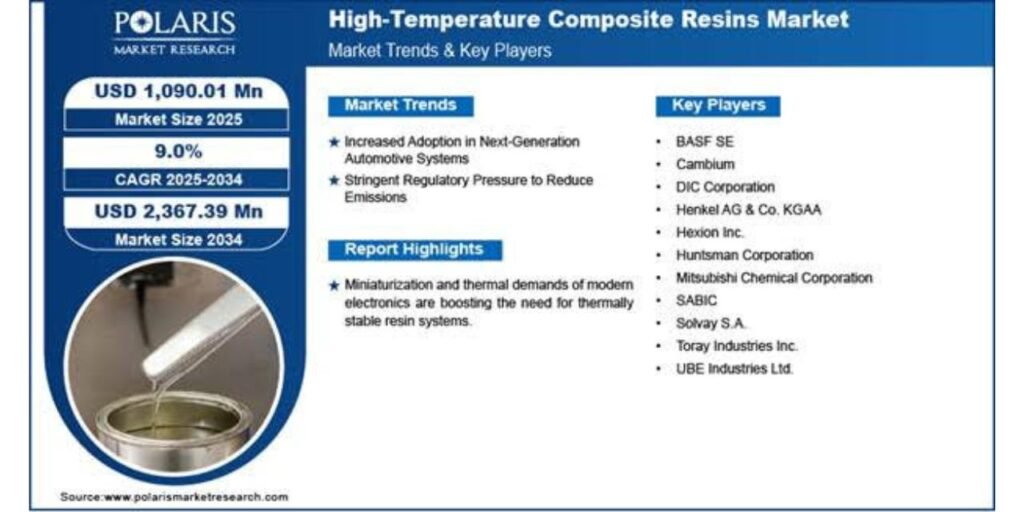
According to Polaris Market Research, the global high-temperature composite resins market stood at USD 1,000.93 million in 2024. It is expected to grow at a CAGR of 9.0% from 2025 to 2034, reaching USD 2,367.39 million.
Key Market Drivers
Increasing Demand in Aerospace and Defense
High-temperature composite resins are becoming the preferred choice for aircraft and defense components, such as engine casings and missile structures. These materials can withstand extreme heat and stress, which explains their rising use. Growth in air traffic and defense budgets is also boosting demand for advanced materials.
Shift Toward Lightweight Vehicles
Automakers face pressure to reduce emissions and improve efficiency. Therefore, they increasingly use lightweight composite resins, which help lower vehicle weight while maintaining strength. These resins are essential for under-the-hood parts, battery housings, and braking systems exposed to heat.
Emerging Trends in the Market
Innovations in Resin Formulations
Manufacturers continue to develop thermally stable, mechanically superior resins. These innovations broaden applications, enhance performance, and reduce maintenance costs.
Growth in Renewable Energy
The wind energy sector is expanding globally. As a result, manufacturers deploy high-temperature resins in turbine parts to handle mechanical stress and environmental exposure.
Focus on Sustainability
Companies increasingly develop recyclable or bio-based resins to meet environmental regulations. This trend drives innovation toward greener, sustainable resin solutions.
Conclusion
High-temperature composite resins are transforming material science. They allow the creation of durable, high-performance components for demanding applications. Driven by advances in aerospace, automotive, and renewable energy sectors, the market is set for significant growth in the years ahead.
Pingback: Industrial Cooling Systems Market Enters a New Era of Expansion and Opportunity by 2034 - Niche Nest