
The International Cotton Advisory Committee (ICAC) has released its 2026 World Cotton Trade Report, highlighting a positive medium-term outlook for global cotton trade despite growing supply-side challenges, geopolitical uncertainties, and evolving trade policies.
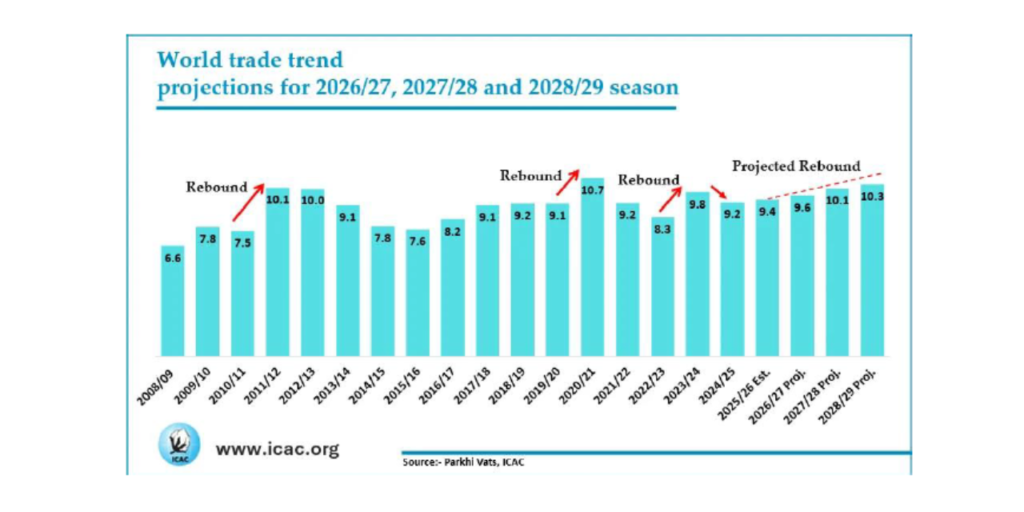
According to the report, global cotton trade is expected to rise from 9.4 million tonnes in the 2025/26 season to approximately 10.3 million tonnes by the end of the 2028/29 season, reflecting sustained international demand and changing sourcing patterns across major textile-producing nations.
The report, available free of charge through the end of 2026, provides a comprehensive analysis of global cotton trade flows, key importer and exporter relationships, policy developments, logistics, and market trends influencing the international cotton industry.
Supply and Demand Balance Tightens
ICAC projects global cotton production to decline by 2% to 25.8 million tonnes during the 2026/27 season, while global consumption is expected to remain relatively strong at 25.5 million tonnes. The narrowing gap between production and consumption is expected to increase dependence on inventories held by major exporting countries.
Should demand continue to strengthen, exporters may need to reduce ending stocks to meet market requirements, further supporting international cotton trade volumes over the coming years.
China to Play a Critical Role
The report identifies China, the world’s largest cotton-consuming country, as one of the most influential markets shaping future trade dynamics. Continued expansion of China’s textile manufacturing sector and rising consumer demand could significantly increase cotton imports, strengthening global trade flows.
Brazil Maintains Export Leadership
Among the report’s key findings, Brazil retained its position as the world’s largest cotton lint exporter during the 2025/26 season, supported by record production, competitive pricing, expanded international market access, and reduced availability of U.S. cotton.
Meanwhile, U.S. cotton exports declined in 2025/26 but are forecast to recover by 3% in 2026/27, driven by larger ending stocks.
Asia Continues to Drive Cotton Imports
The report highlights continued importance of Asian textile manufacturing hubs.
- China’s cotton imports are expected to recover strongly following a sharp decline in the previous season.
- Vietnam continues expanding its position as a leading cotton importer, supported by its rapidly growing textile and apparel industry.
- Bangladesh remains one of the world’s largest cotton importers despite ongoing challenges related to energy shortages, logistics, and broader economic conditions.
- India’s cotton import and consumption patterns continue to evolve under the influence of domestic textile demand, government policies, and tariff measures.
Policy and Logistics Shape Future Trade
Beyond supply and demand fundamentals, the ICAC notes that tariffs, trade agreements, freight costs, energy prices, and shifting supplier relationships are becoming increasingly important in purchasing decisions across the global cotton value chain.
The report also identifies potential disruptions to shipments through the Strait of Hormuz as a significant logistical risk that could affect global cotton trade and supply chain efficiency.
Commenting on the report, Parkhi Vats, ICAC Principal Statistician and Data Architect, stated that while production challenges and geopolitical uncertainty remain key concerns, the medium-term outlook continues to point toward steady growth in cotton trade as markets adapt to changing sourcing relationships and resilient global consumption.
The findings reinforce the importance of supply chain resilience, diversified sourcing strategies, and stable international trade policies in supporting the long-term growth of the global cotton industry.