
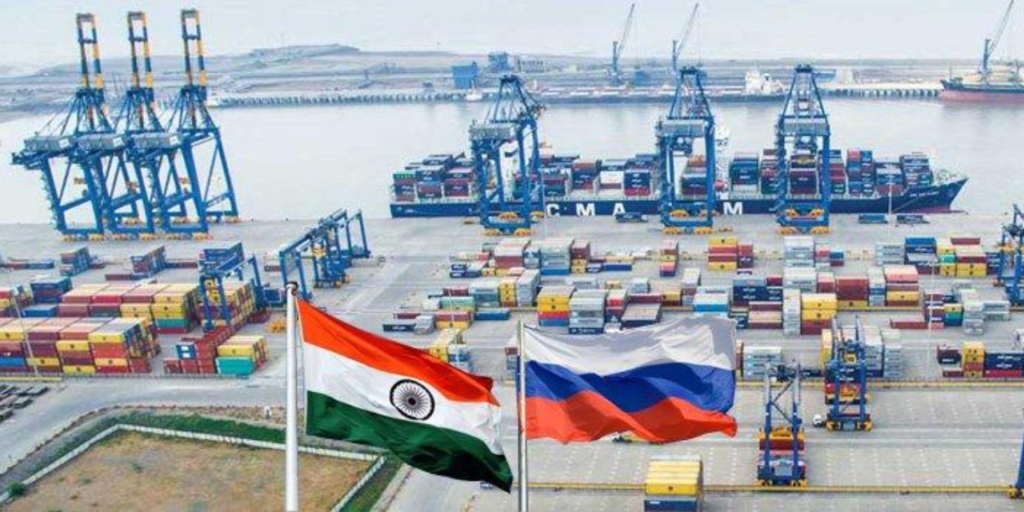
India and Russia are seeking to broaden their long-standing economic relationship beyond traditional trade areas, with manufacturing, technology, logistics, defence and market access emerging as potential areas of cooperation. Bilateral trade reached USD 68.69 billion in 2025-26, while both countries have set targets of USD 100 billion in bilateral trade and USD 50 billion in mutual investment by 2030.
India Emerges as a Global Manufacturing Destination
India and Russia have maintained a long-standing strategic relationship, with cooperation spanning trade, investment, defence and industrial development. The relationship has continued to evolve as both countries explore opportunities to strengthen economic and industrial ties.
For Russian businesses seeking international expansion, India is emerging as an attractive destination because of its large and growing market, young workforce, improving infrastructure and business-oriented policy environment.
India is increasingly being viewed not only as a consumption-driven market but also as a manufacturing base. Over the past decade, the country has focused on improving competitiveness, strengthening logistics infrastructure, developing industrial corridors and promoting domestic manufacturing.
These measures have supported India’s participation in global value chains and created opportunities for Russian companies seeking to participate in India’s manufacturing, technology and industrial development ecosystem.
Strengthening Trade Connectivity and Market Access
As economic engagement expands, trade facilitation has become an important component of the bilateral relationship.
Efforts to reduce trade barriers, improve connectivity, strengthen payment mechanisms and encourage greater business-to-business collaboration are being examined as part of the broader economic relationship.
Discussions around the proposed India-Eurasian Economic Union (EAEU) Free Trade Agreement have also gained importance, with greater market access between the two regions expected to support trade.
In addition, customs cooperation is helping create a more efficient trading environment. The Authorised Economic Operator (AEO) Mutual Recognition Agreement between the customs administrations of India and Russia allows trusted businesses to benefit from faster customs clearances and reduced procedural bottlenecks.
North-South Transport Corridor Gains Importance
Connectivity initiatives such as the International North-South Transport Corridor (INSTC) could help reduce transit time and strengthen commercial linkages between India and Russia.
The corridor is expected to provide an alternative route for trade while supporting more efficient and sustainable movement of goods.
Improved logistics connectivity remains an important element in expanding commercial relations between the two countries.
Opportunities Beyond Energy and Defence
While energy and defence remain important components of India-Russia relations, the scope for economic cooperation extends to several other sectors.
The manufacturing sector presents opportunities for Russian companies to participate in India’s growing industrial ecosystem. Areas including advanced manufacturing, technology and industrial development can provide avenues for joint business activity.
The relationship also offers opportunities in sectors where India has established manufacturing capabilities and where Russian companies can contribute technology, expertise and industrial partnerships.
Building Defence Capabilities Through Joint Development
Defence cooperation remains one of the strongest pillars of India-Russia relations. The two countries have a long history of joint development and production of defence equipment.
Building on this cooperation, opportunities exist for greater participation in India’s growing defence manufacturing ecosystem.
India’s focus on domestic production and technology development provides scope for Russian companies to participate in the country’s expanding defence industrial base.
Financial Connectivity Enters a New Phase
Achieving the bilateral trade target will require stronger financial connectivity and banking cooperation between India and Russia.
Expanding local-currency trade can help reduce dependence on third-country currencies, lower transaction costs and facilitate more direct settlement of commercial transactions.
The development of payment mechanisms that support bilateral trade is therefore an important part of strengthening the economic relationship.
Addressing the Trade Imbalance
Despite the growth in bilateral trade, a significant trade imbalance remains. Increasing Indian exports to Russia could help create a more balanced trade relationship.
Greater export opportunities for Indian manufacturers and suppliers could emerge through stronger market access, improved connectivity and deeper commercial engagement.
Expanding Opportunities Across Industries
Looking ahead, cooperation can extend into advanced manufacturing, aerospace, defence electronics, unmanned systems and emerging technologies.
Other potential areas include pharmaceuticals, chemicals, textiles, energy equipment and digital solutions.
The broader objective is to strengthen industrial cooperation while creating opportunities for businesses in both countries to develop longer-term partnerships.
Strong Foundation for a Balanced Future
India-Russia economic relations have a long-established foundation, but the future of the partnership will depend on expanding cooperation across sectors beyond traditional areas.
For Indian businesses, greater access to the Russian market could support export growth, while Russian companies can explore India’s manufacturing and investment opportunities.
As trade becomes more diversified across sectors and value chains, India-Russia economic cooperation could support a broader industrial partnership focused on manufacturing, technology, investment, connectivity and market access.