
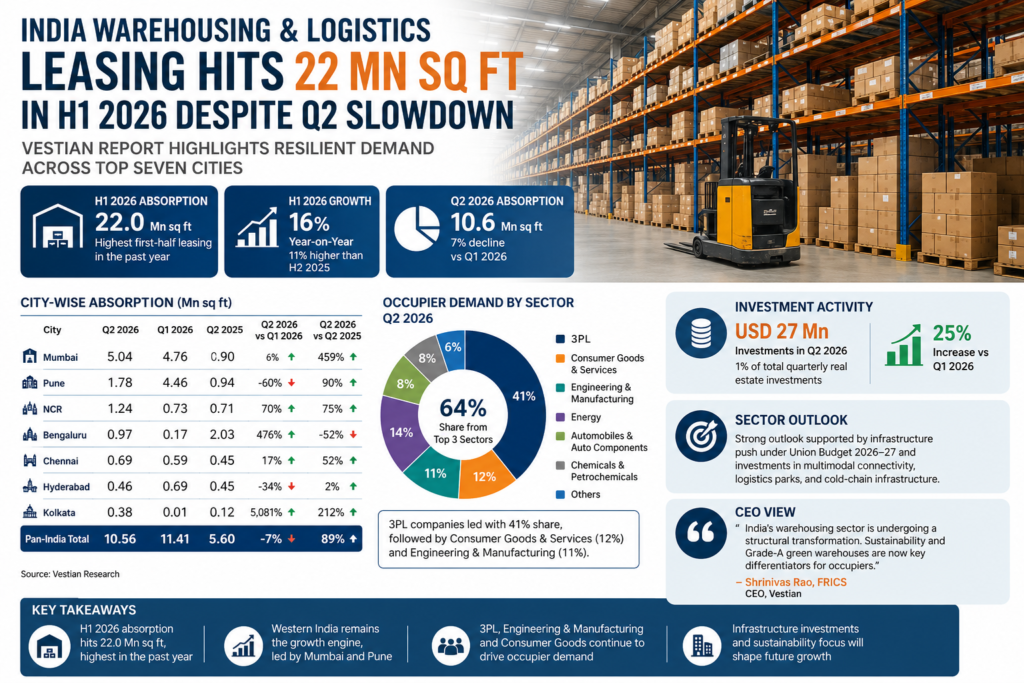
India’s warehousing and logistics sector maintained strong occupier demand during the first half of 2026 despite a moderate slowdown in the second quarter, according to the latest report by Vestian. The top seven cities recorded 10.56 million sq ft of warehousing absorption during Q2 2026, taking the H1 2026 leasing volume to 22.0 million sq ft, the highest first-half absorption recorded in the past year.
Although leasing activity declined 7% quarter-on-quarter, the sector posted a 16% year-on-year increase in H1 2026 absorption and an 11% rise over H2 2025, highlighting the resilience of India’s logistics real estate market amid ongoing global economic uncertainties.
Western India Drives Leasing Activity
Western India continued to dominate the warehousing market during the second quarter, with Mumbai and Pune together accounting for 65% of total pan-India absorption, compared to 33% during the same period last year.
Mumbai emerged as the country’s largest warehousing market, recording 5.04 million sq ft of leasing activity. The city’s performance was largely supported by strong demand in the Bhiwandi micro-market, which contributed nearly 69% of Mumbai’s total absorption.
Pune remained the second-largest market with 1.78 million sq ft of leasing. However, absorption declined 60% compared to the previous quarter after several large transactions were completed during Q1 2026.
Meanwhile, NCR, Bengaluru, Chennai and Kolkata also reported healthy leasing activity, indicating broad-based occupier demand across India’s major logistics hubs.
3PL Companies Continue to Lead Demand
Third-party logistics (3PL) companies remained the largest occupiers during Q2 2026, accounting for 41% of total leasing activity.
Other key demand drivers included:
- Consumer Goods & Services – 12%
- Engineering & Manufacturing – 11%
Together, these three sectors represented 64% of total warehousing absorption during the quarter.
The Energy, Automobiles & Auto Components, and Chemicals & Petrochemicals sectors collectively contributed an additional 22%, reflecting diversified occupier demand across industries.
City-wise Performance
Mumbai registered the strongest performance among all major cities, recording 6% quarter-on-quarter growth and an impressive 459% increase year-on-year, supported by sustained leasing activity in Bhiwandi.
NCR reported 1.24 million sq ft of absorption, increasing 70% over the previous quarter and 75% compared to Q2 2025.
Bengaluru witnessed a significant recovery, with leasing reaching 0.97 million sq ft, its highest quarterly absorption since Q2 2025 following a relatively subdued first quarter.
Chennai maintained positive momentum by recording 0.69 million sq ft, representing 17% sequential and 52% annual growth.
Hyderabad recorded 0.46 million sq ft, declining 34% from the previous quarter while remaining broadly stable on a year-on-year basis.
Kolkata experienced one of the strongest recoveries, with leasing increasing to 0.38 million sq ft, reflecting 212% annual growth after minimal activity during the previous quarter.
Investment Activity Remains Selective
Institutional investors continued to adopt a cautious approach amid global market uncertainty. Total investments in the warehousing and logistics sector stood at USD 27 million during Q2 2026, accounting for 1% of total quarterly real estate investments.
While investment volumes increased 25% compared to the previous quarter, they remained below the levels recorded during the same period last year.
Infrastructure Push Expected to Support Growth
According to Vestian, the sector is expected to benefit from the government’s continued focus on infrastructure development under the Union Budget 2026–27.
Higher capital expenditure alongside investments in multimodal connectivity, dedicated freight corridors, logistics parks and cold-chain infrastructure is expected to improve supply chain efficiency and support the expansion of modern warehousing facilities across the country.
Commenting on the sector’s outlook, Shrinivas Rao, FRICS, CEO, Vestian, said:
“India’s warehousing sector is undergoing a structural transformation, evolving beyond traditional priorities such as supply chain optimization, operational efficiency, and proximity to demand centres. Sustainability has emerged as a key differentiator, with occupiers increasingly seeking Grade-A green warehouses that align with their ESG commitments and long-term business objectives. Backed by supportive government policies and sustained infrastructure development, this transition is expected to accelerate further, reinforcing the sector’s appeal to both global occupiers and long-term institutional investors.”
Outlook
Looking ahead, Vestian expects 3PL, Engineering & Manufacturing, and Consumer Goods & Services to remain the primary drivers of leasing demand. Continued investments in logistics infrastructure, technology-enabled warehousing and supply chain modernization are also expected to support occupier activity while gradually strengthening institutional investor confidence in India’s warehousing and logistics sector.