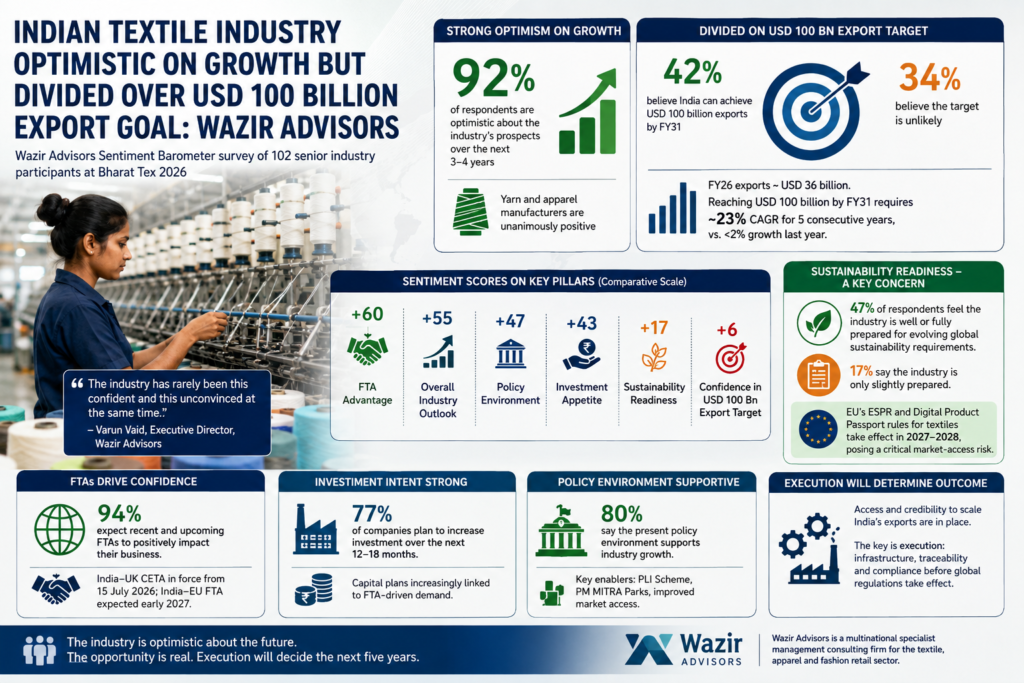
India’s textile and apparel industry is highly optimistic about its medium-term growth prospects but remains cautious about achieving the Government’s ambitious USD 100 billion export target by FY2030-31, according to the latest Indian Textile and Apparel Industry Sentiment Barometer released by Wazir Advisors.
The survey, based on structured interactions with 102 senior industry participants during Bharat Tex 2026 in New Delhi, highlights growing confidence driven by favourable trade agreements and supply chain diversification, while also revealing concerns over execution, infrastructure and sustainability compliance.
92% Confident About Industry Growth
According to the survey, 92% of respondents expressed optimism about the textile and apparel sector’s prospects over the next three to four years. Notably, yarn and apparel manufacturers reported unanimous confidence in future growth.
Industry leaders attributed this positive outlook to structural shifts in global sourcing, particularly the diversification of supply chains away from China and increasing opportunities for India in international markets.
However, confidence declines sharply when it comes to the government’s export ambitions.
Only 42% of respondents believe India’s textile and apparel exports can reach USD 100 billion by FY31, while 34% consider the target unlikely to be achieved.
With India’s textile and apparel exports standing at approximately USD 36 billion in FY26, achieving the target would require an annual compound growth rate of nearly 23% over the next five years—far exceeding the industry’s recent growth trajectory.
Commenting on the findings, Varun Vaid, Executive Director at Wazir Advisors, said the industry is simultaneously optimistic about growth and sceptical about achieving the export target.
He noted that while market access has improved significantly through free trade agreements, the real challenge now lies in execution. According to Vaid, infrastructure development, supply chain readiness and implementation of traceability systems before new European sustainability regulations come into effect will determine India’s export competitiveness over the coming years.
Sustainability Readiness Remains a Concern
The survey identified sustainability compliance as the industry’s biggest challenge.
Only 47% of respondents believe the industry is well or fully prepared for evolving global sustainability requirements, while 17% said the sector is only slightly prepared.
Upcoming regulations such as the European Union’s Ecodesign for Sustainable Products Regulation (ESPR) and Digital Product Passport (DPP) requirements, expected to be implemented during 2027 and 2028, are viewed as critical market-access challenges rather than simple compliance obligations.
Wazir Advisors believes that companies failing to meet these requirements risk losing access to major international buyers.
FTAs Drive Investment Confidence
The survey recorded its strongest positive response on Free Trade Agreements (FTAs).
An overwhelming 94% of respondents expect recently signed and upcoming FTAs to positively impact their businesses. The survey was conducted shortly after the India–UK Comprehensive Economic and Trade Agreement (CETA) came into force on 15 July 2026, while the India–EU Free Trade Agreement is expected to become operational by early 2027.
Reflecting this optimism, 77% of companies plan to increase investments over the next 12–18 months, with many linking future capital expenditure directly to anticipated demand generated by new trade agreements.
In addition, 80% of respondents said the current policy environment supports industry growth, citing initiatives such as the Production Linked Incentive (PLI) Scheme, PM MITRA Parks, and improved international market access.
Sentiment Scores Highlight Industry Priorities
Using a comparative sentiment scale, the survey ranked key industry drivers as follows:
The findings indicate that while India’s textile industry sees significant opportunities through trade agreements and favourable policy support, sustained export growth will depend on faster execution, stronger infrastructure, and improved sustainability compliance.
According to Wazir Advisors, the foundations for expanding India’s textile exports are now largely in place. The next phase of growth will depend on how effectively the industry converts market access into long-term competitiveness through investment, innovation and regulatory preparedness.