
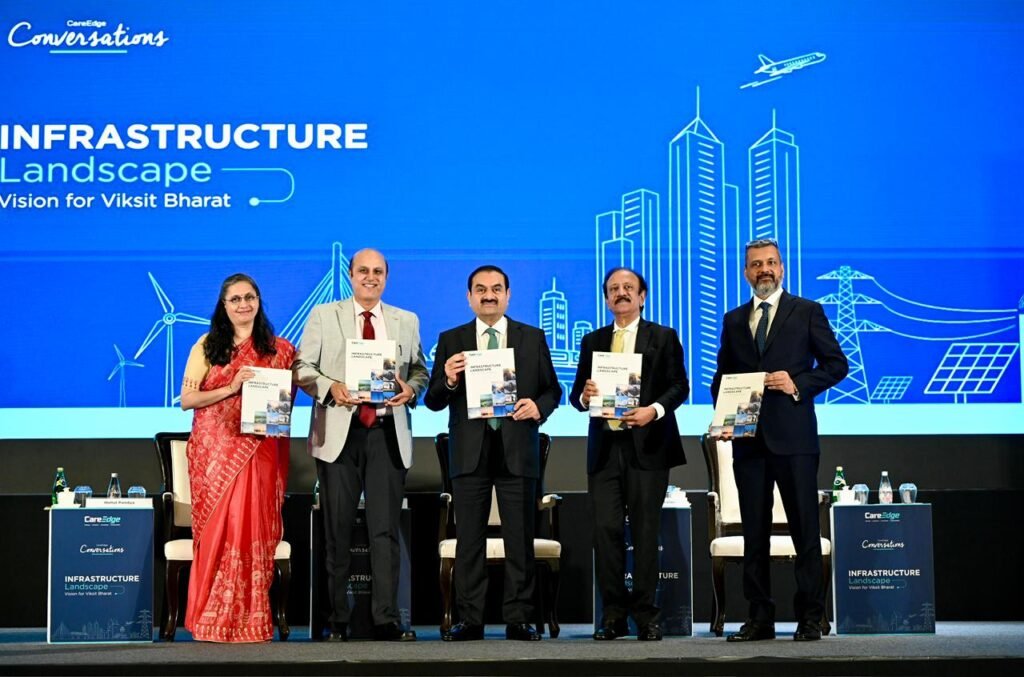
India’s infrastructure sector is entering a new phase of development, shifting its focus from simply creating capacity to building integrated, resilient, efficient and future-ready infrastructure, according to a new report by CareEdge Ratings titled ‘Infrastructure Landscape: Vision for Viksit Bharat’.
The report highlights that achieving the vision of Viksit Bharat 2047 will require a coordinated approach to infrastructure development. Future-ready cities, efficient and clean transportation systems, secure and greener energy networks, globally competitive logistics and digitally enabled public infrastructure will be critical to supporting India’s long-term economic growth.
The report also points to a growing emphasis on asset utilisation, infrastructure monetisation, sustainability, technology adoption and private-sector participation as India moves into the next stage of its infrastructure journey.
Integrated Infrastructure to Drive the Next Decade
India’s infrastructure development is increasingly moving away from isolated projects towards interconnected ecosystems. According to CareEdge Ratings, multimodal connectivity, logistics efficiency, energy security, sustainability and citizen-centric services will need to be planned together to maximise the economic value of infrastructure investments.
Union Government capital expenditure on key infrastructure sectors stood at nearly Rs 38 trillion between FY22 and FY26, while the Union Budget 2026-27 allocated Rs 12.20 trillion for capital expenditure, equivalent to approximately 3.1% of GDP.
Speaking at the event, Gautam Adani, Chairman, Adani Group, called for the development of a comprehensive credit framework capable of evaluating integrated infrastructure platforms and recognising the wider ecosystem and adjacency value created by such projects.
Mehul Pandya, Managing Director and Group CEO, CareEdge, said the sustained government capital expenditure has created a multiplier effect across sectors, services, employment and regional development. He added that improved project visibility and reduced execution risks are also helping attract greater private investment and create opportunities for infrastructure monetisation.
Energy Security Becomes a Key Infrastructure Priority
CareEdge Ratings believes India’s power sector is gradually moving from a capacity-addition challenge to an integration challenge, particularly as renewable energy capacity continues to expand.
Non-fossil fuel sources account for around 50% of India’s installed power capacity, but contribute approximately 29% of electricity generation. This growing renewable capacity will require substantial investments in energy storage, transmission infrastructure and flexible generation.
India’s energy storage requirement is expected to reach approximately 411 GWh by FY32, compared with around 54 GWh of operational storage capacity as of June 2026. CareEdge Ratings estimates that more than Rs 4 lakh crore of investment could be required to meet the projected FY32 storage requirement.
Both Battery Energy Storage Systems (BESS) and Pumped Storage Plants (PSPs) are expected to play important roles in supporting the integration of renewable energy.
Meanwhile, contracted coal-based thermal power assets are expected to retain their relevance by providing reliable electricity and the flexibility required to balance increasing renewable generation.
The transmission sector is also expected to witness significant investment, with an estimated Rs 5.19 lakh crore of capex during FY27-FY31.
Solar Manufacturing Shifts Towards Integration
India’s solar manufacturing industry is entering a phase where backward integration, cost competitiveness and export capabilities are expected to become increasingly important.
Domestic solar module manufacturing capacity reached approximately 210 GWp as of July 2026, compared with estimated annual demand of around 70 GWp.
CareEdge Ratings notes that the potential oversupply of modules, combined with continuing constraints in cells, wafers and polysilicon, could place pressure on capacity utilisation and profitability, particularly for manufacturers without integrated production capabilities.
Manufacturers with capabilities spanning cells, wafers and polysilicon are expected to be better positioned to manage input-cost volatility and increasing competition.
Digital Infrastructure and Smart Metering Gain Strategic Importance
The report identifies smart metering and data centres as increasingly important components of India’s digital infrastructure.
Around 6.5 crore smart meters had been installed by April 2026. CareEdge Ratings believes accelerating prepaid activation will be important to unlocking the programme’s financial and operational benefits.
At the same time, India’s data centre industry is entering a major investment cycle. Data centre capacity is expected to increase to around 7-8 GW during FY27-FY31, compared with approximately 1.5 GW of co-location capacity in 2026.
The rapid growth of artificial intelligence is expected to further drive demand for AI-ready facilities featuring higher power density, advanced computing infrastructure and more efficient cooling systems.
Transport Infrastructure Moves Towards Efficiency and Monetisation
India’s roads sector is entering a more selective and execution-focused phase following a decade of substantial network expansion. CareEdge Ratings maintains a Stable outlook for the sector, supported by operational assets and resilient annuity-based cash flows.
More than half of the National Highway Hybrid Annuity Model (NH-HAM) portfolio is operational, providing greater cash-flow visibility and supporting opportunities for asset monetisation.
In the ports sector, the emphasis is also shifting from simply adding capacity towards better utilisation, cargo generation, productivity and improved first- and last-mile connectivity.
India’s port capacity has increased from around 1,400 MMT in 2014 to 2,818 MMT in 2026, while average vessel turnaround time at major ports has fallen from approximately 96 hours in FY14 to 48.8 hours in FY26.
Private airports are also expected to maintain a stable credit profile, supported by tariff revisions, capacity expansion, non-aeronautical revenue opportunities, healthy operating cash flows and long concession periods.
InvITs Expected to Continue Expanding
Infrastructure Investment Trusts (InvITs) have emerged as an important mechanism for infrastructure financing and asset monetisation.
According to CareEdge Ratings, InvIT assets under management increased from Rs 3.0 lakh crore at the end of FY22 to Rs 7.11 lakh crore by FY26.
The agency expects InvIT AUM to increase by approximately Rs 95,000 crore in FY27, potentially crossing Rs 8 lakh crore, driven by sectors including roads, transmission, warehousing and renewable energy.
While the credit profiles of InvITs are expected to remain robust due to diversified and operational asset portfolios, CareEdge Ratings highlights the need to deepen the domestic investor base, strengthen creditor protections and maintain an appropriate balance between asset valuations, growth ambitions and access to funding.
Building Infrastructure for a Developed India
Revati Kasture, Executive Director, CareEdge Ratings, said infrastructure should increasingly be viewed not only as a driver of economic activity but as a foundation for sustainable, inclusive and resilient growth.
The report emphasises that India’s infrastructure priorities over the coming decade will need to balance economic expansion with sustainability, technology adoption, financial discipline and resilience against climate and economic risks.
As India advances towards its Viksit Bharat 2047 vision, the focus is expected to increasingly shift from building individual assets to developing integrated infrastructure ecosystems capable of supporting economic competitiveness, energy security, efficient mobility and improved quality of life.