
Meghalaya marked a major milestone in its textile and cultural development landscape with the inauguration of its first Integrated Textile Tourism Centre (ITTC) at Nongpoh, Ri-Bhoi. The launch, held on Saturday, accompanied the opening of EKTA Meghalaya (Exhibition-cum-Knowledge Sharing for Textiles Advantage)—a flagship initiative aimed at strengthening the region’s presence on the national textile map.
Union Textiles Minister Giriraj Singh presided over the ceremony, joined by Union Minister of State for Textiles & External Affairs Pabitra Margherita and Meghalaya Textiles Minister Metbah Lyngdoh. Together, they underscored Meghalaya’s growing potential as both a textile powerhouse and a cultural tourism destination.
A Hub for Heritage, Skills, and Tourism
EKTA serves as a comprehensive platform uniting the full spectrum of India’s textile ecosystem—handloom, silk, jute, handicrafts, technical textiles, and state textile missions. By bringing these sectors together, the initiative aims to deepen investments, build stronger market linkages, and promote innovation-driven collaborations across states.
Unveiling the ITTC, Giriraj Singh said the new centre will “empower local artisans, strengthen the textile value chain, promote eco-tourism, and showcase the Northeast’s rich cultural heritage to national and global audiences.”
The ITTC—which has been jointly developed by the Ministry of Textiles and the Meghalaya government—has been envisioned as a multifunctional facility. It integrates heritage displays, skill development infrastructure, entrepreneurship support, and tourism experiences, with a strong focus on the state’s iconic Eri and Muga silk traditions.
Showcasing Meghalaya’s Indigenous Strengths
Union MoS Pabitra Margherita applauded the region’s enduring leadership in natural fibres, indigenous dyeing practices and the pivotal role of women artisans. He called the new complex “a groundbreaking initiative that blends heritage with sustainable tourism and trade. Under the leadership of Prime Minister Narendra Modi, we are committed to empowering artisans in the remotest corners of India.”
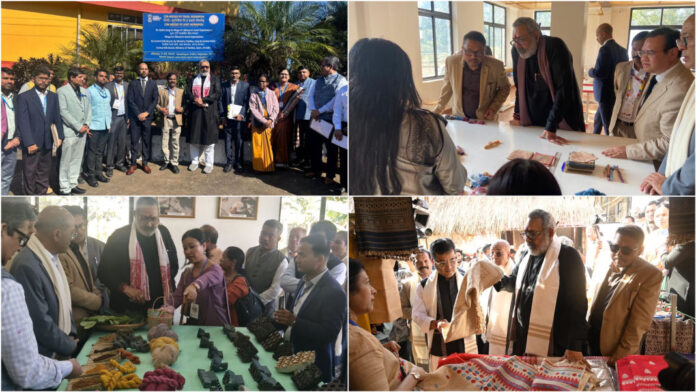
Singh and Margherita also visited the P-3 Muga Seed Farm at Nongpoh, where they engaged with sericulture scientists and farmers. Margherita highlighted the government’s sustained push to enhance Muga silk production—describing it as “the golden pride of the Northeast”—and reaffirmed efforts to increase global visibility for local cultivators.
Strengthening Silk-Based Livelihoods
Central Silk Board Member Secretary P. Sivakumar noted that the EKTA platform will significantly improve coordination between Boards, States and institutions. He emphasised CSB’s commitment to supporting Meghalaya in scaling up Eri and Muga silk output through scientific interventions and stronger market-driven strategies.
With the ITTC now operational, Meghalaya is poised to combine its textile heritage with tourism-led economic opportunities—marking a new chapter for the state’s artisans, entrepreneurs and cultural identity.