
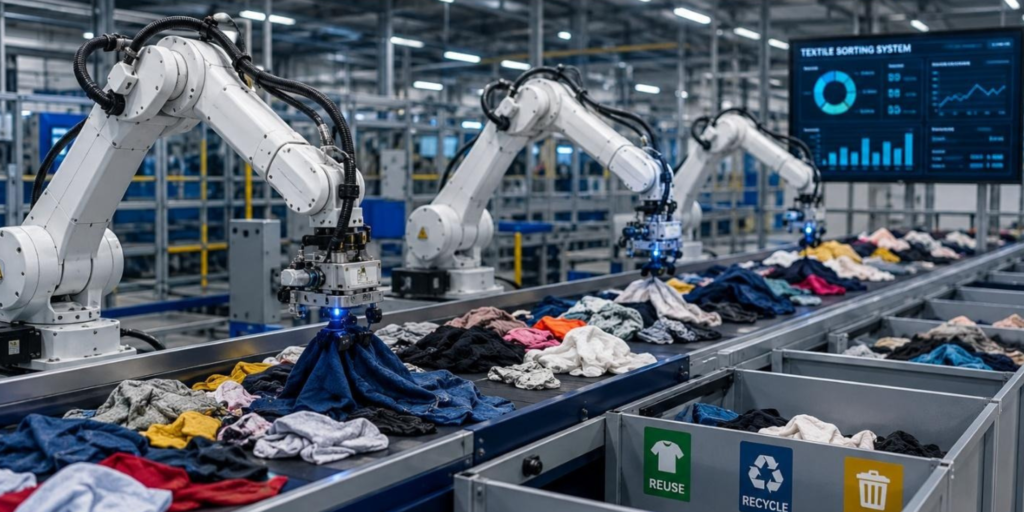
The global robotic textile sorting market is poised for strong expansion over the next decade, driven by rising textile waste, circular economy goals, and growing adoption of AI-powered automation across recycling and waste management operations. According to the latest market estimates, the sector was valued at USD 400.1 million in 2025 and is projected to reach USD 1.12 billion by 2034, growing at a CAGR of 12.1% from 2026 to 2034.
The market’s rapid growth reflects a major shift in the textile and fashion value chain, where traditional manual sorting methods are no longer sufficient to handle increasing volumes of post-consumer garments, industrial textile waste, and mixed-fiber materials. Robotic textile sorting is emerging as a critical solution to improve recycling efficiency, recover high-value materials and reduce dependence on landfill disposal.
Automation becomes central to textile recycling
The textile industry is under increasing pressure to address the environmental impact of waste generated by fast fashion, industrial manufacturing and post-consumer disposal. As global clothing production rises, so does the volume of discarded textiles entering waste streams, creating an urgent need for more efficient and scalable sorting solutions.
Robotic textile sorting systems are designed to automate the identification, classification and separation of textile waste using a combination of artificial intelligence, computer vision, near-infrared spectroscopy, hyperspectral imaging and robotic handling systems. These technologies enable facilities to distinguish between different fibers, colors, garment types, contaminants and reusable versus recyclable materials with far greater speed and precision than traditional manual sorting.
By increasing throughput, improving sorting accuracy and generating cleaner material outputs, robotic systems are becoming an important enabler of fiber-to-fiber recycling, resale preparation, waste diversion and circular textile production.
What robotic textile sorting means for the industry
Robotic textile sorting refers to the automated process of recognizing and sorting textile products and waste using intelligent machines and sensor-based systems. These systems can identify cotton, polyester, wool, nylon, viscose and blended materials, while also detecting damage, contamination and garment type.
Unlike manual sorting, which is labor-intensive and often inconsistent, robotic systems can process thousands of items per hour while continuously learning from textile data. This makes them highly valuable for recycling plants, waste management companies, donation centers, apparel brands and industrial textile manufacturers looking to improve efficiency and sustainability.
The technology is increasingly being viewed as the backbone of modern textile recycling infrastructure, especially as governments and brands move toward circular economy targets and higher textile recycling rates.
Key growth drivers behind the market
The robotic textile sorting market is benefiting from several long-term structural trends reshaping the global textile sector. One of the biggest growth drivers is the rapid increase in textile waste volumes worldwide, driven by rising apparel consumption, shorter product life cycles and limited recycling infrastructure in many markets.
At the same time, demand for recycled fibers is increasing as brands seek alternatives to virgin raw materials and work to meet sustainability targets. Governments in Europe and other regions are also introducing stricter regulations around waste management, extended producer responsibility and textile collection, further accelerating investment in smart recycling technologies.
Other major drivers include:
- Increasing use of automation in waste processing and textile recycling
- Labor shortages and rising costs in manual sorting operations
- Growing pressure on brands to improve traceability and circularity
- Advances in AI, robotics and sensor-based material recognition
- Rising consumer awareness around environmental responsibility and sustainable fashion
Together, these factors are creating a strong commercial case for robotic sorting technologies across the textile recycling ecosystem.
AI, sensors and robotics power next-generation sorting
The market’s expansion is closely linked to rapid innovation in automation and intelligent recognition technologies.
Artificial intelligence plays a key role by enabling sorting systems to identify complex textile blends and continuously improve decision-making through machine learning. Computer vision systems use high-resolution cameras to analyze shape, texture, stitching, labels and defects in real time. Near-infrared (NIR) spectroscopy helps determine fiber composition by reading how materials reflect light, allowing machines to distinguish between cotton, polyester, wool and other textiles with high precision.
At the physical handling level, robotic arms equipped with vacuum grippers, adaptive motion systems and soft handling technologies can sort garments without damaging reusable products. In addition, cloud-based analytics platforms allow operators to monitor performance, optimize workflows and improve equipment maintenance planning.
These technologies are enabling sorting facilities to move away from basic classification and toward more sophisticated, high-purity material recovery models.
Applications expand across the textile value chain
While robotic textile sorting has gained traction primarily in recycling plants, its applications are expanding across the wider textile and apparel ecosystem.
In textile recycling facilities, robotic systems improve the purity of recovered fibers, making them more suitable for reuse in new textile manufacturing. Fashion brands are beginning to explore robotic sorting as part of take-back and circularity programmes to sort returned garments for resale, repair or recycling. Industrial textile manufacturers are using automation to recover production scraps and reduce waste during manufacturing.
The technology is also proving valuable for charity organizations, which need to classify large volumes of donated clothing quickly and efficiently, and for municipal waste management companies aiming to divert textiles from landfills and improve recycling rates.
Circular economy transition fuels market opportunity
The shift from a linear “take-make-dispose” model to a circular textile economy is one of the strongest forces driving investment in robotic textile sorting.
Circular systems depend on the ability to collect, identify, separate and recover textiles for reuse, repair or recycling. Sorting is one of the most important steps in that chain, and automation offers a way to scale the process while maintaining quality and consistency.
As more countries introduce textile waste collection systems and circular fashion policies, demand for high-performance sorting technology is expected to rise sharply. Robotic textile sorting is therefore becoming a strategic investment area not only for recyclers, but also for technology providers, investors and brands seeking more resilient material supply chains.
Challenges remain despite strong momentum
Despite the strong outlook, the market still faces several operational and commercial challenges. Mixed-fiber garments remain difficult to sort accurately due to increasingly complex material compositions, while older garments often lack reliable labeling, forcing systems to rely entirely on sensor-based detection.
High upfront capital costs can also be a barrier for smaller recycling facilities, especially in emerging markets where textile recycling infrastructure is still developing. Integration with legacy systems, workforce training and handling contaminated textile waste also remain practical challenges.
However, continuous improvements in AI models, spectroscopy, cloud analytics and robotic handling are expected to address many of these limitations over time.
Future outlook: toward autonomous textile recycling systems
Looking ahead, the robotic textile sorting market is expected to evolve beyond semi-automated systems toward highly intelligent and increasingly autonomous recycling environments.
Future innovations may include digital garment passports that simplify material identification, blockchain-based traceability systems, autonomous mobile robots for material transport, and self-learning AI systems capable of recognizing increasingly complex blended fabrics. These advances could pave the way for fully automated textile recycling facilities operating with minimal human intervention.
With the market expected to cross USD 1.12 billion by 2034, robotic textile sorting is no longer a niche innovation. It is rapidly becoming one of the most important technologies in the future of sustainable textiles, circular fashion and next-generation recycling infrastructure.