
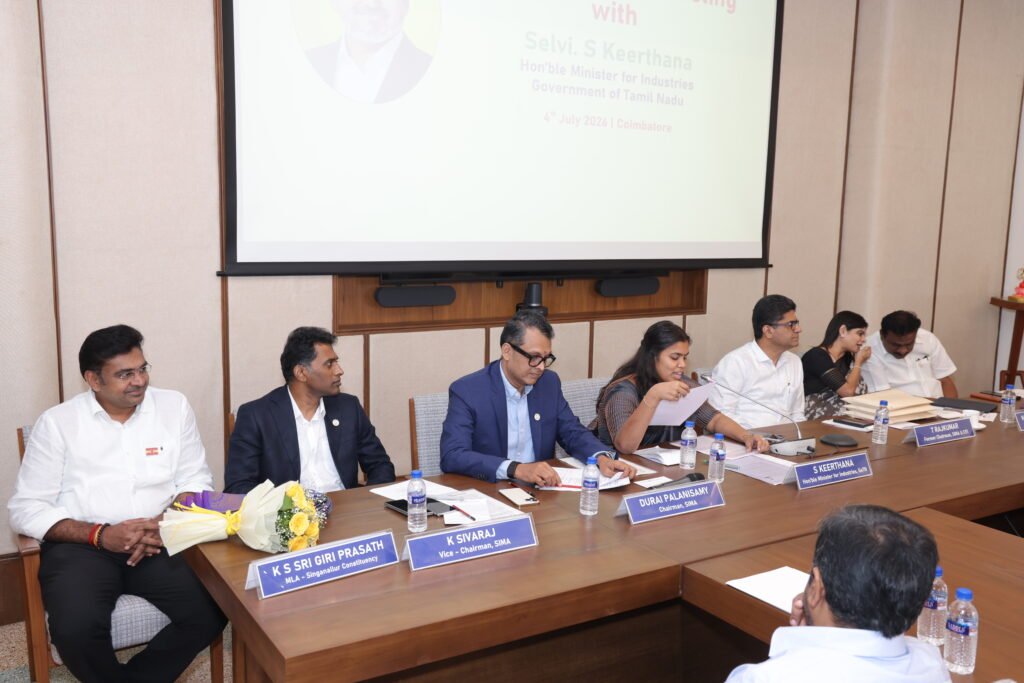
Tamil Nadu’s textile industry has received a renewed policy push after Industries Minister Selvi S. Keerthana urged the sector to gear up for the state’s Vision 2035 goal of becoming a USD 1.5 trillion economy, while also assuring industry leaders that key concerns related to power costs, solar policy, open access and textile effluent treatment would be taken up with the Chief Minister.
The assurance came during a textile industry interaction convened by The Southern India Mills’ Association (SIMA) in Coimbatore, where office-bearers of textile associations representing the full textile value chain in Tamil Nadu met with the Minister to discuss urgent sectoral challenges and policy priorities.
The meeting was attended by representatives from across spinning, weaving, processing and related textile segments, along with MLAs Tmt. Kanimozhi Santhosh (Kavundampalayam), Thiru N.M. Sukumar (Sulur) and Thiru K.S. Sri Giri Prasath (Singanallur).
Tamil Nadu textile sector under pressure despite its national leadership
Tamil Nadu remains one of India’s most important textile hubs, accounting for roughly one-third of the country’s textile business size and serving as a major centre for spinning, knitting, weaving, processing and garmenting. However, the industry has faced growing pressure in recent years due to a sharp rise in production costs, particularly power tariffs and energy-related charges.
Industry leaders pointed out that Tamil Nadu produces only 3–4 per cent of its annual cotton requirement and currently has no man-made fibre manufacturing base within the state, leaving the sector exposed to raw material dependency and logistics costs. Despite these structural disadvantages, the industry has managed to sustain itself through manufacturing efficiency, export strength and entrepreneurial resilience.
Industry credits state support for helping ease recent crisis
The textile associations acknowledged that two recent interventions by the Tamil Nadu government had helped the sector recover from a difficult period.
According to industry representatives, the Chief Minister Thiru C. Joseph Vijay had supported the sector by recommending to the Central Government that cotton imports be exempted from the 11 per cent import duty during the off-season, a move aimed at easing raw material pressure. The government also refrained from implementing a proposed 3.48 per cent electricity tariff hike, helping mills and textile units manage export commitments and stabilise operations.
These measures, the industry said, played an important role in helping the sector bounce back from a period of severe stress.
Minister promises time-bound action on textile sector demands
At the SIMA-led interaction, Industries Minister Selvi S. Keerthana reportedly assured representatives that the demands raised by textile associations would be placed before the Chief Minister and pursued in a time-bound manner.
She acknowledged the urgent need to address power-related issues, which continue to weigh heavily on spinning, weaving and processing units across the state. The Minister also recognised the difficulties faced by the textile processing sector, often seen as one of the most vulnerable links in Tamil Nadu’s textile value chain due to high compliance costs, water treatment challenges and energy intensity.
In a significant indication of policy support, the Minister also suggested that the state could move toward improving ease of doing business by forming a Policy Advocacy Committee that would include major textile stakeholders and serve as a structured platform for resolving industry issues.
SIMA submits key policy demands on power, solar and effluent treatment
In a press statement issued after the meeting, SIMA Chairman Mr. Durai Palanisamy outlined a set of specific requests made to the Industries Minister on behalf of the textile sector. These demands were largely focused on reducing energy costs, improving renewable power utilisation and creating long-term support for processing units.
The requests included:
- Annual banking facility for windmills commissioned after 2018 for captive consumers
- Permission to adjust excess solar generation produced during the day against night-time consumption between 10 p.m. and 6 a.m.
- Waiver of penal interest on pending deemed demand charges to enable quicker settlement
- Freezing demand charges at the existing rate of Rs 608 per kVA per month for three years
- Withdrawal of network charges on rooftop solar power generation
- Exemption of open access power from cross subsidy and additional surcharges for 10 years for new investments
- A long-term, cost-competitive solution for textile effluent treatment and disposal
These demands reflect the industry’s growing concern that high power costs and policy uncertainty are eroding competitiveness, particularly at a time when global buyers are pushing for both lower costs and higher sustainability standards.
Power cost and processing remain the sector’s most urgent pain points
Among all the issues raised, electricity and energy policy remain at the centre of the textile sector’s concerns. Tamil Nadu’s textile industry, especially spinning and processing units, is heavily energy-intensive, and rising costs related to demand charges, open access surcharges and renewable power restrictions have significantly affected profitability.
At the same time, the textile processing sector continues to face major challenges linked to wastewater treatment, environmental compliance and operational viability. Industry bodies have repeatedly argued that unless a viable and affordable long-term solution for textile effluent treatment is put in place, the processing segment will remain under severe strain.
Because processing is a critical link in the textile value chain, any sustained weakness in the segment could impact the state’s broader textile competitiveness, particularly in value-added exports.
Vision 2035 puts pressure on industry and government to work together
The interaction comes at a crucial time for Tamil Nadu’s industrial policy roadmap. With the state targeting a USD 1.5 trillion economy under Vision 2035, textiles remain one of the sectors most central to employment, exports and regional industrial development.
For the state to meet that ambition, industry leaders believe Tamil Nadu will need to protect and modernise its textile ecosystem through lower energy costs, infrastructure support, sustainability investments, easier approvals and more competitive manufacturing conditions.
The proposed Policy Advocacy Committee, if implemented, could become an important mechanism for bridging the gap between policy and execution, particularly for a sector as large and diverse as textiles.
A critical moment for Tamil Nadu’s textile future
The SIMA-led meeting underscores the extent to which Tamil Nadu’s textile sector is at a turning point. While the industry remains one of India’s strongest manufacturing and export engines, its long-term growth will increasingly depend on how quickly policy support can address the twin pressures of cost competitiveness and sustainability transition.
With the Industries Minister now indicating a willingness to take up the sector’s concerns at the highest level, the coming months could prove significant for decisions related to power reforms, solar usage, open access policy, demand charges and textile processing support.
For an industry that forms the backbone of Tamil Nadu’s manufacturing economy, the outcome of these discussions could shape not only its competitiveness, but also its contribution to the state’s Vision 2035 ambitions.