
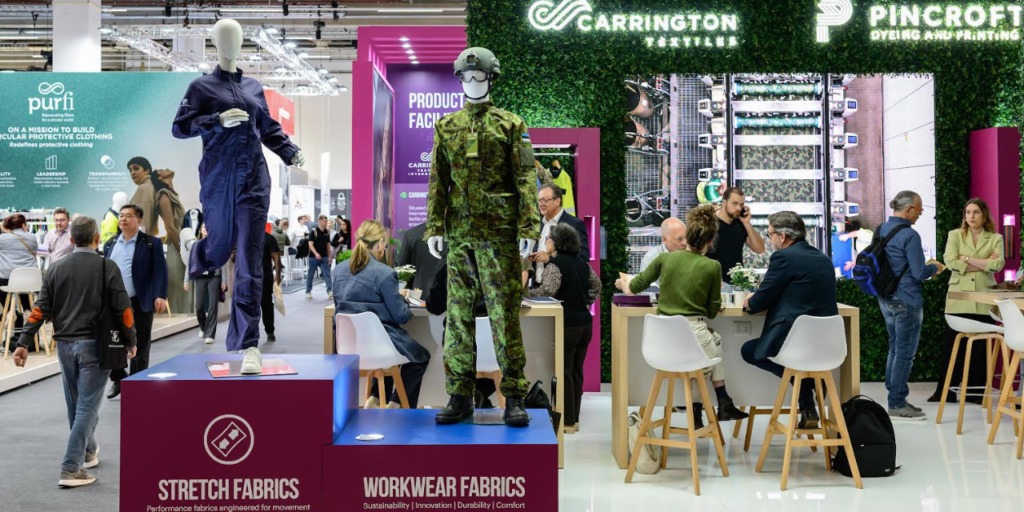
Frankfurt am Main, 24 April 2026. With over 36,000 visitors and 1,700 exhibitors from 112 countries, Techtextil and Texprocess 2026 demonstrated how innovation is being applied in real-world industrial settings. The convergence of research, industry, and application created a strong platform for advancing material solutions, manufacturing methods, and processing technologies. Natural fibres, performance apparel, connected systems, and AI-driven processing technologies emerged as key growth areas and future markets.
Techtextil and Texprocess 2026 concluded with strong participation from both visitors and exhibitors. With more than 36,000 visitors and 1,700 exhibitors, the leading international trade fairs created opportunities for new business and partnerships. Visitor satisfaction remained high at 95 per cent, while exhibitor satisfaction reached 86 per cent overall and 90 per cent at Texprocess. The perceived quality of visitors also increased by 13 per cent. These results confirm the events’ role as leading global platforms for launching innovations and bringing them into practical use with the right partners. Accordingly, expected post-fair business has increased significantly.
In a challenging market environment, the events provided a stable global meeting place, attracting participants from 112 countries. The top visiting countries included Germany, Italy, France, Türkiye, the Netherlands, Spain, Belgium, the United Kingdom, Poland, and Switzerland, while growth was seen from India, Japan, Portugal, Sweden, and the USA.
“Volatile market developments are driving lasting changes in business models. Connectivity, flexibility and speed are key success factors in this environment. At Techtextil and Texprocess, relevant partners come together to rapidly translate ideas into applications. New materials and innovations on supply chains are decisive competitive advantages,” says Detlef Braun, Member of the Executive Board of Messe Frankfurt.
Collaboration between research, industry, and application partners remains essential for developing new solutions. This is reflected in the Techtextil and Texprocess Innovation Awards 2026, where many award-winning innovations were created through partnerships. For example, Samsara Eco worked with Deakin University, The Lycra Company, Nilit, and Lululemon to develop an enzyme-based recycling technology.
Textile innovations continue to find applications across sectors, from protective clothing to medical and automotive uses. New opportunities often arise through unexpected collaborations between manufacturers, processors, and application partners. “At Techtextil and Texprocess, it becomes clear which solutions can succeed in cross-industry markets and secure investment. At the same time, unplanned encounters with new business partners open up access to new markets – and drive innovation,” says Olaf Schmidt, Vice President Textiles & Textile Technologies at Messe Frankfurt.
Natural performance solutions reducing reliance on fossil resources
The Nature Performance segment at Techtextil showcased natural and bio-based alternatives to synthetic fibres. These materials combine sustainability with high performance, offering CO2 savings, recyclability, and reduced dependence on fossil resources. More than 110 exhibitors demonstrated their growing industrial applications. Cordenka presented compostable technical viscose fibres for agriculture, while Oceansafe introduced a high-performance polymer made from bio-based and recycled materials that can be scaled for industrial use.
Market-ready high-performance textiles for apparel
The Performance Apparel Textiles segment saw strong growth, with the number of exhibitors doubling compared to the previous edition. Increased investment in security, defence, and civil protection is driving demand for durable, standards-compliant textiles and advanced processing technologies. Exhibitors presented innovative materials for outdoor, sports, fashion, military, and industrial safety applications. Texprocess complemented this with processing technologies required to meet these demands. Concordia showcased a durable, permanently flame-retardant fabric, while Advance Hitech Textile International introduced a stretch fabric for workwear with enhanced abrasion resistance, dimensional stability, and colour fastness.
Connected, demand-driven systems and efficient processing technologies
At Texprocess, visitors gained a comprehensive market overview to support investment decisions in a challenging environment. A clear trend emerged: alongside processing machinery, connected solutions are becoming increasingly important across the production chain. These systems integrate processes from design and resource planning to manufacturing, enabling more flexible, demand-driven production.
“The future of apparel production lies in connected supply chains and holistic business models. Innovative system architecture and efficient technologies are crucial for responding flexibly to market demands and customer needs. The latest developments were presented at Texprocess,” says Elgar Straub, Managing Director of VDMA Textile Care, Fabric and Leather Technologies.
Companies presented advanced solutions across the value chain. Style3D | Assyst introduced AI-driven tools for product development that streamline processes and reduce costs. Comelz demonstrated a cutting system using artificial image processing to minimize manual steps, while Dürkopp Adler unveiled a new sewing system designed for easy integration through smart interfaces.