
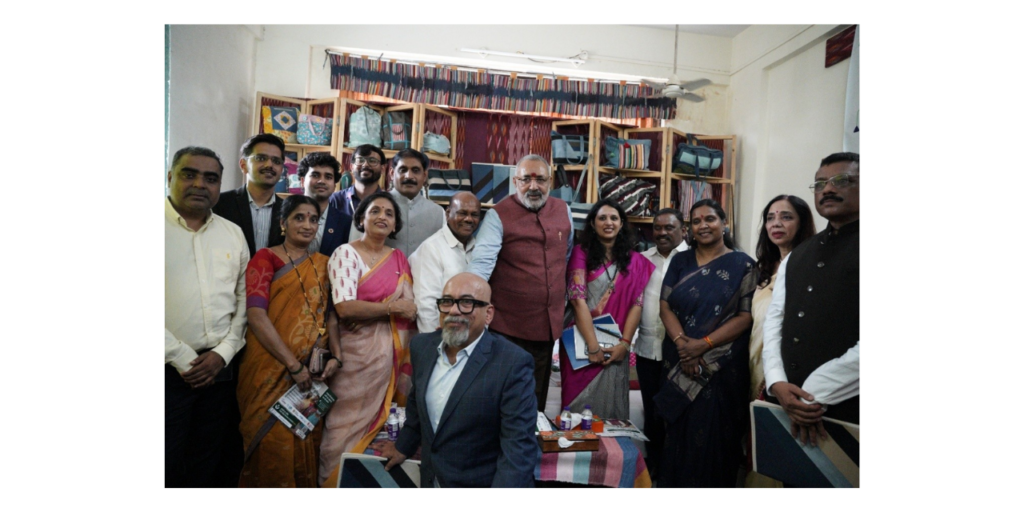
Union Minister of Textiles Shri Giriraj Singh visited the Textile Recovery Facility (TRF) in Navi Mumbai on Saturday, August 22, during the Foundation Day of the Textiles Committee. The Minister reviewed the facility’s textile waste recovery operations and called for stronger recycling and circularity across India’s textile value chain.
During the visit, a Letter of Intent (LoI) was signed between the Textiles Committee and ReFiber to develop a digital circular textile infrastructure platform focused on the collection of post-consumer textiles, traceability and impact measurement.
Minister Calls for Wider Textile Recycling
Interacting with project partners, Shri Giriraj Singh stressed the importance of increasing textile recycling to reduce dependence on natural resources.
The Minister also suggested that the initiative should be expanded beyond the Navi Mumbai Municipal Corporation (NMMC) area, creating the potential for a wider, technology-enabled textile recovery network.
He appreciated the collective efforts of the Textiles Committee, NMMC, SBI Foundation and Tisser Artisan Trust in establishing systems for textile collection, sorting, upcycling and recycling.
The Minister also commended the use of technology developed by Kosha to segregate discarded clothes according to their fibre groups, supporting more efficient downstream recovery.
Technology at the Centre of Textile Recovery
During his visit, Shri Giriraj Singh inspected the facility’s end-to-end processing operations.
The TRF incorporates processes including:
- Automated textile sorting
- Fibre identification
- Shredding
- Secondary material recovery
- Collection and processing of post-consumer textiles
- Recovery of pre-consumer textile waste
The facility is designed to divert textile waste away from municipal landfills and direct recovered materials towards appropriate reuse, upcycling and recycling pathways.
The integration of fibre identification and automated sorting is particularly significant because accurate fibre segregation can help determine the most suitable recovery route for discarded textiles.
Digital Infrastructure for Circular Textiles
The LoI between the Textiles Committee and ReFiber represents another step towards building a more structured digital infrastructure for textile circularity.
The proposed platform will focus on collection, traceability and impact measurement, potentially creating greater visibility over the movement of textiles from disposal through recovery.
Such digital systems can help stakeholders track collected material, improve accountability and generate data on the environmental impact of textile recovery activities.
Expanding the Circular Textile Economy
The Navi Mumbai facility forms part of a broader collaborative effort to establish organised systems for managing post-consumer textile waste.
By bringing together government institutions, municipal authorities, foundations, technology providers and circularity organisations, the project seeks to address one of the key gaps in the textile value chain: what happens to textiles after consumer use.
The Minister emphasised that robust textile recovery frameworks will be important for supporting India’s climate commitments and strengthening the country’s ambition to become a global hub for sustainable textile manufacturing.
Building a Scalable Recovery Model
The suggestion to expand the initiative beyond NMMC could provide an opportunity to develop a scalable model for textile recovery across other cities and regions.
A wider network combining collection, fibre-level sorting, traceability, upcycling and recycling could help increase the volume of textiles diverted from landfills while creating new opportunities for recovered fibres and materials.
As India’s textile industry continues to focus on sustainability and resource efficiency, organised post-consumer textile recovery is becoming an increasingly important component of the circular textile economy.
Dignitaries Attend the Visit
The visit was attended by Development Commissioner (Handlooms) Dr. M. Beena; Textile Commissioner and Vice Chairperson, Textiles Committee, Smt. Vrunda Manohar Desai; NMMC Commissioner Shri Kailas Shinde; Deputy Mayor Shri Dashrath Bhagat; Director (MR) and Project Coordinator (TRF), Textiles Committee, Dr. Tapan Kumar Rout; and Founder, Tisser Artisan Trust, Dr. Megha Phansalkar.
The visit and the signing of the LoI underline the growing emphasis on creating an organised and technology-driven ecosystem for textile waste management in India.
With digital traceability, fibre identification and automated recovery becoming increasingly integrated into textile waste management, initiatives such as the Navi Mumbai TRF could help accelerate India’s transition towards a more circular, resource-efficient and sustainable textile industry.