
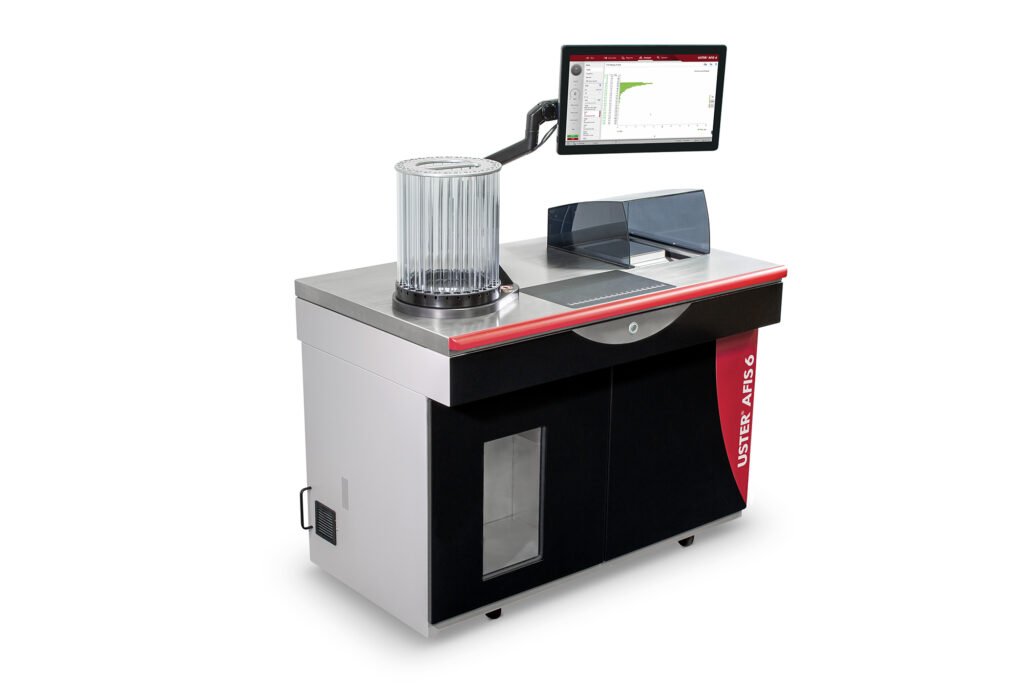
Uster has unveiled a major innovation for the textile recycling industry with the launch of the Recycling Opening Index (ROI), a new measurement tool designed to help spinners improve the quality, processability and profitability of recycled fiber blends. The innovation is part of the new R Recycling Module for Uster AFIS 6 and was officially introduced at ITM 2026 in Istanbul, Türkiye.
As sustainability and circularity become increasingly important across the global textile industry, recycled cotton has emerged as a strategic solution to address textile waste, resource scarcity, environmental impact and evolving regulatory requirements. However, ensuring consistent quality when processing recycled fibers remains one of the industry’s biggest challenges.
Recognizing this need, Uster has developed the Recycling Opening Index (ROI), providing spinners with objective data to evaluate the effectiveness of fiber opening processes and make more informed production decisions.
Growing Importance of Textile Recycling
Industry data indicates that approximately 75% of textile waste originates from post-consumer sources, while the remaining 25% comes from post-industrial or pre-consumer waste. Despite representing a smaller share of total waste, post-industrial textile waste currently accounts for nearly 95–99% of recycled textile materials due to its cleaner, more consistent and easier-to-process characteristics.
Many spinning mills begin their recycling initiatives using post-industrial waste because it offers predictable processing behavior and allows manufacturers to refine production techniques before incorporating more complex post-consumer materials into fiber blends.
Introducing the Recycling Opening Index
The Recycling Opening Index (ROI) is a new metric within the Uster AFIS 6 R Recycling Module that measures the effectiveness of cotton fiber opening during recycling processes. It is calculated as the ratio between successfully opened fibers and remaining yarn pieces, commonly known as hard ends.
The module also measures the total number of yarn pieces present in recycled raw materials that have not yet been completely separated into individual fibers.
According to Uster, a low ROI value signals inadequate opening performance, which can negatively affect spinning operations. Poor opening can contribute to yarn irregularities, increased imperfections, weak spots and uneven yarn surface structures, ultimately reducing yarn quality and manufacturing efficiency.
For the first time, textile manufacturers can obtain a quantitative assessment of recycled cotton opening performance, enabling more precise process control and improved raw material evaluation.
Enhanced Process Control for Recycled Fiber Blends
The new R Recycling Module provides a comprehensive set of advanced measurements that support better decision-making throughout the recycling process. By combining ROI data with yarn piece analysis, spinners gain deeper insight into the quality and suitability of recycled raw materials.
In addition to ROI, the module offers enhanced short fiber content analysis, including measurement of fibers shorter than 6.35 millimeters, which are generally considered non-spinnable. The system also provides detailed evaluations of fiber length, nep content and other critical fiber quality parameters.
These advanced analytics help manufacturers optimize blending strategies, improve spinning performance and achieve higher-quality yarn production from recycled materials.
Supporting Circular Textile Production
The R Recycling Module is available as an optional feature exclusively for the latest Uster AFIS 6 platform. It complements the system’s expanded measurement capabilities for synthetic fibers, including detailed analysis of cut length and fiber fineness, helping manufacturers make more accurate raw material selections.
The updated reporting package simplifies complex data interpretation, while integrated Uster Statistics enables mills to benchmark performance and optimize intermediate process stages more effectively.
By providing measurable insights into recycled fiber quality and opening efficiency, Uster aims to support textile producers in achieving stronger sustainability goals without compromising operational performance or profitability.
As demand for recycled materials continues to grow across global textile supply chains, innovations such as the Recycling Opening Index are expected to play an increasingly important role in enabling high-quality, commercially viable circular textile production.