
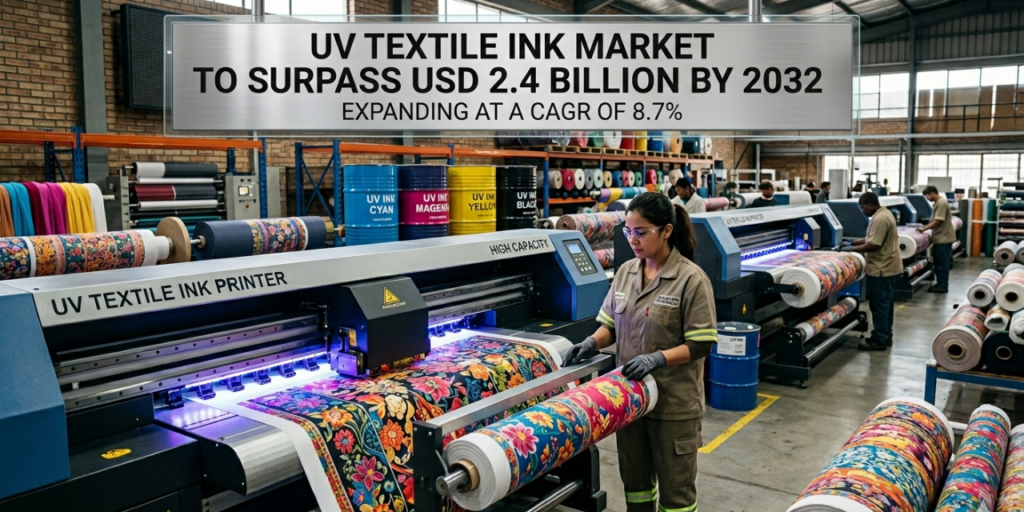
According to the latest analysis by Marketintelo, the global UV Textile Ink market is experiencing rapid growth, fueled by the increasing adoption of digital textile printing and stricter sustainability requirements. The market was valued at around USD 1.1 billion in 2024, rising from USD 0.96 billion in 2023, reflecting a strong year-on-year growth of 14.6%.
The growing preference for eco-friendly, low-VOC inks is significantly boosting demand. UV-curable inks, in particular, help reduce water consumption by nearly 60–70% compared to conventional dyeing methods, making them highly attractive for applications in apparel and home textiles.
Historical Market Performance (2016–2024): Transition to Mainstream Adoption
Over the past decade, the UV Textile Ink market has evolved from a niche segment into a widely adopted industrial solution. In 2016, the market was valued at approximately USD 520 million and grew at a CAGR of 9.8% between 2016 and 2020. Despite pandemic-related challenges, the market reached USD 780 million in 2020, supported by rising demand for customized and on-demand printing.
The recovery phase was strong, with the market reaching USD 890 million in 2021 and surpassing USD 1.02 billion in 2022.
Year-wise growth trends include:
• 2019–2020: Growth slowed to 4.2% due to supply chain disruptions
• 2020–2021: Strong recovery with 14.1% growth
• 2021–2022: Stable growth at 13.5%
• 2022–2023: Growth increased to 12.9%
• 2023–2024: Accelerated to 14.6%
This steady upward trend highlights growing industrial adoption and continuous technological advancements.
Key Market Highlights:
• Market size (2024): USD 1.1 billion
• Projected size (2032): USD 2.4 billion
• CAGR (2025–2032): 8.7%
• Digital printing penetration: 38% in 2024, expected to reach 55% by 2030
• Energy savings: Up to 30% lower than conventional curing methods
• Print speed: 20–25% faster than solvent-based inks
• Adoption rate: Increased from 18% in 2018 to 34% in 2024
Growth Drivers:
The expansion of the UV Textile Ink market is closely linked to digital transformation in textile manufacturing. Global digital textile printing volume reached 16 billion square meters in 2024, up from 12.5 billion in 2022, marking a 28% increase.
Sustainability regulations are another key factor, with over 65% of European textile manufacturers partially adopting UV-curable inks to meet environmental standards. Additionally, the rise of fast fashion and customization has increased short-run production by 40% since 2019, further driving demand.
Government support is also contributing to growth:
• Asia-Pacific invested over USD 1.8 billion in textile modernization (2020–2024)
• EU allocated USD 750 million for sustainable textile technologies
Market Challenges:
Despite strong momentum, the market faces certain limitations. UV ink systems require specialized printers that cost 20–30% more than conventional equipment. Compatibility issues with substrates remain, with about 22% of manufacturers reporting adhesion challenges on natural fibers like cotton.
Operational costs are also higher, with UV lamp maintenance contributing to 10–15% increased expenses compared to water-based systems.
Regional Insights:
Asia-Pacific:
The region leads the market with a 42% share in 2024, valued at USD 462 million. China and India account for over 65% of regional demand. Growth is expected at a CAGR of 9.5%, supported by strong textile exports exceeding USD 900 billion annually.
North America:
Holding a 24% share, the market is valued at USD 264 million in 2024. The U.S. drives adoption, with nearly 48% of facilities using UV ink systems. Growth is projected at a CAGR of 7.8%.
Europe:
Europe accounts for 21% of the market, valued at USD 231 million. Sustainability adoption is highest here, with 70% of manufacturers using eco-friendly inks. Germany, Italy, and France contribute 58% of regional revenue.
Rest of the World:
Latin America and the Middle East & Africa collectively represent 13% of the market, valued at USD 143 million, with growth exceeding 8.2% CAGR.
Competitive Landscape:
The market is moderately consolidated, with the top five players accounting for around 48% of global revenue.
Key industry metrics include:
• Production capacity: 25,000–40,000 tons annually
• R&D investment: 6–9% of revenue
• Innovation cycles reduced from 24 to 14 months
Advancements in nano-pigment technology have improved color vibrancy by 35% and durability by 20%.
Future Outlook (2025–2032):
The UV Textile Ink market is expected to maintain strong growth momentum, reaching USD 1.25 billion in 2025 and USD 1.48 billion by 2027. By 2030, it is projected to surpass USD 2.0 billion, driven by demand in sportswear, home décor, and technical textiles.
Technological innovations such as AI-driven print calibration and hybrid UV-LED systems are expected to enhance efficiency by 15–20%. Additionally, global sustainability targets aim to reduce textile water consumption by 50% by 2030, positioning UV inks as a key solution.
Conclusion:
The UV Textile Ink market shows a strong and consistent growth trajectory, expanding from USD 520 million in 2016 to USD 1.1 billion in 2024, and expected to reach USD 2.4 billion by 2032. With an 8.7% CAGR, rising adoption rates, and strong demand led by Asia-Pacific, the market is well-positioned for long-term expansion.
Key advantages such as 30% energy savings, 60–70% reduction in water usage, and increasing digital printing penetration reinforce its importance. As sustainability regulations tighten and customization trends grow, UV textile inks will continue to play a crucial role in the future of textile printing.