
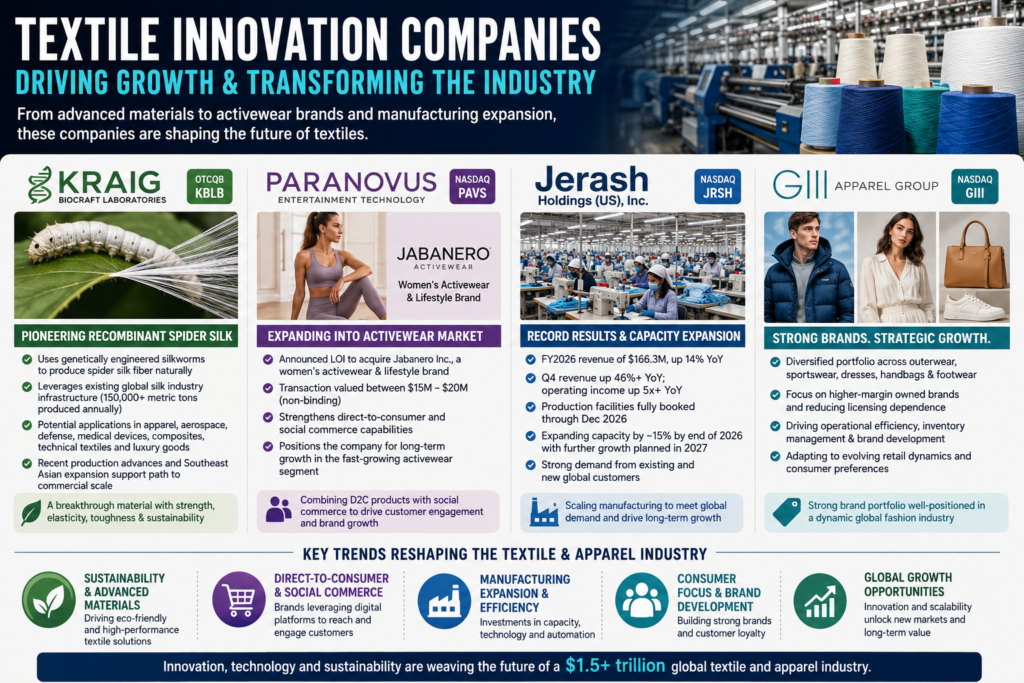
The global textile and apparel industry is undergoing a significant transformation as companies embrace advanced materials, sustainable production methods, innovative consumer products and expanded manufacturing capabilities.
While traditionally viewed as a mature sector, the industry is increasingly attracting investor interest due to breakthroughs in textile technology, supply chain innovation and rapidly evolving consumer demand.From recombinant spider silk and next-generation performance materials to direct-to-consumer activewear brands and large-scale manufacturing expansion, several companies are emerging as key players in shaping the future of textiles.
Kraig Biocraft Laboratories Advances Recombinant Spider Silk Technology
Among the most closely watched innovators is Kraig Biocraft Laboratories (OTCQB: KBLB), which continues to advance its efforts to commercialize recombinant spider silk through its genetically engineered silkworm platform.
Unlike competing technologies that rely on fermentation-based production methods, Kraig Biocraft utilizes genetically modified silkworms capable of naturally spinning spider silk fibers. This approach leverages the existing global silk production infrastructure, potentially offering a scalable and cost-effective path to commercialization.
Spider silk has long been recognized for its exceptional combination of strength, elasticity, toughness and lightweight properties. Industry experts believe successful commercialization could unlock applications across apparel, aerospace, defense, medical devices, technical textiles, composites and luxury goods.
Recent developments, including the company’s BAM-1 hybrid production systems and manufacturing expansion initiatives in Southeast Asia, demonstrate its focus on transitioning from research and development to commercial-scale production.
Paranovus Expands Consumer Brand Strategy
Paranovus (NASDAQ: PAVS) has announced a non-binding Letter of Intent to acquire Jabanero Inc., a women’s activewear and lifestyle brand, in a deal valued between $15 million and $20 million.
The proposed acquisition marks another step in the company’s broader transformation strategy, expanding its presence beyond digital commerce and livestreaming operations into proprietary consumer brands.
Management believes the combination of direct-to-consumer products and social commerce capabilities could strengthen growth opportunities while enhancing customer engagement and brand loyalty.
The move also reflects growing investor interest in the activewear segment, which continues to benefit from strong demand driven by health, wellness, fitness and athleisure trends worldwide.
Jerash Holdings Delivers Record Financial Performance
Jerash Holdings (NASDAQ: JRSH), a leading apparel manufacturer, recently reported one of the strongest financial performances in its history, highlighting the resilience and growth potential of the global apparel manufacturing sector.
The company recorded annual revenue of $166.3 million for fiscal year 2026, representing a 14 percent increase compared to the previous year. It also returned to strong profitability as demand increased from both established global customers and newly acquired business relationships.
The fourth quarter proved particularly impressive, with revenue rising more than 46 percent year-over-year and operating income increasing more than five times compared to the same period last year.
To support future growth, Jerash is investing in manufacturing expansion projects expected to increase production capacity by approximately 15 percent by the end of 2026, with further expansion planned through 2027.
G-III Apparel Focuses on Brand Growth and Operational Efficiency
G-III Apparel Group (NASDAQ: GIII) remains a significant player within the global fashion industry as it continues to strengthen its portfolio of owned and licensed brands.
The company operates across multiple apparel categories, including outerwear, sportswear, dresses, handbags and footwear, providing diversified exposure to changing consumer trends.
Recent strategic initiatives have focused on expanding higher-margin owned brands while reducing dependence on licensing agreements. At the same time, management continues to prioritize operational efficiency, inventory optimization and long-term brand development.
Industry analysts view G-III’s evolving business model as an example of how established apparel companies are adapting to changing retail dynamics and consumer preferences.
Innovation Reshaping the Future of Textiles
The developments across these companies highlight broader trends transforming the textile and apparel industry. Sustainability, advanced materials, digital commerce, manufacturing modernization and consumer-centric product development are increasingly becoming key competitive differentiators.
As businesses invest in breakthrough technologies and scalable production systems, investors are paying closer attention to companies capable of delivering innovation while meeting growing global demand.
Whether through revolutionary materials such as recombinant spider silk, expanding consumer brands, or modern manufacturing facilities, the next generation of textile companies is redefining an industry that continues to evolve far beyond traditional fabric production.