
Growing infrastructure investment, urbanisation and demand for high-performance concrete are driving the global concrete fiber market
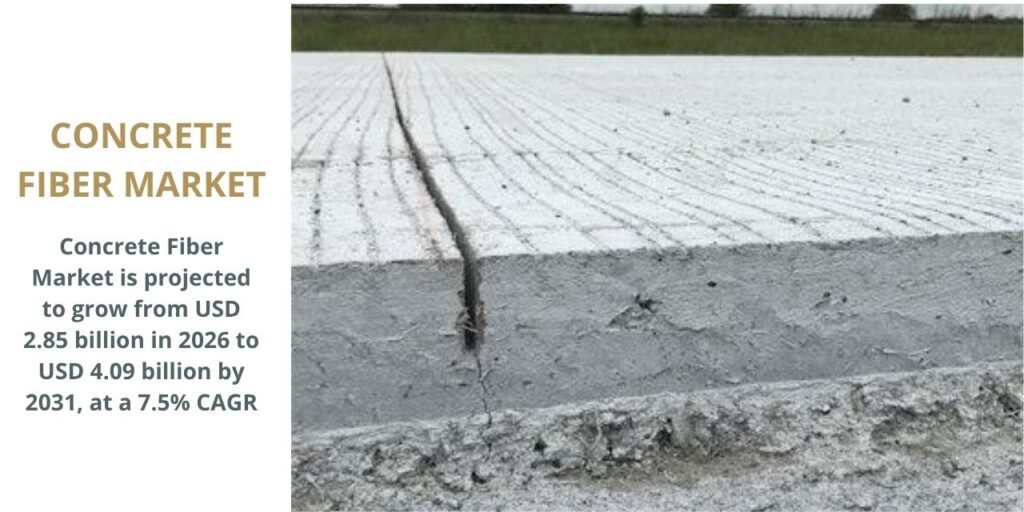
The global concrete fiber market is projected to grow from USD 2.85 billion in 2026 to USD 4.09 billion by 2031, registering a compound annual growth rate (CAGR) of 7.5%, according to a new market study.
The market is being supported by accelerated infrastructure development, rapid urbanisation and increasing construction activity across residential, commercial, industrial and transportation sectors.
As construction projects demand greater durability and structural performance, fiber-reinforced concrete is gaining wider adoption. The incorporation of fibers can improve properties including crack resistance, tensile strength, impact resistance and overall structural integrity.
Concrete fibers are increasingly being used in applications such as slabs and floors, precast concrete, shotcrete, pavements, tunnels and mining projects.
Multiple Fiber Types Support Market Growth
The concrete fiber market encompasses several material types, including steel, glass, synthetic, natural and basalt fibers.
Each fiber type offers different performance characteristics, allowing manufacturers and construction companies to select materials according to application requirements.
Synthetic fibers, for instance, can provide crack-control and durability benefits, while glass and basalt fibers offer reinforcement properties suited to specific construction applications. Steel fibers continue to play an important role in applications requiring enhanced structural performance.
The increasing focus on durable and high-performance construction materials is expected to support demand across these fiber categories.
Asia Pacific Expected to Record Fastest Growth
Asia Pacific is expected to be the fastest-growing regional market for concrete fibers, supported by rapid urbanisation and significant infrastructure investment across China, India and Southeast Asia.
The region is witnessing extensive construction activity across roads, bridges, tunnels, metro systems, airports, industrial facilities and commercial buildings.
These developments are increasing demand for concrete solutions capable of delivering enhanced durability and performance, creating opportunities for fiber-reinforced concrete technologies.
India’s expanding infrastructure and urban development projects are also expected to contribute to regional market growth.
Infrastructure Development Creates New Opportunities
The growing construction of transportation infrastructure is emerging as an important application area for concrete fibers.
Roads, pavements, bridges, tunnels and other infrastructure projects require materials that can withstand heavy loads, environmental exposure and long operating cycles. Fiber reinforcement can help improve concrete performance and reduce cracking and other forms of deterioration.
Similarly, applications in precast construction, shotcrete and mining are contributing to the broader adoption of concrete fiber technologies.
Key Areas Covered by the Market Study
The market study analyses the concrete fiber industry across type, form, application, end-use industry and region. It also examines manufacturing processes and evaluates market opportunities across North America, Europe, Asia Pacific, South America, and the Middle East & Africa.
The study aims to assess key market drivers, restraints, opportunities and challenges while examining competitive developments such as product launches, expansions and strategic deals.
It also evaluates market shares and the core competencies of leading players and considers the potential impact of AI and generative AI alongside broader macroeconomic factors.
Outlook
With global infrastructure investment continuing to expand and construction companies placing greater emphasis on durability and performance, the demand for fiber-reinforced concrete is expected to remain strong.
The projected growth to USD 4.09 billion by 2031 highlights the increasing role of concrete fibers in developing stronger, more durable and high-performance infrastructure.