
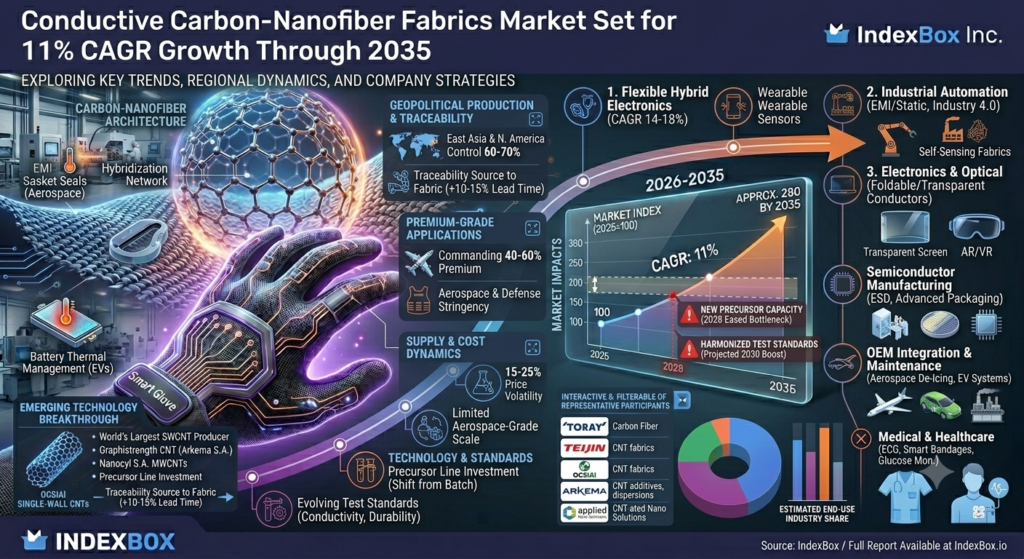
The global conductive carbon-nanofiber fabrics market is entering a period of strong expansion, driven by rising demand for flexible hybrid electronics, electromagnetic interference (EMI) shielding, smart textiles, automotive sensors and advanced industrial applications. According to the latest IndexBox report, the market is projected to grow at a CAGR of around 11% between 2026 and 2035, with the market index expected to reach approximately 280 by 2035, compared with 100 in 2025.
Conductive carbon-nanofiber fabrics are increasingly being adopted where lightweight, flexible and electrically conductive materials are required. Their applications range from flexible displays and wearable electronics to industrial automation, semiconductor manufacturing, aerospace, automotive systems and medical monitoring.
Flexible Electronics Emerging as a Key Growth Engine
One of the strongest demand drivers is the rapid development of flexible hybrid electronics. Medical monitoring devices, wearable technology, smart textiles, foldable displays and AR/VR systems require materials that can maintain conductivity while remaining flexible and lightweight.
The medical and healthcare segment is emerging as a particularly high-growth application, with conductive fabrics being explored for wearable health monitors, smart bandages, ECG and EEG garments, and other fabric-based sensing systems.
Industrial automation is another major demand centre. Conductive fabrics can provide EMI shielding and static-dissipation capabilities in control systems, robotic equipment, sensors and cleanroom environments. The increasing adoption of Industry 4.0 technologies and connected manufacturing is expected to further strengthen demand.
Semiconductor and Automotive Applications Expand
The expansion of semiconductor manufacturing is also creating opportunities for conductive carbon-nanofiber fabrics. Their use in ESD-safe garments, equipment covers, wafer-handling systems and EMI shielding is becoming increasingly relevant as advanced chip manufacturing demands tighter control of static electricity and electromagnetic interference.
Meanwhile, the automotive sector is adopting conductive materials for sensors, heating elements, shielding applications and emerging electric-vehicle systems. Aerospace applications, including avionics protection and de-icing systems, are also supporting demand for premium-grade materials.
Asia-Pacific Leads Global Market
Asia-Pacific is estimated to account for about 45% of the market, making it the largest regional market. Strong electronics, semiconductor and automotive manufacturing bases in China, Japan and South Korea are supporting consumption, while government investments in advanced materials and nanotechnology are encouraging further development.
North America, estimated at around 25%, is benefiting from demand in defense, aerospace, healthcare and semiconductor manufacturing. Europe, representing approximately 20%, remains an important market for premium conductive fabrics, particularly in automotive and industrial automation applications.
Latin America and the Middle East & Africa currently represent smaller shares, but growing industrial automation, infrastructure development, defense requirements and advanced-materials initiatives could create new opportunities.
Supply and Standardisation Challenges Remain
Despite strong growth prospects, the industry faces several challenges. Limited production capacity for high-quality carbon nanofibers remains a major bottleneck, particularly for aerospace-grade materials. Volatility in catalyst-grade chemicals and purified carbon feedstocks can also create significant cost fluctuations.
The absence of globally harmonised standards for conductivity, durability and EMI-shielding performance is another barrier, potentially extending qualification timelines for new applications.
However, the transition from research-scale batch production toward dedicated industrial manufacturing lines is expected to improve supply consistency and reduce lead times. Increasing traceability from nanofiber production through finished fabric is also becoming an important procurement requirement for high-reliability applications.
Outlook to 2035
The market is expected to benefit from continued innovation in nanofiber deposition, conductive coatings, flexible electronics and smart-textile technologies. As production scales up and costs decline, conductive carbon-nanofiber fabrics could move beyond specialised applications into a broader range of industrial and consumer products.
With flexible electronics, semiconductor manufacturing, smart textiles, automotive systems and advanced filtration among the key areas of opportunity, conductive carbon-nanofiber fabrics are positioned to become an increasingly important material within the next generation of technical textiles and electronic systems.
Source: IndexBox market analysis.